 Coffee Gear Picks
Single Serve Grind and Brew Coffee Maker Burr vs Blade (2026)
Choose burr if you grind beans every morning and want repeatable flavor. Choose blade if you mainly want an affordable, flexible one-cup routine, with fresh beans as an occasional extra.
Burr vs blade: what changes in your cup?
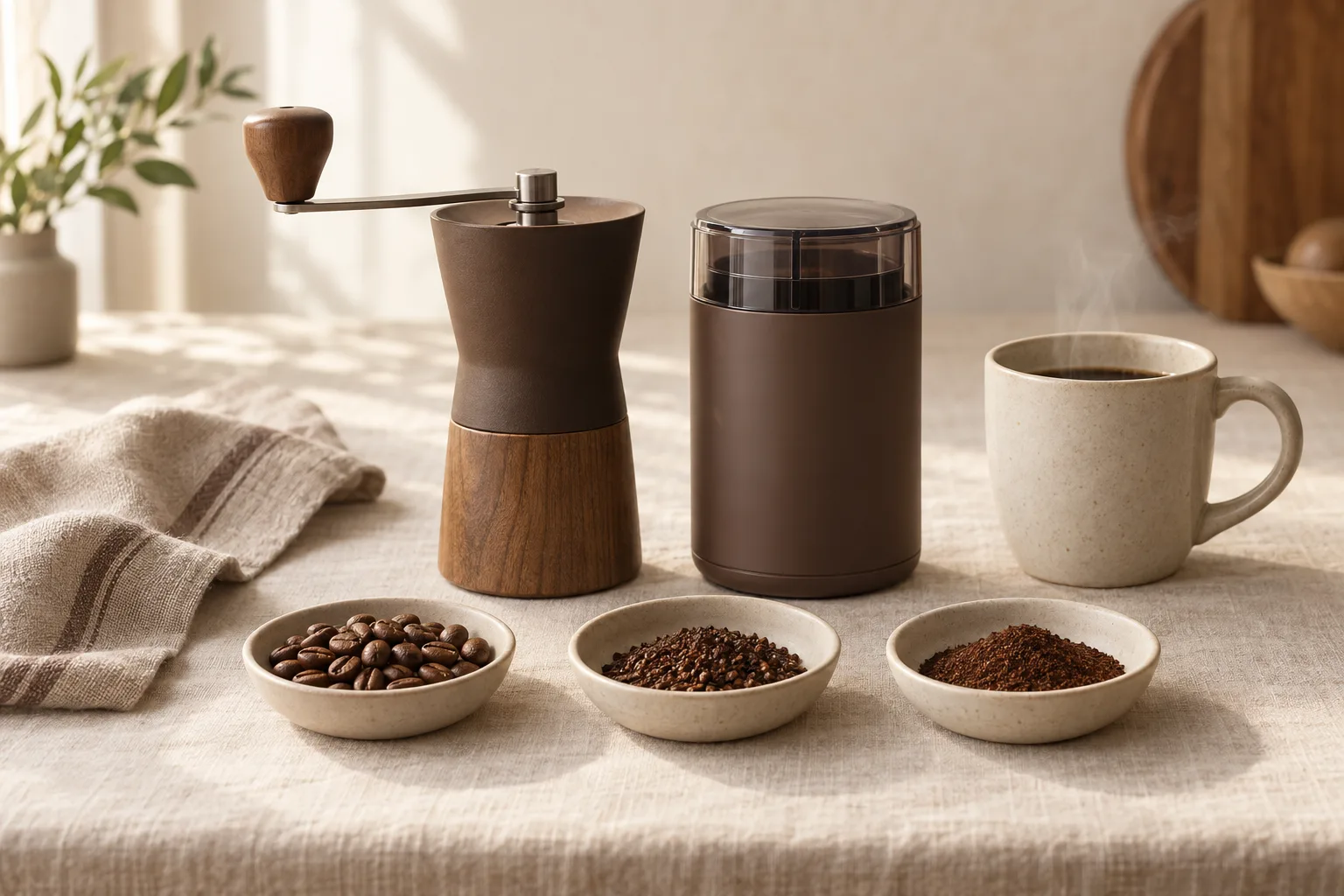
Burr grinders give you more even grounds and a clearer way to adjust grind size. Blade grinders chop beans for a set time, leaving a wider mix of sizes. Serious Eats' burr-versus-blade comparison favors burrs for consistency. For a daily whole-bean cup, that's the difference worth paying attention to.
| Grinder type | Best for | Control | Trade-off |
|---|---|---|---|
| Burr | Daily beans and repeatable cups | Adjustable spacing between burrs, when offered | Worth prioritizing only if you'll use the grinder |
| Blade | Occasional beans and value-first shopping | Grinding time, rather than a fixed burr gap | Less even grounds |
Burr: for a cup you can fine-tune
Burrs crush beans between two grinding surfaces. Think of grounds closer to one size, rather than a scoop mixing flour-like dust with chunky crumbs. As Serious Eats explains, evenness helps water pull flavor more evenly from the coffee. An adjustable burr grinder also gives you a useful next move when a cup needs work.
Blade: a compromise, not a deal-breaker
A blade whirls through the beans, so running it longer changes the overall grind without making every piece equal. I'd accept that trade-off for occasional bean use. I wouldn't pay extra for lots of grind-time buttons and mistake them for true burr adjustment.
Grinder type is only one part of the machine choice. Our Best Single Serve Coffee Maker with Grinder (2026) guide gives you current machine-by-machine picks for speed, cleanup, brew quality, and pod flexibility.
What should one-cup buyers check first?
Check the smallest supported brew, how the machine measures coffee, and whether your mug fits before counting grind settings. For one-cup shopping, I'd put those checks ahead of hopper size. A generous bean container is little comfort if your usual morning drink falls outside the brewer's supported range.
Dose control: coffee amount is not grind size
The dose is simply how much coffee goes into your cup. Look for instructions that distinguish coffee quantity from grind size and water volume. A strength button might change the dose or the brewing process; read what it actually does rather than assuming it makes the grind finer.
For a useful burr-mill example, Cuisinart's DGB-30 manufacturer page describes its single-serve feature set. Use that level of detail when comparing controls. You want to know what you can change, not just how many buttons appear in the photo.
Minimum brew size and travel-mug clearance
Compare the smallest listed drink with what you actually pour, not the reservoir's capacity. A carafe brewer with a pause feature is not automatically a direct-to-mug machine. For tall mugs, check the clearance with the drip tray in its allowed position, and measure your mug without its lid.
Pods, pre-ground coffee, and decaf
Require separate confirmation for whole beans, loose grounds, and K-Cup-style pods. These are three different jobs. A grinder-off mode may let you use pre-ground decaf, but it doesn't create a pod holder. Check whether the needed basket or adapter is included, and where it lives when not in use.
For households switching between fresh beans, grounds, and K-Cup-style pods, see Best Coffee Maker with Grinder and K-Cup Combo (2026). It narrows the search to machines chosen for that mixed routine instead of treating every built-in grinder as a pod brewer.
Cleaning access and counter space
Open the manual's cleaning section before buying. Count the parts you must remove after brewing, and check how you reach the grinder chute. Don't assume blade means easy cleanup or burr means difficult cleanup. The arrangement of the parts matters more than the label.
Measure the space with room to lift the hopper lid, refill water, and remove the basket. Also check the service instructions: if the built-in grinder stops working, can you still brew with grounds? I'd favor a clear answer over another automatic setting.
When is the burr upgrade worth your budget?
Spend more on burr grinding when fresh beans are your everyday routine and you want to adjust the result. Spend less when the grinder is a weekend extra. My advice is to pay for controls you'll use, not for a premium label on a machine that mostly brews pods.
| Price band | Shopping priority | What to verify |
|---|---|---|
| $ | Basic fresh-bean convenience | True one-cup brewing and required adapters |
| $$ | Useful everyday controls | Actual grinder type, dose choices, and removable parts |
| $$$ | Adjustable burr control and format flexibility | Whether added cup or carafe options justify the space |
These are spending priorities, not guarantees of features. If price matters more than burr refinement, use Best Grind and Brew Coffee Maker Under $200 (2026) Compared for a narrower under-$200 shortlist. Check each pick's brew format, since affordable grind-and-brew machines aren't all single-serve.
Which shopping mistakes are easiest to avoid?
Don't confuse grinding controls with brewing controls, or an interrupted carafe pour with a supported single-cup cycle. Read the exact model's instructions for each. These distinctions are more useful than a long feature list, especially when several similar-looking versions share a product name but accept different baskets or drinks.
- Buying for an occasional guest. Don't give up your daily mug fit just to gain a carafe you'll use twice a year. Rank your normal routine first.
- Ignoring how you switch beans. If one person drinks decaf, check the pre-ground route and hopper-emptying instructions before committing to a shared bean supply.
- Counting grind seconds as grind sizes. A longer blade cycle isn't the same mechanism as adjusting the gap between burrs. Read the grinder description, not just the setting count.
- Assuming integrated means maintenance-free. Grinding and brewing share one appliance, not one cleaning task. Follow the manual's separate instructions for wet brew parts and the grinder.
Where should you look for specific machine picks?
Choose your shopping route by the job the brewer must do: daily whole beans, a strict budget, or shared pod-and-bean use. The three guides linked above cover those paths. Keep your minimum drink size, mug height, and required coffee formats beside you when checking the final shortlist.
Frequently asked questions
single serve grind and brew coffee maker blade vs burr
Choose burr for daily whole-bean brewing and blade when value and occasional bean use matter more. Serious Eats favors burr grinders for more uniform grounds. That makes burr the better starting point for repeatable flavor, but it does not guarantee a better brewer overall.
Is a blade grinder good enough for one cup?
A blade grinder can be good enough if you want convenient fresh-bean coffee rather than fine flavor control. Serious Eats explains that blade grinders produce less even grounds. My buying advice: accept that compromise if you mostly use grounds or pods and grind beans only occasionally.
Do more grind-time settings mean a machine has burrs?
No, grind-time settings do not prove a machine has burrs. A blade machine can offer several run times without changing the way it chops beans. Serious Eats distinguishes blade chopping from grinding between burrs; look for an explicit burr or burr-mill description in the manufacturer specifications.
Can a burr grind-and-brew machine use K-Cup-style pods?
A burr grinder does not tell you whether a machine accepts K-Cup-style pods. Pod compatibility is a separate brewer feature. Check the exact model manual for accepted capsules, required holders, and any restrictions; a pre-ground bypass alone is not proof that pods will fit.
Is a burr grinder always quieter or easier to clean?
No, you should not assume a burr machine is quieter or easier to clean. Those are model-specific questions, not benefits guaranteed by the grinder label. For shopping, check the manual for removable parts and cleaning steps, and seek a named review comparing noise on the exact machines.
Should I choose Breville Grind Control for a tiny counter?
I would not make Breville Grind Control the default for a tiny counter. It combines adjustable grinding with cup and carafe brewing, according to Breville, but that flexibility may be unnecessary if you only want one small mug. Measure the space and lid clearance before choosing it.