 Coffee Gear Picks
Gooseneck Kettle vs Regular Kettle (2026)
You are not really choosing a spout shape. You are deciding whether a specialized kettle will make your current pour-over routine easier to repeat, or whether the kettle already on your stove is good enough. For most occasional brewers, it is good enough; frequent V60 and dripper users will notice the gooseneck’s control every morning.
Gooseneck Kettle vs Regular Kettle
One gives your pour a steady hand; the other earns its counter space all day.
Repeatable manual pour-over.
Flexible everyday hot water.
Choose a gooseneck for frequent manual pour-over; keep or buy a regular kettle when versatility matters more than controlled pouring.
Quick verdict
A gooseneck kettle is the top pick for frequent manual pour-over because its narrow spout makes a slow, deliberate pour much easier to repeat. A regular kettle wins when you make pour-over once in a while, need hot water for tea and cooking, or would rather spend the extra money on coffee and a grinder.
If your real question is whether a new brewer would change your mornings more than a kettle, choose the right pour-over brewer first. A fancier spout cannot fix a brewer you do not enjoy using.
Gooseneck vs regular kettle at a glance
| Product | Best for | Price band | Key spec | Verdict |
|---|---|---|---|---|
| Gooseneck kettle | Frequent manual pour-over | $$–$$$ | Long, narrow spout for slower flow | Best control for repeatable recipes |
| Regular kettle | Occasional pour-over and daily hot water | $–$$ | Typically a wider spout for faster pouring | Best all-purpose value |
Flow control: the gooseneck advantage is real
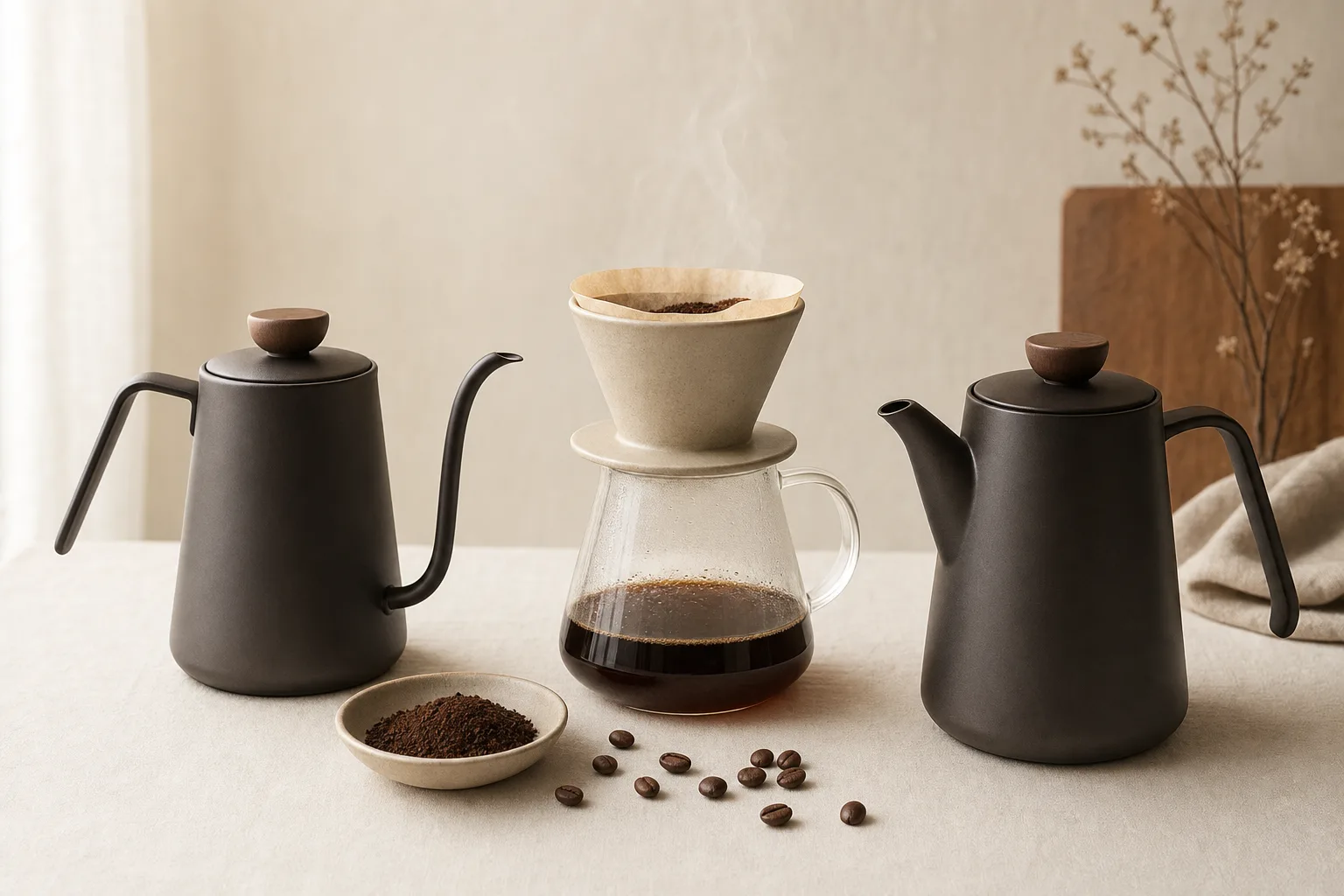
A gooseneck gives you a thinner, calmer stream, so you can add water where you want it instead of dumping a wave into the center. That matters for manual brewers with an exposed bed of grounds: you can make gentle circles, pause, and aim water across the bed without sloshing grounds up the paper filter.
Fellow’s guide to choosing a gooseneck kettle explains the basic mechanical difference well: a conventional spout releases water broadly, while the long narrow gooseneck slows and directs it. Serious Eats’ gooseneck kettle guide likewise discusses steady pouring and even saturation. Think of it like watering a seedling with a showerhead versus a small watering can.
Coffee consistency versus coffee quality
A gooseneck does not magically make coffee taste better. It improves control over one part of brewing — the pour — so a recipe you already like is easier to repeat. Extraction, meaning how much flavor the water pulls from the grounds, still goes sideways when the coffee is stale, the grind is wildly uneven, or the dose changes by a scoopful.
That is why a regular kettle is not a failure or a beginner-only tool. Coffee Analytica’s discussion of whether you need a gooseneck makes the sensible case for learning the fundamentals first. Use the same coffee amount, water amount, and rough pour pace for a few brews; then you will know whether a controlled spout is the missing piece rather than just another shiny object.
Everyday utility and temperature control
A regular kettle is often the better one-kettle household tool. It can fill a teapot, make oatmeal, or boil pasta water without feeling like you brought a fountain pen to write a grocery list. A gooseneck can do those jobs, but its slender spout pours slowly and many models are sized for one or two coffee brews.
Keep two ideas separate: spout design and heating method. Both regular and gooseneck kettles come in stovetop and electric versions. Temperature settings are a model feature, not a gooseneck feature; an electric regular kettle can hold a chosen temperature, and a stovetop gooseneck may have no temperature readout at all. Majesty Coffee’s gooseneck pros-and-cons guide also notes that a normal kettle remains usable for pour-over, just with less flow control.
Who should choose each kettle?
Choose a gooseneck kettle if...
You brew V60, Kalita Wave, Chemex, or another manual dripper most days and want the same recipe to feel less fussy. You will appreciate its slow stream if you enjoy the little pour-over ritual and want to practice a particular pour pattern. Skip it if you rarely brew this way or you hate single-purpose gear; if you are ready to shop, see our researched gooseneck kettle picks.
Choose a regular kettle if...
You make pour-over occasionally, share the kettle with tea drinkers, or simply want one useful pot instead of two. Pour with a lighter hand, keep it partly filled for better control, and accept that you may not trace perfect circles every time. Put your budget toward better beans, a burr grinder, or a scale before upgrading the spout.
What gear matters more than a gooseneck kettle?
A kettle helps you pour a recipe; it does not create the recipe. For a noticeably more repeatable cup, start with coffee you like, even grounds, and measured doses. a coffee scale for repeatable brews keeps both water and coffee doses honest, which is more useful than guessing with a mug.
- Best Pour Over Coffee Maker — find a dripper that fits the cup size and routine you actually want.
- Best Gooseneck Kettle for Pour Over — compare models once you know controlled pouring is worth it for you.
- Best Coffee Scale for Espresso and Pour Over — the simple upgrade that lets you repeat water and coffee doses.
FAQ
Do you need a gooseneck kettle for pour-over coffee?
No. A regular kettle can make good pour-over coffee, especially when you are learning your grinder, coffee dose, and recipe. A gooseneck is worth it when you want to repeat a deliberate pouring pattern more easily and you brew manual pour-over often.
Does a gooseneck kettle make pour-over coffee taste better?
Not by itself. The spout gives you more control over where and how fast water lands, which can make a recipe easier to repeat. Fresh coffee, a capable grinder, the right dose, and sensible water temperature still shape far more of what ends up in your cup.
Can I use a regular kettle for a V60?
Yes. Pour more slowly than feels natural, keep the kettle only partly full, and aim for gentle circles rather than a fast splash into the middle. It is less tidy than a gooseneck, but it is a perfectly sensible way to start with a V60.
Is an electric gooseneck kettle more accurate than a stovetop one?
Not automatically. Electric and stovetop describe how water is heated; gooseneck and regular describe the spout. A temperature-setting electric kettle can help you repeat water temperature, but its accuracy depends on that particular model, not on the shape of its spout.
What gear matters more than a gooseneck kettle for pour-over?
Start with fresh coffee, a burr grinder that can make even filter grounds, and a scale. Those three pieces make it much easier to follow the same recipe and notice whether a change actually improved the cup.