 Coffee Gear Picks
Best Coffee Scale for Espresso and Pour Over (2026)
If you have ever tried to stop an espresso shot by eyeballing the stream, you already know the ending: you stop late, your yield is off, and the cup tastes a little angry. A good coffee scale fixes that. It also makes pour over way easier to repeat, because you are not guessing your water pours like you are in a cooking show.
We compared the best coffee scale for espresso and pour over by the things you actually feel day-to-day: how fast the numbers react, how annoying the buttons are, and whether the thing even fits on a cramped espresso tray without turning into a balancing act.
6 Coffee Scales That Make Espresso and Pour Over Easier
Picked for fast readouts, sane buttons, and setups that actually fit on real counters
Overall
Best all-around workflow
- Fast feel for shot stop timing
- Compact footprint for espresso trays
- Timer workflow for pour over
- Easy to live with daily
Top Pick Timemore Basic 2.0 Coffee Scale, Black
$$
Best mixed-brew pick
Check Price on Amazon Pour over
Classic manual-brew rhythm
- Simple controls
- Comfortable pour-over timing
- Readable display
- No-frills consistency
Top Pick Hario V60 Drip Scale
$$
Pour-over-first favorite
Check Price on Amazon Budget
Best first coffee scale
- Low-cost upgrade
- Built-in timer
- Clear readout
- Great starter value
Top Pick Greater Goods Coffee Scale
$
Budget pick that works
Check Price on Amazon Premium
If you love dialing in recipes
- Brew Assist ratio guidance
- Readings settle in under a second
- OLED display + metal dial
- Made for nerdy routines
Top Pick Fellow Tally Pro
$$$
Best premium smart scale
Check Price on AmazonQuick answer: If you want one scale that works for both espresso and pour over without drama, get the Timemore Basic 2.0 Coffee Scale, Black. If you are pour-over-first, the Hario V60 Drip Scale keeps life simple. If you are on a tight budget, Greater Goods is the easiest upgrade. If you genuinely love dialing in ratios and repeating recipes, the Fellow Tally Pro is the premium pick that makes sense.
If you are still guessing doses and pours, this one tool will make your coffee taste more consistent faster than almost anything else.
Quick picks
Our Top Picks


Comparison table
| Scale | Best For | Price band | |
|---|---|---|---|
| Timemore Basic 2.0 Coffee Scale, Black | Espresso and pour over in one compact footprint | $ | Check Price |
| Hario V60 Drip Scale | Classic manual brew workflow with simple timing | $ | Check Price |
| Greater Goods Coffee Scale | First dedicated coffee scale on a tight budget | $ | Check Price |
| Fellow Tally Pro | Guided ratio brewing with a premium build | $$$ | Check Price |
| KitchenTour Coffee Scale | Small espresso stations with limited tray space | $ | Check Price |
| Maestri House S3 Pour Over Coffee Scale | USB-C charging with espresso and pour-over timer modes | $ | Check Price |
How we evaluate coffee scales
I am not looking for a “perfect” scale on paper. I am looking for the scale you will still be using three months from now, when you are half-awake and just want your coffee to taste good.
So we compared each pick like a real kitchen tool:
- Speed (how fast the numbers react): Espresso changes quickly at the end of a shot. Laggy readouts are how you end up overshooting your target.
- Footprint + fit: A scale can be accurate and still be useless if it does not fit on your drip tray with your favorite cup.
- Timer and buttons: Pour over should feel smooth. If you have to fight the controls, you will stop using the timer.
- Daily sanity: Is the display readable? Does it feel stable? Does it make a mess or get in your way?
If you want the “why” behind these numbers, our coffee brewing ratio guide is a great companion read. And if you are dialing espresso too, pair this with our burr grinder settings for espresso guide.
Individual reviews
1) Timemore Basic 2.0 Coffee Scale, Black — Best Overall
If you brew both espresso and pour over, this is the kind of scale that just slides into your routine. It is compact enough to play nice with espresso setups, but still feels comfortable when you are timing a bloom and watching your pour-over weight climb.
The main reason it wins is balance. Nothing about it feels wildly overkill, and nothing feels like a cheap compromise either. If you want one scale that can live on the counter full-time, this is the pick I would start with.
Pros
- ✓ Solid all-around workflow for espresso and pour over
- ✓ Compact footprint that fits more espresso trays
- ✓ Timer workflow is usable (you will actually use it)
- ✓ Good “set it and forget it” daily feel
Cons
- ✗ Costs more than basic starter scales
- ✗ Small platforms can feel tight with very large brewers or servers
- ✗ If you only brew one method, you may not need the extra polish
2) Hario V60 Drip Scale — Best for Pour Over
This is the “classic” pour-over scale for a reason. It is straightforward. The timing workflow matches how people actually brew V60: bloom, pour, watch the weight, stop when you hit your number.
For espresso, it can work, but it is not the one I would buy if espresso is your main thing. Espresso is a sprint at the finish line. Pour over is more like keeping a steady pace. This scale feels more at home in the steady-pace world.
Pros
- ✓ Simple controls that make pour over feel smooth
- ✓ Readable display for kettle-height pouring
- ✓ Good fit for classic manual-brew routines
- ✓ A safe, no-drama buy for pour-over-first brewers
Cons
- ✗ Not the best match if you are espresso-first
- ✗ Footprint can be bigger than “espresso mini” options
- ✗ Not built around app-driven logging workflows
3) Greater Goods Coffee Scale — Best Budget
If you are coming from scoops and vibes, a budget scale like this can feel like putting on glasses for the first time. Suddenly your “same recipe” is actually the same recipe.
Just be real about what you are buying: this is about better habits for cheap. It is not about flexing features. If you are espresso-obsessed and want tight stop timing, you may outgrow it. But for most people starting out, it is a great first step.
Pros
- ✓ Very affordable upgrade with real day-to-day payoff
- ✓ Built-in timer for basic pour-over recipes
- ✓ Clear readout (no squinting)
- ✓ Great for building consistency habits
Cons
- ✗ Less “snappy” feel than nicer scales
- ✗ Not the best choice if you want espresso stop timing to feel effortless
- ✗ Fewer premium convenience touches
4) Fellow Tally Pro — Best Premium Pick

This is for the person who actually enjoys the nerdy part: dialing in ratios, repeating recipes, comparing how different beans behave week to week. Its Brew Assist mode lets you set a water-to-coffee ratio once and follow the on-screen target to the last gram, and Fellow says readings settle in under a second.
If that is not you, save your money. A premium scale is only worth it when you will use the premium part. Otherwise it is like buying a race bike to ride to the mailbox.
Pros
- ✓ Brew Assist guides you to a target weight from your ratio
- ✓ Metal dial, OLED display, and a removable weigh pan
- ✓ Up to 13 hours of continuous weighing per USB-C charge
- ✓ Strong pick for high-discipline hobbyists
Cons
- ✗ Very expensive if you just need weight + timer
- ✗ The 7 x 5.9 in platform will not fit every espresso drip tray
- ✗ Overkill for casual “one cup in the morning” routines
5) KitchenTour Coffee Scale — Best Compact Pick
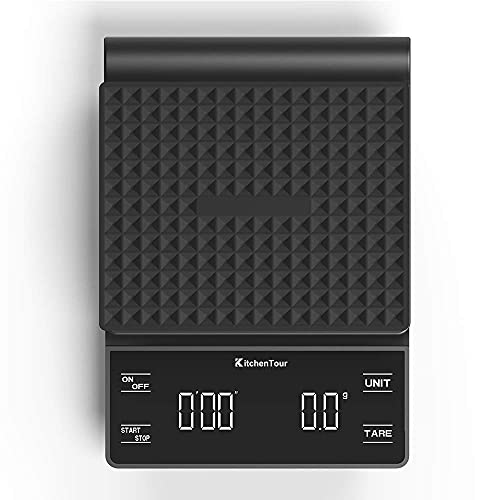
If your espresso station is tight, fit becomes everything. A scale that constantly bumps the cup, blocks the spouts, or barely balances on the tray makes you hate the whole process. This pick is about avoiding that.
It is not trying to be fancy. It is trying to fit. And honestly? That is the difference between a scale you use every day and a scale that lives in a drawer.
Pros
- ✓ Compact footprint for small espresso trays
- ✓ Simple operation that does not slow you down
- ✓ Affordable way to fix a real “fit” problem
- ✓ Good option when clearance is your biggest issue
Cons
- ✗ Less premium feel than higher-priced models
- ✗ Small platforms can feel cramped with large pour-over servers
- ✗ If you want advanced workflows, look elsewhere
6) Maestri House S3 Pour Over Coffee Scale — Best Rechargeable Pick

If you are tired of swapping batteries, a rechargeable scale is a small quality-of-life win that adds up. Maestri House rates the S3 at up to 90 days per USB-C charge. When the tool is always ready, you use it, and your coffee gets more consistent. Simple chain reaction.
It also covers both brews, with separate auto-timer modes for pour over and espresso, plus ratio presets that beep at your target water weight. A nice middle lane: modern convenience and a price that does not make you feel guilty for wanting an easier life.
Pros
- ✓ Up to 90 days per USB-C charge, per Maestri House
- ✓ Auto-timer modes for pour over and espresso
- ✓ Ratio presets with a target-weight beep and flow rate readout
- ✓ 3 kg capacity and an IPX4-rated display panel
Cons
- ✗ Multiple modes and presets take a little setup to learn
- ✗ Countertop-size body, so check your drip tray for espresso
- ✗ If you are fine with batteries, the value is less dramatic
How to use a scale for espresso (without overthinking it)
Here is the simple version: pick one recipe and make it boringly repeatable. Something like 18 g in → 36 g out. Then keep that ratio steady while you adjust grind size. That is how you learn what changes actually do.
When you pull a shot, put your cup on the scale, tare to zero, and watch the last few grams like a hawk. Espresso is polite at the start and chaotic at the end. If your scale feels a bit laggy, stop a touch early and let the flow carry you over the line.
If you want more help dialing, our best espresso machine under $200 guide and espresso grind setting guide are great next reads.
How to use a scale for pour over (the “no guesswork” version)
For pour over, a scale turns “that looked about right” into repeatable coffee. Start with a simple ratio like 1:16 (20 g coffee → 320 g water). Keep that steady for a week. Once the ratio is stable, you can actually taste what grind size and pouring style are doing.
Use the timer like a set of checkpoints. Start it on your first pour, hit your bloom weight, then hit your final weight, then notice the drawdown. When something tastes off, you have real clues instead of pure vibes.
If you want a deeper ratio walkthrough, bookmark our coffee brewing ratio guide.
Common coffee scale mistakes
Buying the biggest platform you can find. For espresso, big can be a problem. Measure your tray space first.
Ignoring button layout. If tare and timer are annoying, you will stop using them. That is not “user error.” That is bad design.
Letting steam live on the scale. Steam is basically a slow leak into electronics. Wipe it down. Keep it dry.
Changing five things at once. Keep dose and ratio steady, then change one thing. It is the fastest way to get better coffee without getting confused.
The espresso tray fit test (do this before you buy)
Here is a boring truth that saves you money: most coffee scale regrets are not about accuracy. They are about fit. A scale can be “great” and still make you miserable if it does not physically work with your machine and cup.
Before you buy, do a quick check at your espresso setup:
- Measure your drip tray space (width and depth).
- Put your most-used cup on the tray and look at what space is left.
- Think about clearance: will the scale + cup block the spouts, steam wand, or bottomless portafilter flow?
If your current setup feels cramped, lean toward compact picks like the TIMEMORE Nano or the KitchenTour style mini. If your setup is roomy, you can prioritize readability and comfort instead of playing Tetris every morning.
What “fast response” feels like in real espresso
People talk about response speed like it is a spec. To me, it is a feeling. A fast scale feels like you and the numbers are moving together. A slow scale feels like you are watching espresso through a security camera feed from five seconds ago.
If your scale is a little laggy, do not panic. Use this simple trick: pick a repeatable target (say 36 g out), then aim to stop the pump at 34–35 g and let the flow finish the last bit. After a few shots, you will learn your machine’s “coast” and your scale’s lag, and you will land on target more often.
Also: do not chase perfection if your grinder is still inconsistent. A scale makes your decisions clearer, but the grinder still decides how the shot behaves. If you are still dialing in, our best burr grinder for espresso guide can help you tighten the whole system.
A quick “choose your scale” cheat sheet
If you want the simplest decision, use this:
- You brew espresso + pour over: start with Timemore Basic 2.0 Coffee Scale, Black.
- You are pour-over-first: Hario V60 Drip Scale keeps the workflow easy.
- You want the cheapest real upgrade: Greater Goods is the budget pick.
- You love dialing in recipes: Fellow Tally Pro is the premium guided-brewing option.
- Your tray is tiny: go compact (KitchenTour style).
- You hate batteries: the Maestri House S3 is the rechargeable convenience pick.
No matter what you choose, the win is the same: you stop guessing. You brew with numbers. And your coffee gets way easier to repeat.
Frequently asked questions
Do I need a different scale for espresso and pour over?
Not usually. One good scale can cover both if it feels quick on espresso (so you can stop a shot on time) and the timer/buttons are easy for pour over. If your espresso setup is tight, footprint matters as much as accuracy.
What accuracy should a coffee scale have?
Look for 0.1 g readings for coffee use. That level of precision is the sweet spot for espresso yields and pour-over ratios without turning your counter into a science project.
Why does response speed matter for espresso?
Because the last few seconds of a shot move fast. If the display lags, you overshoot your target and your espresso can swing from sweet to bitter before you can blink.
Is a premium smart scale worth it?
Only if you will actually use the smart part. If you like brewing to a set ratio, following a target weight on screen, or repeating recipes across lots of different beans, guided brew modes can be fun and helpful. If you just want better coffee on a Tuesday morning, a simpler scale is usually the smarter buy.
How do I keep a coffee scale from dying early?
Keep it dry, wipe it after brewing (steam is sneaky), and do not store heavy stuff on top of it. Most scale problems start with moisture and abuse, not “bad accuracy.”