 Coffee Gear Picks
Grind Size for French Press: Coarse or Medium-Coarse? (2026)
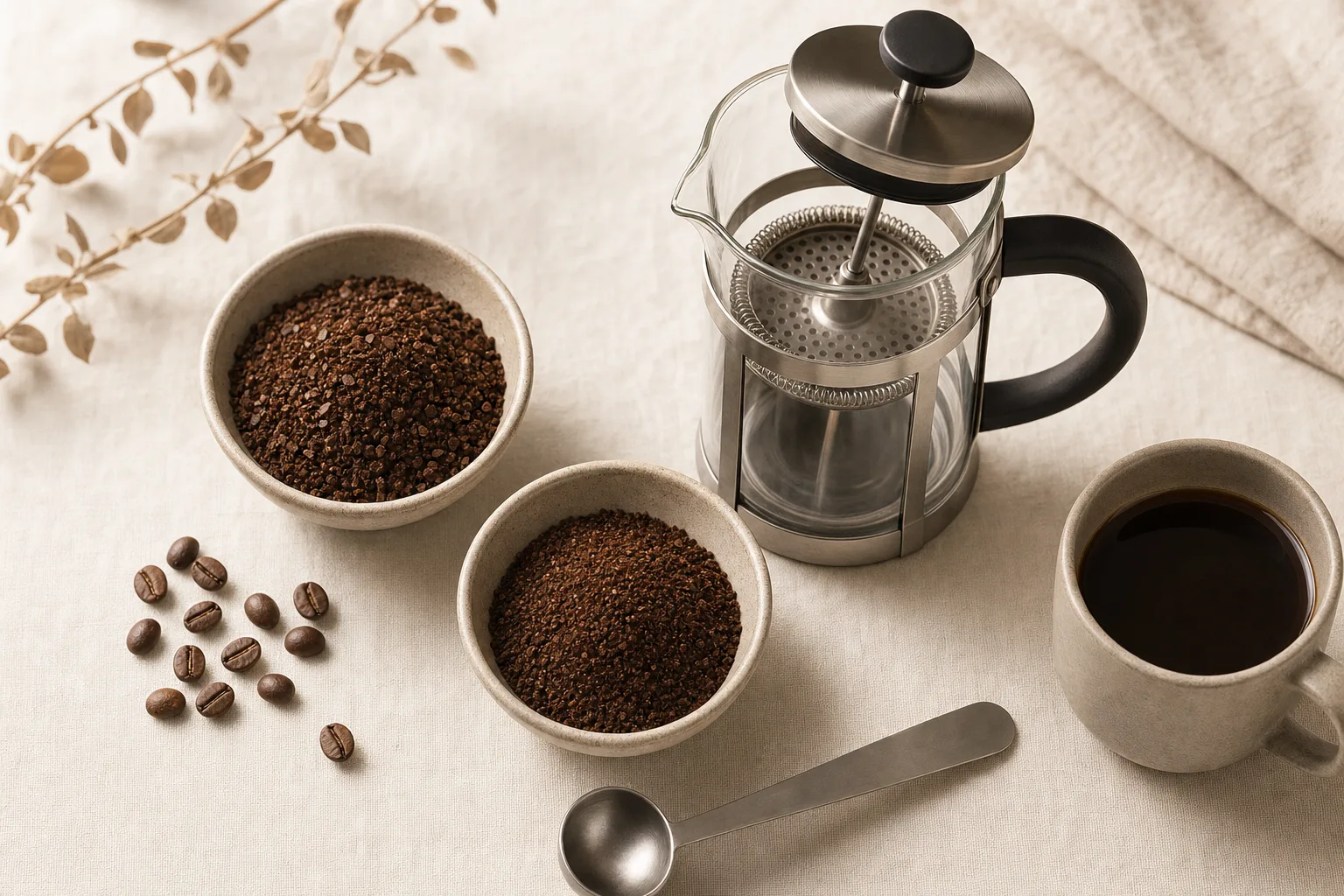
Use an even coarse grind for French press coffee, roughly the texture of coarse sea salt or rock salt. If a very coarse setting produces a thin or sour cup with an otherwise fixed recipe, move one small step finer toward medium-coarse, then taste again before changing anything else.
Find Your French Press Grind in Three Passes
Keep the recipe steady, then let the cup tell you where to move
- Weigh coffee and water
- Record current setting
- Start coarse
- Keep the recipe unchanged
- Identify the main problem
- Move one increment
A clearer, fuller French press cup without guessing at someone else’s grinder number
What is the right grind size for French press?
Coarse is the sensible starting point because a French press uses a steel mesh filter rather than paper. ESPRO’s grind guide describes coarse as the traditional choice: larger grounds are less likely to slip through the mesh and into the cup.
Think coarse sea salt, not powdery table salt. Perfect Daily Grind uses the same rock-salt comparison; it is more useful than borrowing a click number from a different grinder.
What do you need to set a French press grind?
You need a way to repeat the same brew, not a shelf full of gear. A burr grinder gives you small, repeatable setting changes; a scale and timer keep the recipe from drifting while you adjust.
- French press and whole beans — use the same coffee while you find the setting.
- Burr grinder — use its settings to make small, repeatable moves.
- Scale and timer — keep dose, water, and steep time consistent.
- Hot water — use the same water temperature for each comparison.
How do you find the right coarse setting on your grinder?
Start coarse, brew one controlled cup, and change only one small grinder increment after tasting. The number printed on a grinder is not a universal language, so your own notes beat a stranger’s “perfect” setting every time. If a blade grinder or inconsistent burr grinder makes that impossible, see our French press grinder picks.
Step 1: Set one boring, repeatable recipe
Weigh your coffee and water, choose a steep time, and write down the grinder setting. For a concrete starting recipe, Perfect Daily Grind gives 35 g coffee to 475 ml water—useful as a starting recipe, not a rule carved in stone.
Keep the dose and water amount fixed while you change grind; our coffee-to-water ratio guide can help you choose a ratio before you begin. Otherwise, you will not know whether the grind or the recipe changed the cup.
Step 2: Grind coarse and brew without fiddling
Aim for chunky, even grains like coarse sea salt. Steep, press slowly, and pour gently. The traditional coarse choice leaves fewer grounds able to slip through the filter, according to ESPRO.
Step 3: Taste first, then move one notch
If the cup feels thin or sharply sour, move one small step finer toward medium-coarse and brew the same recipe again. Fellow’s grind-size guide includes medium-coarse for French press, which makes it a fair adjustment, not proof that every press should start there.
If it is thick, gritty, or muddy, go coarser and check whether your grinder is making a cloud of fines. Those dust-like bits are the usual troublemakers in a metal-filter brew.
Step 4: Stop when the cup tastes like itself
You are looking for a cup with body but without a sandy finish, where the coffee’s sweetness is not buried under harshness. Once you get there, keep the note. New beans may need another small change, but your record gives you a real place to begin.
What else matters besides grind size for French press coffee?
Grind matters, but it cannot rescue a drifting recipe. Perfect Daily Grind notes that water, temperature, ratio, and the filter all shape the result alongside grind.
- Changing three things at once — keep water, dose, and steep time steady until the grind is close.
- Assuming coarse means weak — a thin cup may need one finer step, more coffee, or a different ratio. It is not an invitation to leap straight to a medium grind.
- Ignoring particle consistency — for a broader electric-grinder shortlist, start with reliable burr grinders under $200.
How do you fix a weak or muddy French press?
Fix the loudest problem first: go one increment finer for a thin cup, or coarser for a gritty, muddy one. Brew the identical recipe again before judging it, because changing everything at once turns a simple adjustment into a guessing game.
The coffee tastes weak or sour
Keep the ratio, water, and steep time fixed, then move one small step finer toward medium-coarse. If it still tastes watery after that, check the dose and ratio rather than pushing the grind finer and finer.
The cup is muddy or gritty
Go coarser, pour gently, and let the grounds settle briefly before decanting. Some sediment is part of French press coffee, but an uneven grind with lots of fines makes the last sip feel like wet sand.
The cup tastes bitter and rough
First look for a very fine, dusty grind or a longer steep. Move one step coarser and keep the rest steady. If bitterness remains, revisit the coffee, water, and ratio instead of blaming grind alone.
Frequently asked questions
What grind size should I use for a French press?
Start with a coarse, reasonably even grind that looks like coarse sea salt or rock salt. ESPRO calls coarse the traditional French-press choice because large grounds are less likely to slip through the steel mesh. If a controlled brew tastes thin, try one move toward medium-coarse; expect a little more sediment.
Can I use medium grind coffee in a French press?
Yes, but medium grounds extract faster and can leave more fines—tiny coffee particles—and sediment in the cup through the metal filter. Move only one step finer from coarse, keep the rest of the recipe steady, and taste before making another change. A French press will never filter as cleanly as paper.
Is coarse or medium-coarse better for French press coffee?
Coarse is the dependable place to begin. Medium-coarse is a dial-in option, not a universal upgrade: Fellow lists it as a valid French-press range, but the better choice depends on your grinder, recipe, steep time, and how much sediment you enjoy tolerating.
Why is my French press coffee muddy?
A too-fine or uneven grind creates lots of fines that can pass through the metal filter, and a forceful pour stirs them back into the cup. Go coarser or use a more even burr grind, then decant gently. Some fine sediment is normal with a French press; a gritty mouthful is not.
What grind size for French press coffee if it tastes weak?
Keep your ratio, water, and steep time fixed first, then move one small grinder increment finer toward medium-coarse. If the cup stays weak, look at your dose and ratio instead of repeatedly changing grind. Perfect Daily Grind notes that ratio and water matter alongside grind.
What French press grinder setting should I use?
Do not copy a generic click number. Begin in the coarse brewed-coffee range in your grinder’s own guide, write down the result, and move one increment at a time. If your grinder sprays out wildly mixed particles, see our French press grinder picks and reliable burr grinders under $200.