 Coffee Gear Picks
How to Set Up a Home Espresso Bar (2026)
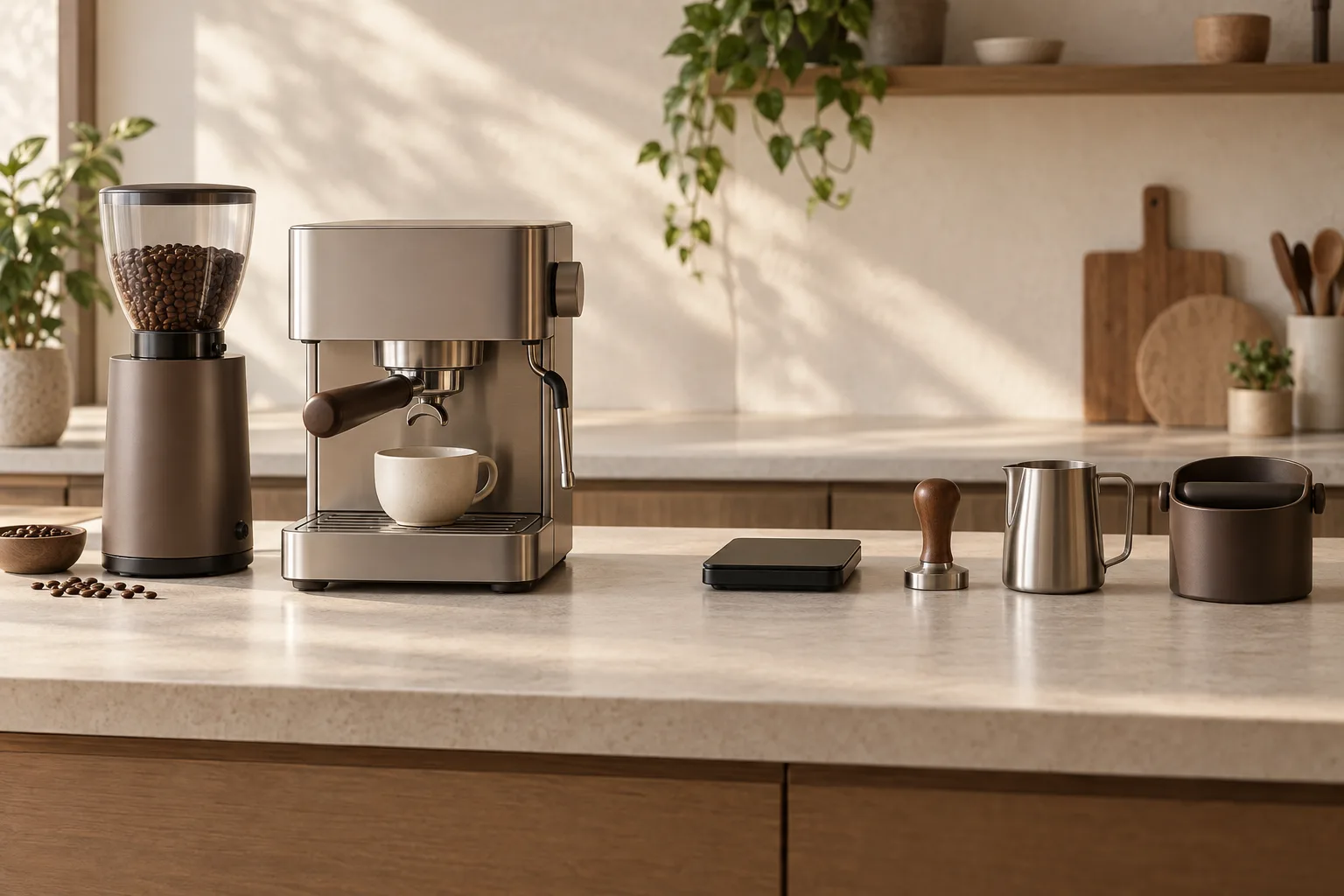
A home espresso bar needs more than a machine: it needs a grinder, scale, and clear working space. Measure first, then build a layout that lets you brew without moving half the kitchen.
Make room for better mornings
Plan the whole station, not just the machine
- Check counter and cabinets
- Find outlets and water access
- Mark equipment footprints
- Leave a clear prep area
- Walk through an empty brew
- Check tank and wand access
A tidy station you can use without shuffling appliances
How should you plan your station?
Choose a spot with a usable outlet, easy water access, and room for the entire routine. Footprint and finish matter because this machine will stay on the counter. Our Best Espresso Machine Design (2026): 7 Picks offers a visual and practical comparison of the available designs.
What should you have ready?
Gather the brewing basics before buying decorative extras. Clive Coffee's setup guide identifies the first six essentials below. Add somewhere to discard used grounds and tools for cleaning. Follow your machine's water guidance; do not assume every filter makes tap water suitable for it.
- Espresso machine
- Espresso-capable burr grinder
- Scale that reads to 0.1 g
- Tamper sized to your filter basket
- Fresh coffee beans
- Water that meets the machine manual’s guidance
- Knock box for used grounds
- Cleaning cloths, brush, and machine-approved cleaner
How do you set everything up?
Measure the space, choose your grinder arrangement, place the working tools, and rehearse before filling the machine. Use grinder-to-machine-to-prep-space-to-storage as a planning model, not a rigid rule. Mahlkönig's coffee-station guide supports zoning; mirror or bend the layout for left-handed use and awkward counters.
1. Measure the counter and cabinet clearance
Record usable width, depth, and overhead clearance. Mark equipment footprints with tape, allowing for cords, handles, tank removal, and steam-wand movement. Confirm which dimension is width in the current manual. For tight spaces, Best Espresso Machine Compact Picks (2026) gives you a focused route for limited width or depth.
2. Choose separate or integrated grinding
Choose a compact machine plus a separate grinder if you want to position each independently. The Bambino Plus fits this approach. De'Longhi La Specialista Arte Evo illustrates an integrated burr-grinder setup: fewer appliances, but one larger body to accommodate.
Our Best Coffee Grinder and Espresso Machine 2026 helps match both pieces into one coherent setup. Do not choose by the biggest pressure-bar number; it is not proof of better espresso.
3. Leave a landing zone beside the brewing head
Reserve a clear patch beside the group head, where the handled filter basket (portafilter) locks into the machine. Put your tamping mat there. Keep the grinder nearby and the knock box beyond the prep area. JavaPresse's layout guide recommends keeping frequently used tools within one-hand reach.
4. Do an empty dry run
Before filling the machine, place empty cups, portafilter, scale, grinder, tamper, knock box, and milk pitcher in brewing order. Rehearse: grind, dose or weigh, distribute the grounds evenly, tamp, lock in, extract, knock out, and wipe down. Check that the cup and scale fit together, then remove the water tank without moving anything.
5. Fill, brew, and reset
Follow the manual's first-use rinse and startup instructions. After brewing, discard the grounds, rinse the basket, and clean the wand as directed. Empty the drip tray before carrying it to the sink. Store beans cool, dry, and away from machine heat, following the National Coffee Association's storage advice.
Which setup mistakes are worth avoiding?
Do not let styling crowd out the places where you actually work. Keep decorative jars and spare mugs away from the tamping area. A station should still function when the pitcher, cups, and wet portafilter are all out at once, not only when everything has been put away.
- Buying every accessory: Leave spare tools in a drawer until you need them.
- Ignoring power instructions: Follow each appliance's manual rather than improvising with extension cords.
- Mixing cloth jobs: Keep the milk-wand cloth separate from the one sweeping up gritty grounds.
What if the station feels cramped?
Fix the movement that causes the squeeze before replacing equipment. A blocked tank, crowded tray, or awkward reach calls for a layout change, not another accessory. Run through one empty brew again and note exactly where you stop, bump something, or need to move a tool out of the way.
- You cannot refill easily: Reposition the machine within its required clearances; keep a safe tank-removal path.
- The scale crowds the cup: Check tray clearance before choosing a smaller scale or cup.
- Grounds cross the counter: Move the knock box closer, without taking over your tamping space.
Frequently asked questions
What do you need for a home espresso bar?
Start with an espresso machine, an espresso-capable burr grinder, a scale reading to 0.1 g, a fitted tamper, fresh coffee, and suitable water. Add a knock box and cleaning supplies so making coffee includes an easy cleanup, not a pile of wet tools.
How much space do you need for a home espresso bar?
Allow space for the machine and grinder plus a clear area to prepare the coffee. There is no useful universal minimum: tank removal, hopper access, steam-wand movement, and cup clearance all change the space needed. Mark the complete layout before buying.
How do you organize an espresso station?
Group equipment into grinding, brewing, preparation, and storage zones, then arrange the working tools in brewing order. Keep your tamper and knock box within easy reach. Mirror the arrangement if you are left-handed, rather than forcing a right-handed layout onto your counter.
Can an espresso machine sit under cabinets?
Yes, if the manual allows that placement and you have enough room for refilling, tank removal, and steam use. Machine height alone is not enough. Check the space needed above and beside it, and avoid directing steam toward the cabinet underside.
Where should a knock box go?
Put the knock box beside the brewing area, where you can empty the portafilter without reaching over cups or the scale. Keep it out of the tamping space. Choose a position that also lets you lift it out and empty it easily.
Do you need a grinder for a home espresso bar?
Yes, for a fresh-bean setup you need an espresso-capable grinder, either separate or built into the machine. The Bambino Plus needs a separate grinder. A built-in grinder reduces appliance count, but you still need space for weighing, tamping, and cleaning.