 Coffee Gear Picks
Compact Espresso Machine vs Built In Grinder (2026)
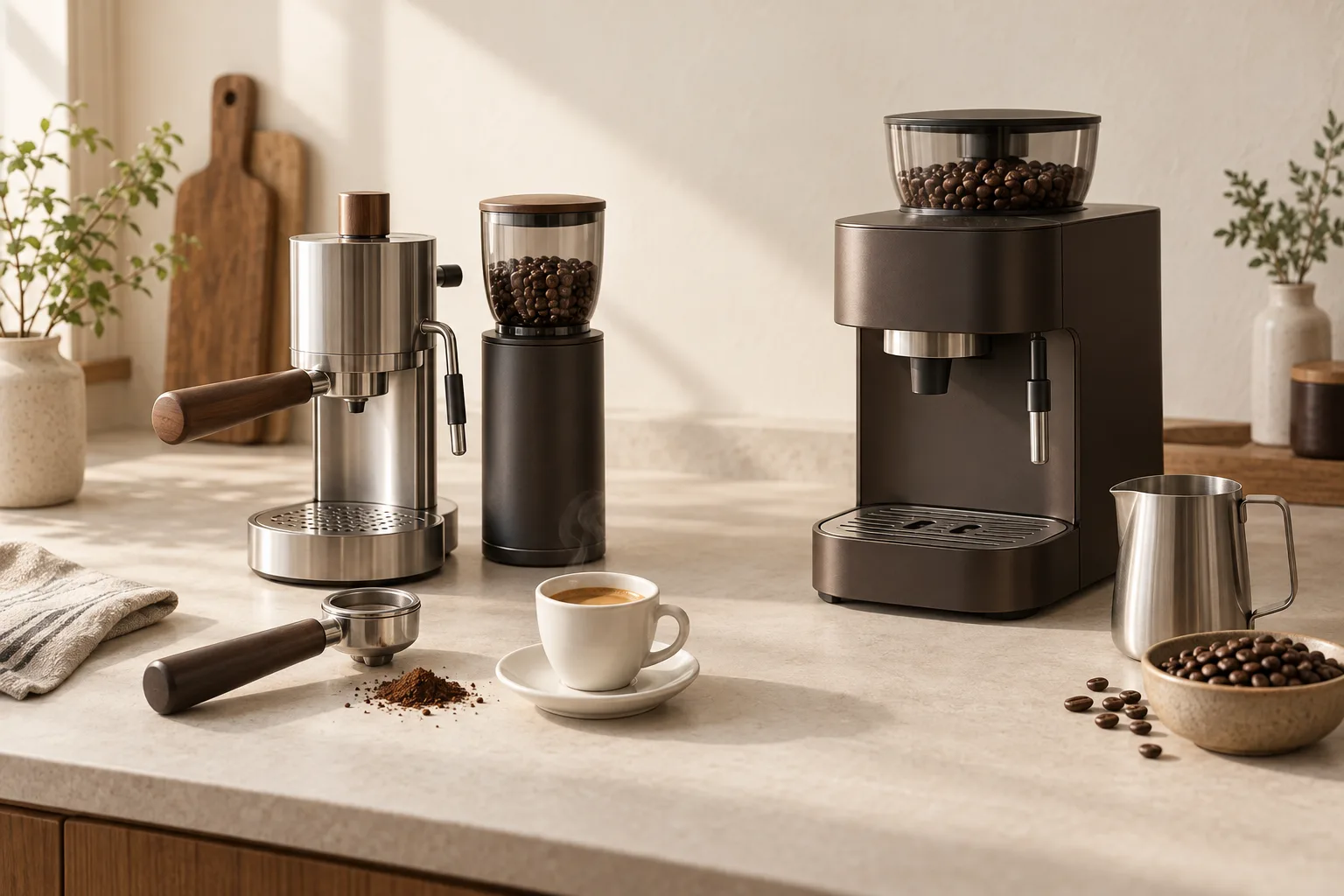
Choose a compact espresso machine plus a separate grinder for better upgrade freedom and a flexible counter layout. Choose a built-in grinder when one coordinated appliance matters more than picking each part yourself.
That heat-up claim describes the heating system, not a finished drink. Breville’s Bambino Plus page explains its heating and milk features. For a design-led look at finishes, footprint, and counter presence, see Best Espresso Machine Design (2026): 7 Picks.
Which espresso setup suits your kitchen and coffee habits?
A compact machine with an electric grinder suits buyers who want control without hand grinding. An integrated grinder suits buyers who want one fixed coffee station. A compact machine with a hand grinder is worth considering when storage matters most, but you trade motor-driven convenience for daily effort.
| Setup type | Best for | Price band | Key difference | Verdict |
|---|---|---|---|---|
| Compact machine + electric grinder | Control and future upgrades | $$–$$$ | Two independently chosen appliances | Our default route |
| Machine with integrated grinder | One coordinated station | $$–$$$ | Fixed grinder and machine layout | Convenience first |
| Compact machine + hand grinder | Stowing the grinder between drinks | $–$$ | Manual grinding, no grinder cord | Space before speed |
Separate electric grinder: choose each part
You can spend more on the grinder now and change the machine later, or do the reverse. Clive Coffee’s separate-versus-built-in guide favors this route for grind control and upgrades. The downside is straightforward: another cord, another purchase, and a layout you must organize yourself.
Integrated grinder: keep the routine together
Beans go in one appliance, and you move the portafilter, the handled basket that holds your grounds, from grinding to brewing nearby. That is appealing if you dislike scattered gear. For model-specific options that prioritize one-appliance convenience, see Best Espresso Machine Built In Grinder (2026): 6 Picks.
Separate hand grinder: store it away
A hand grinder can live in a drawer after breakfast. I would consider this for one drink at a time, not a string of weekend lattes. Check that the grinder is designed for espresso; being small enough to store does not mean it offers the fine adjustments you need.
What should you measure and check before buying?
Measure the whole working station, then check grinder adjustment, milk controls, cleaning access, and repair options. Machine width alone cannot tell you whether the setup fits. You need space to refill beans, remove the water tank, swing the steam wand, and set down a wet portafilter without crowding breakfast prep.
Footprint: measure the setup, not the box
Good Housekeeping’s integrated-grinder guide highlights counter footprint as a buying consideration. My advice is to mark the machine and grinder outlines with paper before ordering. Check depth too: a setup that fits across the counter can still push your cups uncomfortably close to the edge.
As a layout example, a machine that is 8 inches wide beside a 5-inch grinder with a 2-inch gap needs 15 inches. Those are planning numbers, not product specs. Separate pieces can also use an L-shaped corner. For apartment and narrow-counter recommendations, see Best Espresso Machine Compact Picks (2026).
Grind control: small changes matter
Clive Coffee points to grinder adjustment range and burr design, the grinding surfaces that crush beans, as important differences. Look for fine espresso adjustments, not just a large settings count. A setting that pours too fast and a neighboring setting that barely drips leave you stuck between sour and frustrating.
Do not assume every separate grinder beats every integrated one. Compare the specific grinders and their manuals. If you change beans often, check how easily you can switch settings and clear leftover grounds, rather than choosing by burr size alone.
Morning workflow: grinding is only one job
Built-in grinding does not mean push-button espresso. On a semi-automatic machine, you still load and tamp the grounds, brew, and deal with milk. Serious Eats’ espresso-machine guide considers milk steaming and ease of use alongside espresso quality. Check those controls separately.
A compact machine with automatic milk texturing can simplify lattes even without an integrated grinder. If two people share the kitchen, imagine both routines: where does the milk pitcher sit, and can someone reach the kettle while you grind? One tidy appliance can still monopolize a useful stretch of counter.
Cleaning and repair: ask what comes apart
Both routes need grinder cleaning as well as machine care. Before buying, check whether the manual explains how to reach the burrs and remove the drip tray. A matching finish is lovely, but it will not help when you cannot get a brush into the grinder chute.
Clive Coffee also raises the repair and replacement tradeoff of integration. Separate equipment lets you replace a failed grinder without replacing the brewer. That does not guarantee cheap repairs; ask about parts, warranty coverage, and whether servicing an integrated grinder requires sending away the whole machine.
How should you divide your espresso budget?
Budget for the complete station, including the grinder, rather than spending everything on the machine. The brackets below are shopping plans, not quoted product prices. At any level, keep room for a scale, basic cleaning supplies, and beans while you learn; fancy tamping accessories can wait until later.
| Total budget | Separate setup plan | Integrated setup plan |
|---|---|---|
| Under $500 | Prioritize espresso-capable grinding; consider manual grinding to protect the budget. | Compare entry options carefully; do not trade away useful grind adjustment for extra presets. |
| $500–$1,000 | Balance a compact brewer with an electric espresso grinder and basic tools. | Look for a workflow you understand, accessible cleaning, and milk controls you will use. |
| Above $1,000 | Spend on your weak spot: finer grind control, steaming, or machine features. | Pay for genuinely useful automation, not a larger screen or a longer drinks menu alone. |
To browse a shortlist with the machine and grinder considered together, see Best Espresso Machine and Grinder Combo (2026). Compare included tools before adding duplicates to your basket, especially milk pitchers and tampers.
Which buying mistakes create trouble after delivery?
The avoidable mistakes are buying incompatible accessories, confusing heat-up with drink readiness, and expecting integrated grinding to remove every manual task. Read the setup and cleaning instructions before ordering. They tell you more about your weekday routine than a photo of a spotless counter or a long list of drinks.
- Buying the wrong tamper size. Portafilter sizes differ. Check the machine’s stated size before buying a tamper, funnel, or spare basket.
- Treating fast heat-up as instant coffee. You still need to grind, prepare the basket, and warm your cup as directed. The heating-system claim is not a breakfast stopwatch.
- Assuming built-in means automatic. Check whether dosing and tamping are manual or assisted. Those details change the routine far more than sharing one outer shell.
- Choosing by pump pressure. A bigger advertised bar number is not evidence of tastier espresso. Keep your attention on usable grind adjustment and brewing controls.
Which route should you take from here?
Start with the separate route if you enjoy adjusting your coffee or expect your tastes to change. Take the integrated route if your priority is one coordinated station with fewer separate appliances. If you already own an espresso-capable grinder, keep it in the plan rather than paying for another by default.
Use the roundups linked above to narrow your choices after measuring. Before checkout, compare the manuals for your final two setups and write down the jobs each one actually handles. That is the clearest way to distinguish helpful convenience from a feature you will never use.
Frequently asked questions
Is an espresso machine with a built-in grinder smaller than a separate setup?
Not automatically. Compare the integrated machine with the combined space for a compact machine, grinder, and working area. Separate appliances can sit at an angle or on different counter sections; an integrated machine needs one continuous space plus room above its bean hopper.
Does a separate grinder make better espresso?
A separate grinder gives you more choice, not a guaranteed better cup. Clive Coffee favors dedicated grinders for adjustment and upgrade flexibility. You still need an espresso-capable model with small enough changes between settings, rather than a basic grinder meant mainly for drip coffee.
Is a built-in grinder easier for beginners?
It can make the routine easier to organize because grinding and brewing happen at one appliance. But a semi-automatic machine still asks you to adjust the grind, load the portafilter, and tamp. Check the actual controls rather than assuming built-in means fully automatic.
Can I use a separate grinder with an integrated-grinder machine?
Generally, yes, if the machine lets you load ground coffee into its removable portafilter. Check its manual first, especially for machines with automatic dosing or brewing. This can extend your options, but you will still have the unused built-in grinder taking up counter space.
Does the Bambino Plus need a grinder?
The Breville Bambino Plus has no built-in grinder. For fresh-bean espresso, pair it with an espresso-capable grinder and include that space in your measurements. Its automatic milk texturing handles one part of the routine, but it does not grind, dose, or tamp your coffee.
Which setup is better if I also make pour-over coffee?
A separate grinder is the more flexible starting point if you also make pour-over. Choose one explicitly designed for both brew styles, and check how easily you can return to your espresso setting. Some espresso-focused grinders are awkward to switch back and forth.