 Coffee Gear Picks

Moka Pot Not Working on Induction? Fix It (2026)
No heat or a “no pan” warning? Check the base material, zone size, and centering before touching your grind setting.
Find the fault before changing your brew
Start with a cool pot and the power off
Step 1 Check the base
- Read the compatibility claim
- Try a magnet underneath
Step 2 Match the zone
- Check minimum base size
- Center on a suitable zone
Step 3 Choose the fix
- Use direct induction if possible
- Check adapter permission first
Result
Separate a detection problem from a brewing problem.
Why won’t the hob heat your moka pot?
The usual culprits are a nonmagnetic aluminum bottom, a base smaller than the zone’s detection minimum, or poor centering and contact. An adapter adds another possibility: the disc heats, but the pot warms slowly. Moka-pot cup counts are small espresso-style servings, not regular mugs. GE Appliances’ induction guidance explains why magnetic cookware and a suitable fit matter.
After these checks, use Best Moka Pot for Induction (2026): 5 Smart Picks for a verified, compatibility-focused shortlist if you need a replacement.
What should you check before switching on?
Gather the exact pot specification and your cooktop manual, not just a photo of a shiny brewer. GE Appliances recommends checking magnetic suitability and cookware fit. Start with everything cool so you can inspect the bottom safely; do not touch a heating base to check whether it is working.
- A small magnet for the underside.
- A ruler for the flat base diameter, not the handle width.
- The manual’s minimum cookware size for each zone.
How do you fix it step by step?
Confirm compatibility first, then match the base to a suitable zone. Only consider an adapter after those checks. GE Appliances’ cookware guidance supports this order: a hotter setting cannot fix an unsuitable base. Once the hob recognizes the pot, move on to water, coffee, and heat control.
1. Check the cool underside with a magnet
Hold a magnet against the bottom, then confirm the maker’s induction claim. Stainless-looking sides prove nothing. An aluminum upper chamber can still work: Bialetti’s Moka Induction listing specifies a stainless boiler beneath its aluminum top.
2. Measure, center, and check contact
Compare the flat bottom with the manual’s minimum diameter, then center it on a qualifying zone. GE Appliances calls for flat cookware with full contact. Remove cool debris and check for rocking. A magnetic base that is too small can still trigger “no pan.”
3. Choose direct heating or an approved disc
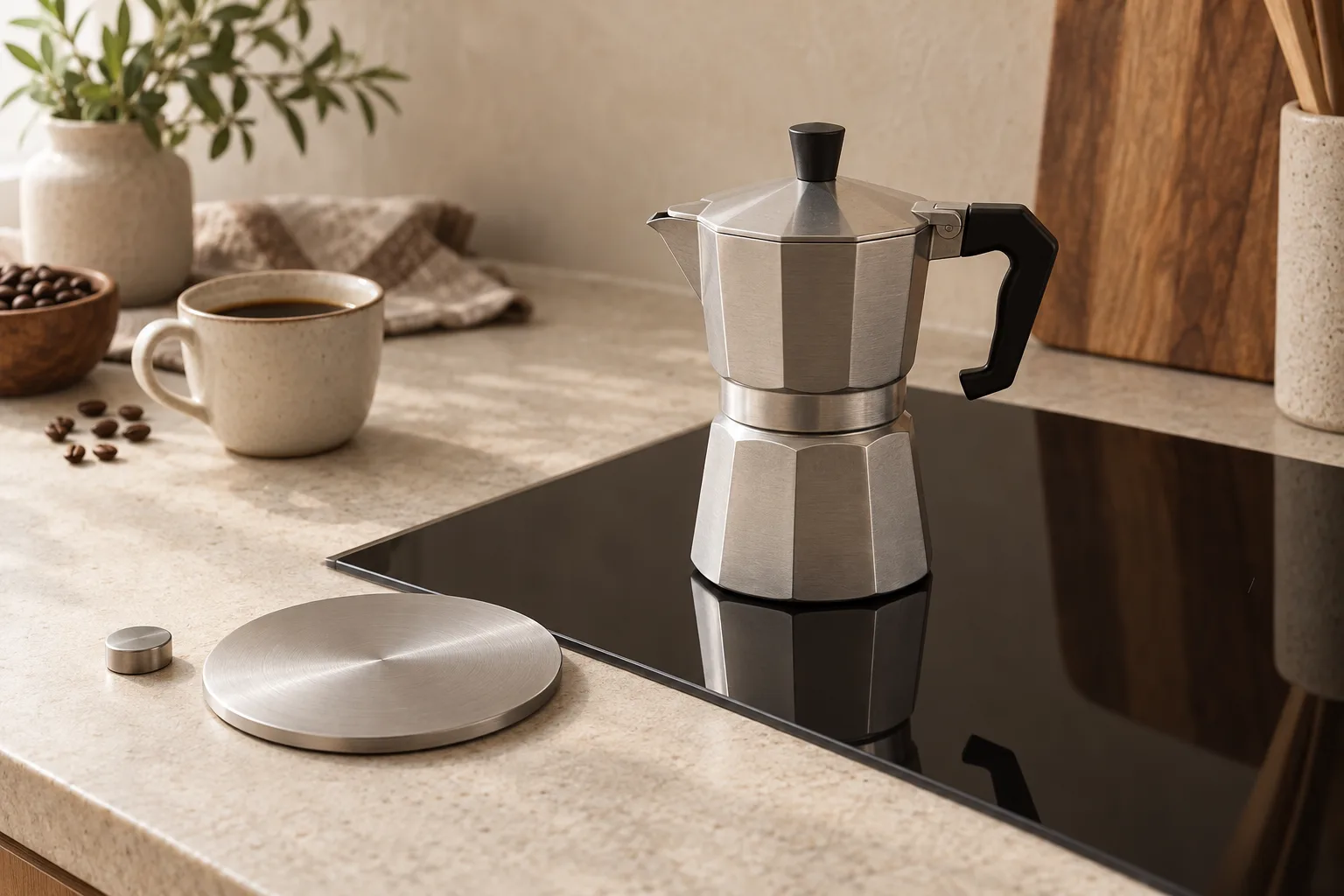
Prefer a directly compatible pot for fewer complications. To keep an aluminum pot, Honest Coffee Guide describes a magnetic adapter disc that passes heat to the brewer. Check both manuals first; if permitted, center the disc and pot, follow the disc’s heat limits, and expect slower response.
What brewing checks keep the pot safe?
Follow your brewer’s instructions for filling, assembly, and heat rather than using maximum power to force coffee through. Bialetti’s Moka Induction guidance calls for water below the safety valve, untamped grounds, and gentle heat. Keep the valve clear and never let the pot boil dry.
What if it heats but still brews badly?
A detected, heating pot needs brewing checks rather than more compatibility checks. Separate slow warming with a disc from coffee struggling through the basket. Honest Coffee Guide explains the disc’s extra heat-transfer stage; Bialetti’s operation guidance warns against tamping grounds. Change one thing at a time so the result means something.
The adapter is hot, but brewing is slow
Check pot-to-disc contact and the permitted setting. Don’t use boost to rush it. If the setup remains awkward, choose direct induction instead.
The pot heats, but coffee barely emerges
After cooling, inspect the filter and gasket. Use a consistent moka grind, finer than filter coffee but not powdery espresso grounds, and don’t tamp, as Bialetti advises. For an affordable manual setup, Best Manual Coffee Grinder Under 100 (2026): Top 7 Picks offers an under-$100 shortlist.
Also brew immersion coffee? Best Coffee Grinder for French Press (2026): 7 Top Picks covers grinder choices with a useful coarse-to-fine range. Check each model’s moka suitability rather than using your French press setting unchanged.
Frequently asked questions
Why is my moka pot not working on induction?
Check the base and zone first. A nonmagnetic aluminum base cannot heat directly, and a small magnetic base may miss pan detection. GE Appliances recommends magnetic cookware, correct sizing, and full contact. If detection works, investigate the brewing setup instead.
Can you use any moka pot on an induction stove?
No, not directly. You need a model with an induction-compatible base and a footprint your cooktop accepts. Bialetti lists the Venus 6-Cup for all hob types, including induction. A traditional aluminum pot needs an approved adapter setup or a different heat source.
How do I know if a moka pot is induction compatible?
Confirm the exact model and size in the maker’s specification, then check the base with a magnet. GE Appliances recommends this magnetic check for cookware. Measure the bottom against your zone’s minimum diameter too, because magnetic attraction alone does not guarantee detection.
Why does an induction stove say no pot?
The stove is not detecting suitable cookware. GE Appliances identifies incompatible material and undersized cookware as possible causes. Center a compatible pot on the correct zone and check full contact. If known-compatible cookware also fails, follow the cooktop manual’s fault checks.
Will a stainless-steel moka pot work on induction?
Only if its base is suitable and the hob detects it. Stainless appearance is not proof. Alessi’s 9090 listing specifically identifies a magnetic bottom, while Bialetti explicitly lists induction compatibility for the Venus 6-Cup. Check that same detail on your exact model.
Can an adapter plate be used with an aluminum moka pot?
Yes, if both the cooktop and adapter instructions permit the setup. Honest Coffee Guide describes a magnetic disc that heats first, then transfers heat to the aluminum pot. Expect slower response, and follow the maker’s limits; the disc stays hot after switching off.