 Coffee Gear Picks
Why Is a Pour Over Better? (2026)
Pour-over is better when you value a clean, expressive cup and like having a hand in how it comes together. It is not automatically better than drip coffee: a capable automatic brewer is the smarter tool for batch brewing and hassle-free consistency.
Should you choose pour-over or automatic drip for your routine?
Choose pour-over for one or two cups when you want to steer the recipe; choose automatic drip when you need coffee for a group with almost no attention. Neither method owns “better.” The winner is the one that fits your mornings often enough to use well.
Pour-over versus drip for your routine
Pick the workflow that gives you the cup you actually want to make
- Usually one or two cups
- Enjoy adjusting a recipe
- Want a clean, layered cup
- Need several cups at once
- Want a button-start morning
- Prefer low-effort repeatability
Great coffee comes from a repeatable routine, not from choosing the more photogenic method.
Pour-over puts the recipe in your hands
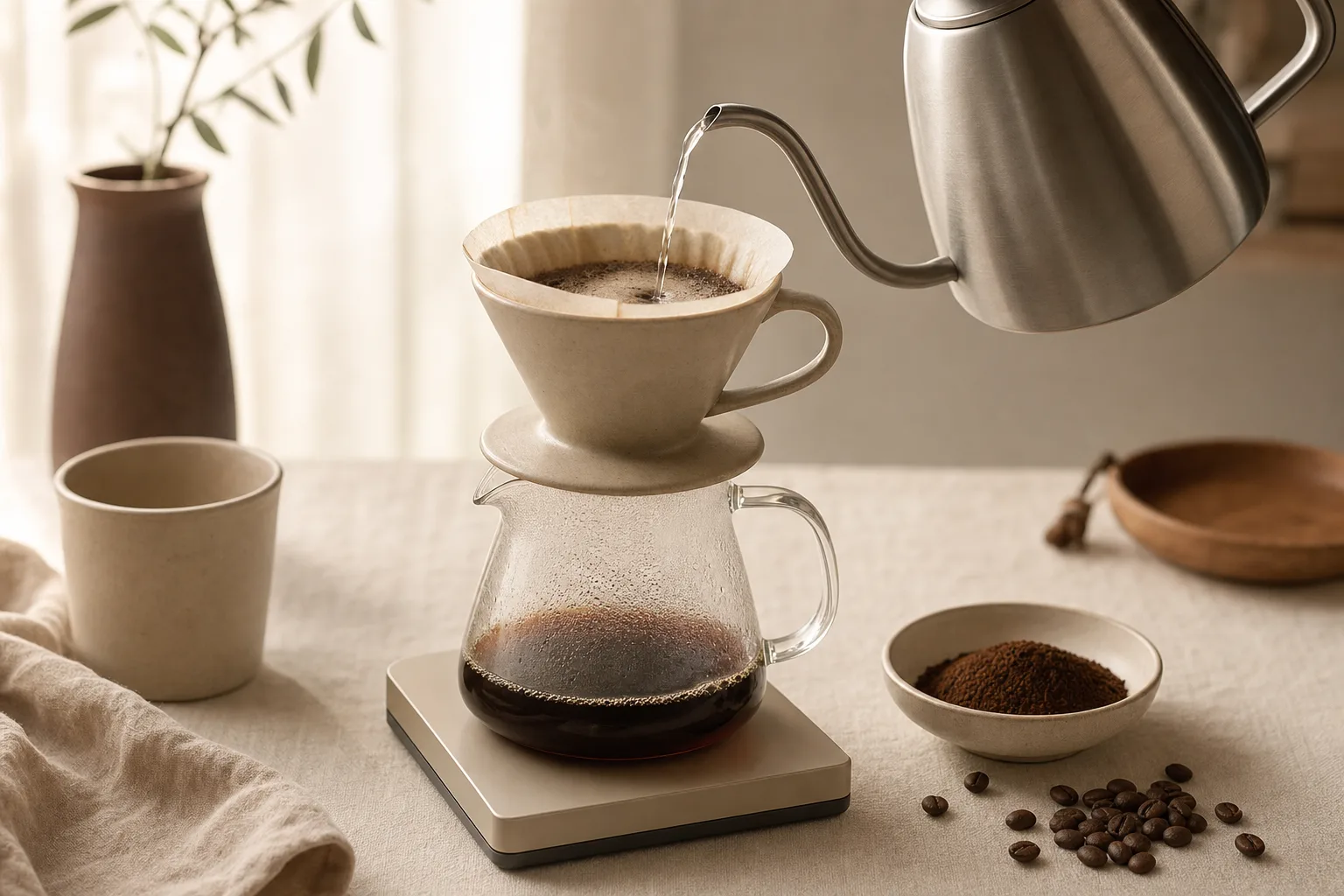
With a dripper, you decide the dose, grind, water temperature, when to pour, and how fast to pour. That sounds fussy, but it can be useful: change one thing and you can tell whether the cup became sweeter, sharper, or more drying. Blue Bottle Coffee Lab describes the bloom, timing, and individual pours as intentional parts of the manual recipe.
Automatic drip removes the daily fuss
A good drip machine heats and delivers water for you, so you can grind, press a button, and make breakfast. That is not settling. Works in Progress makes the important corrective point: well-designed automatic brewers can brew extremely well because they hold heat and repeat the same process reliably.
What does pour-over coffee genuinely improve?
Pour-over can improve clarity and make recipe changes easier to repeat because you control the water and can keep notes. It does not magically fix stale beans or a sloppy grind. Think of it as a clear window into the coffee, not a flavor-upgrade button.
Paper filters can make flavors easier to separate
Paper catches fine particles and much of the oil that would otherwise reach your mug. The result can feel lighter and cleaner than a metal-filter brew. Breville’s pour-over versus drip guide similarly frames paper-filter brewing as a route to a cleaner, more nuanced cup.
Flow control gives you a useful steering wheel
Extraction is simply how much flavor the water pulls from the grounds. A gentle, even pour can keep the coffee bed wet without blasting a channel through it; a rushed, lopsided pour may encourage uneven flow. The point is not to perform a perfect spiral. It is to make the same calm pour again tomorrow. As Works in Progress explains, percolation brewing is sensitive to grind size and agitation, including the effect of pouring speed.
A repeatable recipe makes learning faster
When you weigh coffee and water, set a timer, and use the same grinder setting, a change has a clear meaning. If the cup tastes thin and lemony, grind a little finer next time; if it tastes harsh and dry, go a little coarser. That feedback loop is the real pleasure of pour-over for coffee tinkerers.
The small batch is also the limitation
One lovely cup is easy. Four cups while packing lunches is a different story. Pour-over asks you to stay nearby for those few minutes, and pouring more water does not automatically make a bigger batch just as good. If your household drinks together, an automatic brewer is usually the kinder choice.
Which pieces of pour-over gear are worth paying for?
Spend first on consistency, not fancy finishes: a decent burr grinder, a scale, and a dripper with easy-to-find filters matter more than a designer kettle. A basic setup can make excellent coffee. Paying more should buy easier control or a smoother daily routine, not bragging rights.
A sensible pour-over setup
- Dripper and filters: choose a shape whose filters are easy to buy locally or online.
- Burr grinder: even particles make a small grind adjustment actually mean something.
- Scale: measure coffee and water instead of guessing by scoop and mug marks.
- Kettle: start with what you own, then add a gooseneck if you want more precise flow.
Start at $–$$ with the essentials
A simple plastic or ceramic dripper, paper filters, and a basic scale are enough to learn the method. Put the money you save toward fresh coffee and a grinder that produces grounds closer in size. A blade grinder chops beans into a messy mix, which makes any recipe feel like rolling dice.
Upgrade the grinder before chasing accessories
A consistent burr grinder makes grind adjustments meaningful instead of random. For readers comparing the options, see our pour-over grinder picks. The best upgrade is often the boring one: fewer powdery fines, fewer boulders, and a cup that stops swinging between sour and bitter.
Add controlled pouring when the ritual clicks
A gooseneck kettle’s narrow spout helps you place water where you want it and slow the stream down. It is helpful, not mandatory. If targeted pouring sounds appealing, browse our gooseneck kettle picks; if choosing the brewer itself is the sticking point, see our pour-over coffee maker picks for dripper shapes and filter systems.
What mistakes can spoil an otherwise good pour-over?
Most disappointing pour-overs come from changing too many things at once or treating the brew as a vague splash-and-hope routine. Keep the process simple and repeatable first. Then make one small adjustment when the cup gives you a clear reason.
- Brewing by eye — A scoop and an unmarked mug change the strength every morning. Measure both coffee and water; our coffee brewing ratio guide gives you an easy starting point.
- Ignoring the bloom — The bloom is the short first wetting that lets trapped gas escape. Give fresh grounds a brief pause after that first pour so later water can reach them more evenly.
- Pouring like you are filling a bucket — A hard stream can dig holes in the grounds and send water racing through. Pour gently enough to keep the bed evenly wet.
- Changing grind, ratio, and pouring style together — You may land on a good cup, but you will not know why. Change one lever, taste, and write down the result.
Where should you look when you are ready to build a setup?
Start with the component that will make the biggest difference to your own routine. These guides narrow the field without pretending everyone needs the same shiny setup.
- Best Coffee Grinder for Pour Over — find a grinder that makes small recipe changes easier to taste.
- Best Gooseneck Kettle for Pour Over — compare kettles for calmer, more deliberate pouring.
- Best Pour Over Coffee Maker — compare brewer shapes, filter styles, and one-cup routines.
Frequently asked questions
Why is pour-over coffee better than drip coffee?
Pour-over can be better when you want to control the recipe and chase a clean, distinct cup. You choose how quickly and where water lands. Automatic drip is often better for several cups, busy mornings, and repeatable convenience.
Does pour-over coffee taste better?
It can taste better to someone who likes clarity and notices a coffee’s fruit, floral, or cocoa notes. A paper filter often leaves less oil and sediment in the cup. But a well-made automatic brew can be excellent, and taste is personal.
Is pour-over coffee healthier than drip coffee?
Better here is mainly a flavor and workflow question, not a health claim. Both methods can use paper filters, and the coffee, filter, serving size, and what you add to the cup matter more than calling one method healthier.
Is pour-over coffee worth the effort?
It is worth it if making one or two cups feels like a pleasant part of your morning and you enjoy changing a recipe. It is not worth forcing into a rushed household routine. A good automatic brewer earns its counter space when speed matters.
What is the biggest advantage of pour-over coffee?
The biggest advantage is visible control. You can change one thing, such as grind size or pour speed, while keeping the rest of the recipe steady. That makes it easier to learn what your coffee likes and repeat a good cup.
Do I need a gooseneck kettle for pour-over coffee?
No. You can start with a regular kettle and pour slowly. A gooseneck kettle is helpful because its narrow spout makes it easier to aim water gently and avoid splashing the filter, but it is an upgrade rather than an entry ticket.