 Coffee Gear Picks
Best French Press Ratio: The Complete Coffee-to-Water Guide
The best French press ratio is 1:15: use 30 g coffee with 450 g water, grind coarse, and steep for four minutes. It is a balanced, full-bodied starting point that makes strength adjustments easy to understand.
French Press Ratio, Made Simple
A four-minute recipe that gives you a rich cup without the guesswork
Step 1 Weigh
- Add 30 g coffee
- Measure 450 g water
Step 2 Grind
- Grind coarse
- Aim for sea-salt texture
Step 3 Steep
- Pour hot water
- Wait 4 minutes
Step 4 Press
- Plunge slowly
- Pour right away
Result
A balanced, full-bodied French press that is easy to make stronger or lighter
What is the best French press ratio?
Top pick: the 1:15 coffee-to-water ratio by weight, steeped 4 minutes with a coarse grind. It lands at a balanced everyday strength and is simple to nudge stronger or lighter. Planetary Design and ESPRO both publish 1:15 as a French press starting point.
Ratio: 1:15 (coffee:water by weight) · Dose: 30 g coffee / 450 g water · Grind: coarse (sea-salt sized) · Steep: 4 minutes.
What do you need to brew by ratio?
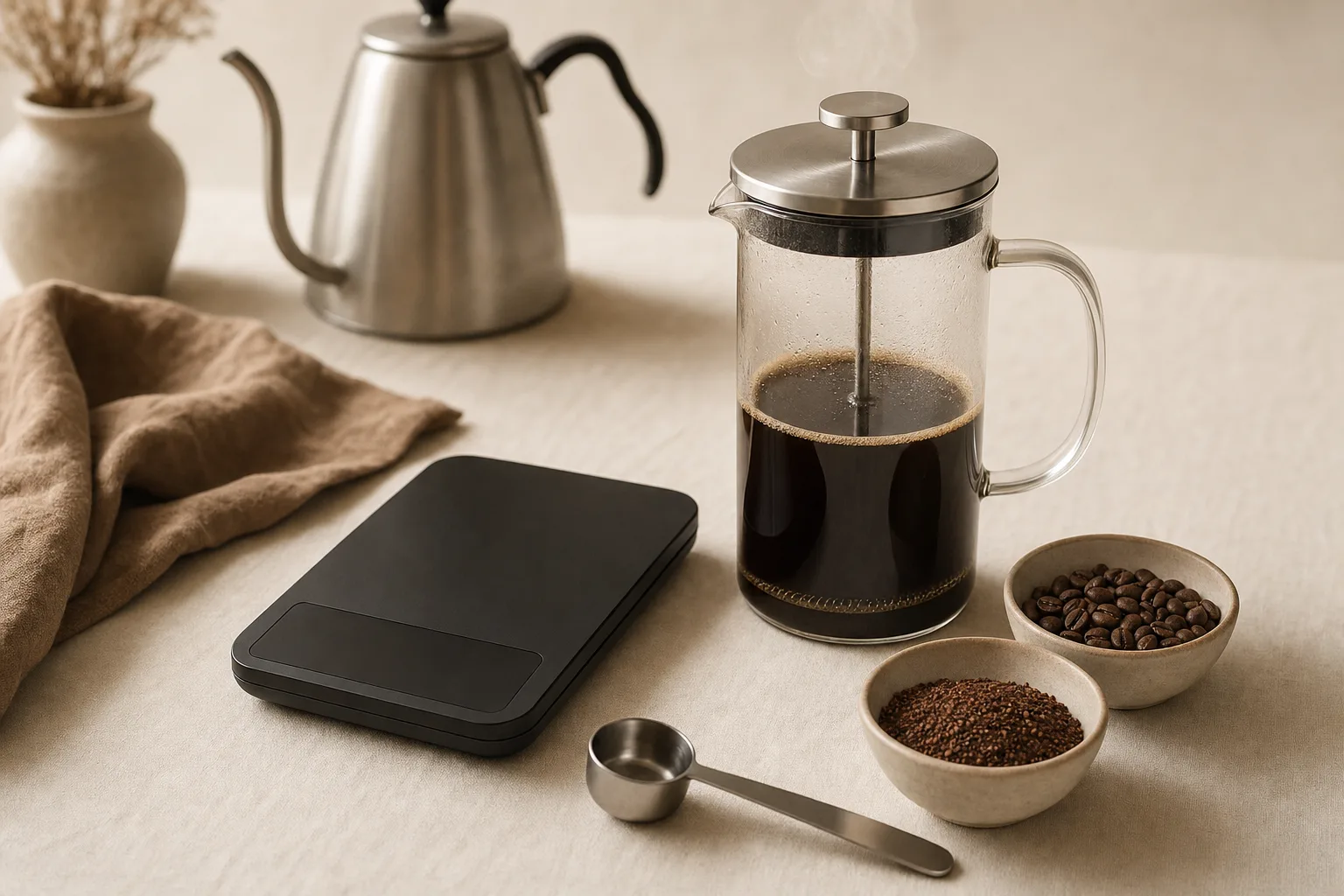
You need a scale, a coarse-capable grinder, a French press, fresh beans, and hot water. The scale is the useful starting point: it turns a vague scoop into a recipe you can repeat tomorrow.
- Scale: the TIMEMORE Black Mirror Basic 2 is the featured tool; the Greater Goods Coffee Scale with Timer is a simple alternative.
- Burr grinder: the Baratza Encore makes a dependable coarse setting.
- Brewer and kettle: a Bodum 34 oz Chambord and Cosori Gooseneck Electric Kettle fit this recipe nicely.
For scale options at different budgets, see our roundup of the best coffee scales. Check the TIMEMORE scale on Amazon
Our Top Picks


How do you make a 1:15 French press?
Measure 30 g of coffee and 450 g of water, use a coarse grind, steep for four minutes, then press slowly and pour. Keep that recipe fixed for the first cup; it lets your taste, not random changes, tell you what to adjust.
Step 1: Weigh 30 g coffee and 450 g water
Put the empty press on your scale, add 30 g of beans, then reset the scale before water goes in. The handy shortcut is water divided by 15 equals coffee grams: 600 g water needs 40 g coffee. You can use water in millilitres here too, since 450 ml of water is close to 450 g for a kitchen recipe.
Step 2: Grind coarse, like chunky sea salt
Grind just before brewing. Fine grounds can slip through the metal filter and leave a sandy, harsh finish; a coarse grind preserves French press body with less sediment. A consistent burr grinder matters more here than extra features on a press: see our best coffee grinder for French press picks and these capable burr grinders under $200.
Step 3: Pour, stir, and steep for four minutes
Pour 450 g hot water over the grounds until they are fully wet, then give them one gentle stir. Put the lid on with the plunger raised and wait four minutes. ESPRO uses a four-minute steep in its French press brew guide, making it a sensible baseline recipe to learn first.
Step 4: Press slowly and pour right away
Lower the plunger with gentle, even pressure. If it jams, do not force it: your grind is probably too fine. Pour into mugs once it is down; leaving coffee on the grounds continues extraction and can make the second cup taste woody.
How much coffee do you need for each French press size?
Use the same 1:15 ratio at every size: divide your water amount by 15 for coffee grams. A smaller press does not need a different formula, just a smaller dose.
- One large mug: 20 g coffee + 300 g water.
- Two mugs: 30 g coffee + 450 g water.
- Three to four mugs: 50 g coffee + 750 g water.
For a strong, heavy cup, move toward 1:12. For something lighter, move toward 1:17. The Handground French press ratio calculator takes the same strength-first approach: choose the taste you want, then set the dose.
Why does your French press taste weak, bitter, or gritty?
Weak coffee usually needs more coffee; bitter coffee often benefits from a coarser grind; grit points to grounds that are too fine. Make one small change, brew again, and you will quickly find your sweet spot.
Weak or watery
Increase the dose from 30 g to 32 g first. If the flavor is still thin, grind a notch finer. Dark roasts can taste stronger at the same ratio, so a lighter dose may be enough if your beans are very dark and smoky.
Bitter or dry
Grind coarser before shortening the brew. Too many tiny particles often make a cup taste rough, even when the top of the cup seems fine. If the coffee is still harsh, drop to 27–28 g at the same water amount.
Gritty at the bottom
Use a coarser grind and leave the last sip behind. French press naturally has more texture than paper-filter coffee, but it should feel plush, not like wet sand.
Frequently asked questions
What is the best French press ratio?
Start with 1 gram of coffee for every 15 grams of water: 30 g coffee and 450 g water is a practical everyday batch. It produces a balanced, full-bodied cup. Change only the coffee dose when you want more or less strength, so you can tell what made the difference.
How much coffee do I use for a 34-ounce French press?
A 34-ounce press is about 1 litre, but do not fill it to the brim. For roughly 750 g water, use 50 g coffee at 1:15. That leaves useful headroom for stirring and pressing.
Can I measure French press coffee with tablespoons?
You can in a pinch, but it is a rough shortcut because beans and grounds pack differently. A scale gives you the same starting point every morning. Planetary Design suggests roughly 2 tablespoons of coarse grounds per 6 ounces of water; use that only as a starting point and adjust by taste.
Why does my French press taste bitter?
Start by grinding coarser, like chunky sea salt, and keep the steep to four minutes. Fine particles can keep extracting after pressing and make the last sip harsh. If it is still bitter, reduce the dose a little before changing several variables at once.
What ratio should I use for French press cold brew?
For a ready-to-drink cold brew, use 1:12 to 1:15, such as 60 g coffee to 720 g cold water. Steep in the fridge for 12 to 16 hours, then press or strain. For concentrate, use more coffee and dilute the finished brew to taste.