 Coffee Gear Picks
Best Pour Over Time (2026): Practical Brew-Time Guide
For a single-cup pour over, start with a total brew time of about 2:30–3:30, aiming near 3:00. If the cup tastes sour and finishes unusually fast, grind a little finer; if it tastes bitter or drying and drains very slowly, grind a little coarser.
Single-Cup Pour Over Timing
A simple 20 g coffee / 320 g water workflow that lands near 3 minutes
- Weigh 20 g coffee
- Heat water and rinse filter
- Start with medium-fine grind
- Pour 40–60 g water
- Wet all grounds
- Wait 30–45 sec
- Pour in steady pulses
- Reach 320 g by ~1:45
- Keep the bed even
- Let the bed drain
- Aim near 3:00
- Adjust by taste next brew
A repeatable pour over that tastes balanced instead of sharp, hollow, or drying.
What is the best pour over time?
The best pour over time for one mug is usually 2:30–3:30 total, with 3:00 as a dependable starting target. Blue Bottle Coffee uses the same 2:30–3:30 window, while PT’s Coffee gives a general 2:30–3:00 range.
Use the clock as guardrails rather than a finish line. If coffee tastes sweet and clear at 2:45, keep it there. If it tastes sharply sour at 2:10 or bitter and drying at 4:15, the timing is a useful clue about what to change.
What do you need to time a pour over accurately?
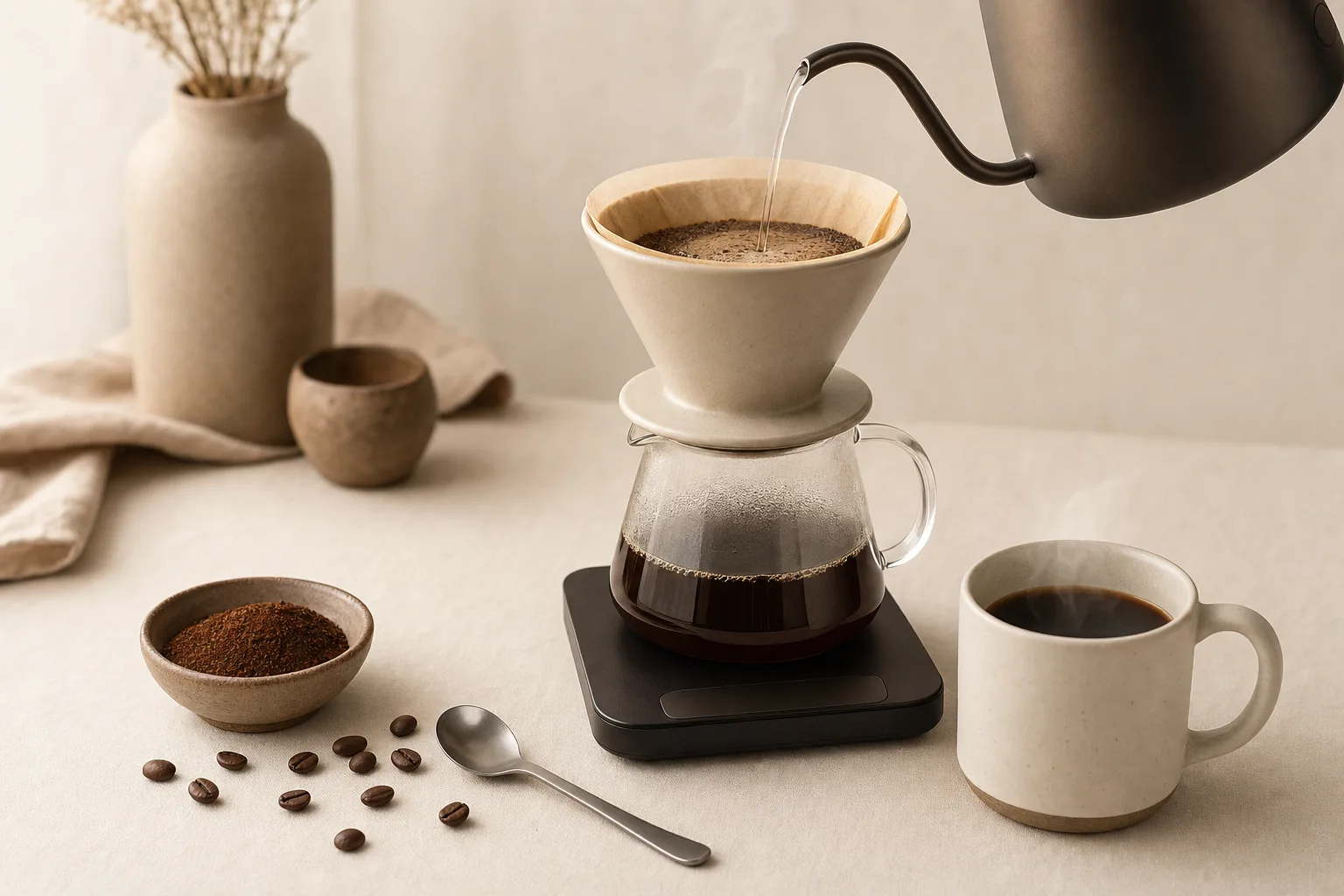
You need a scale with a timer, a burr grinder, a dripper, filters, coffee, and a steady kettle. Weighing coffee, water, and time makes adjustments repeatable instead of random; see our coffee scale picks for pour over if your current scale is difficult to read consistently.
- Coffee: 20 g, ground medium-fine as a starting point.
- Water: 320 g hot water; use a temperature suited to the coffee and your usual recipe.
- Kettle: a controllable gooseneck kettle helps you pour evenly without digging a crater in the coffee bed.
- Notes: record grind setting, total time, and taste in one short line.
How do you brew a single-cup pour over by time?
Use 20 g coffee and 320 g water, start the timer with the bloom, reach your final water weight by about 1:45, and let the bed finish draining near 3:00. The recipe is intentionally simple, so one adjustment remains easy to understand on the next brew.
Step 1: Prepare the brewer
Rinse the filter, warm the dripper, add 20 g of ground coffee, and gently level the bed. An even bed encourages even flow; a lopsided one gives water an easier path through some grounds than others.
Step 2: Bloom for 30–45 seconds
Start the timer as soon as water hits the grounds. Pour 40–60 g of water, wetting every dry patch, then wait. The bloom gives trapped gas a chance to escape and makes the later pours more even.
Step 3: Pour to 320 g by about 1:45
Pour in slow circles or gentle pulses until the scale reads 320 g. Keep the water level calm and avoid repeatedly scraping the filter wall. Aggressive pouring can stir up fine particles that slow the drawdown and muddy the cup.
Step 4: Let it draw down and taste
Stop pouring and let the coffee finish dripping. If it lands around 2:30–3:30 and tastes balanced, the recipe is working. Serious Eats treats recipes as starting points, which is the most useful approach: use taste to decide whether the next brew needs a change.
What common timing mistakes make pour over taste off?
The usual problems are chasing the timer alone, changing several variables at once, pouring too forcefully, and skipping the bloom. Each can produce a sharp, hollow, muddy, or drying cup even when the final time appears to be right.
- Only watching the clock — a three-minute brew can still taste wrong, so use time alongside flavor.
- Changing grind, dose, and water together — change one variable, then compare the result.
- Pouring too hard — a heavy stream can create channels, leaving some grounds over-extracted and others under-extracted.
- Skipping the bloom — dry pockets can lead to uneven flow and a thin cup.
How do you fix a pour over that drains too fast or too slowly?
For a fast brew, grind a little finer; for a slow brew, grind a little coarser. Make small, repeatable moves while holding the recipe steady. If your grinder makes that difficult, see our pour-over grinder recommendations for options designed for controlled adjustments.
Sour and finished under 2:30
Grind one or two small clicks finer. Water may be moving through before it extracts enough sweetness, leaving the cup sharp and thin. Keep your pour pattern and dose the same for the next attempt.
Bitter, drying, and over 3:30
Grind a little coarser. If the filter bed looks muddy and the last drops linger, fine particles may be restricting flow and pushing extraction too far. Also avoid excessive swirling or forceful pours.
Time looks right, but flavor is flat
Keep the time steady and check coffee freshness, water temperature, and ratio. A brew can reach 3:00 yet taste dull when beans are stale, the water is poorly suited to the coffee, or the recipe is too weak for your preference.
Frequently asked questions
Is 3 minutes always the best pour over time?
No. Three minutes is a useful starting point, not a fixed rule. Some coffees and brewers run well a little faster or slower. Keep the cup’s sweetness, clarity, and balance ahead of the stopwatch when you decide whether to adjust.
Should I change grind or pour speed first?
Change grind first when your pour is already steady and the brew time is clearly off. Grind finer for a fast, sour cup and coarser for a slow, bitter cup. Keep dose and water weight unchanged so you can judge the result.
Does brewer shape change pour over time?
Yes. Cone and flat-bottom drippers, filter papers, coffee-bed depth, and dose all affect drainage. That is why a range is more useful than one magic number. Start near three minutes, then use flavor to refine the recipe for your brewer.
When should I start the timer for pour over?
Start the timer when the first bloom water touches the grounds. That records the whole brew, from bloom through drawdown, on one clock. It also makes notes from one morning to the next much easier to compare.
Can old coffee make pour over drain too fast?
It can. Older coffee often blooms less and may drain faster because it releases less gas. If a quick brew also tastes flat, try a slightly finer grind, but consider whether fresher beans would address the larger problem.