 Coffee Gear Picks
Grind Size for Hario V60 (2026): Starting Settings
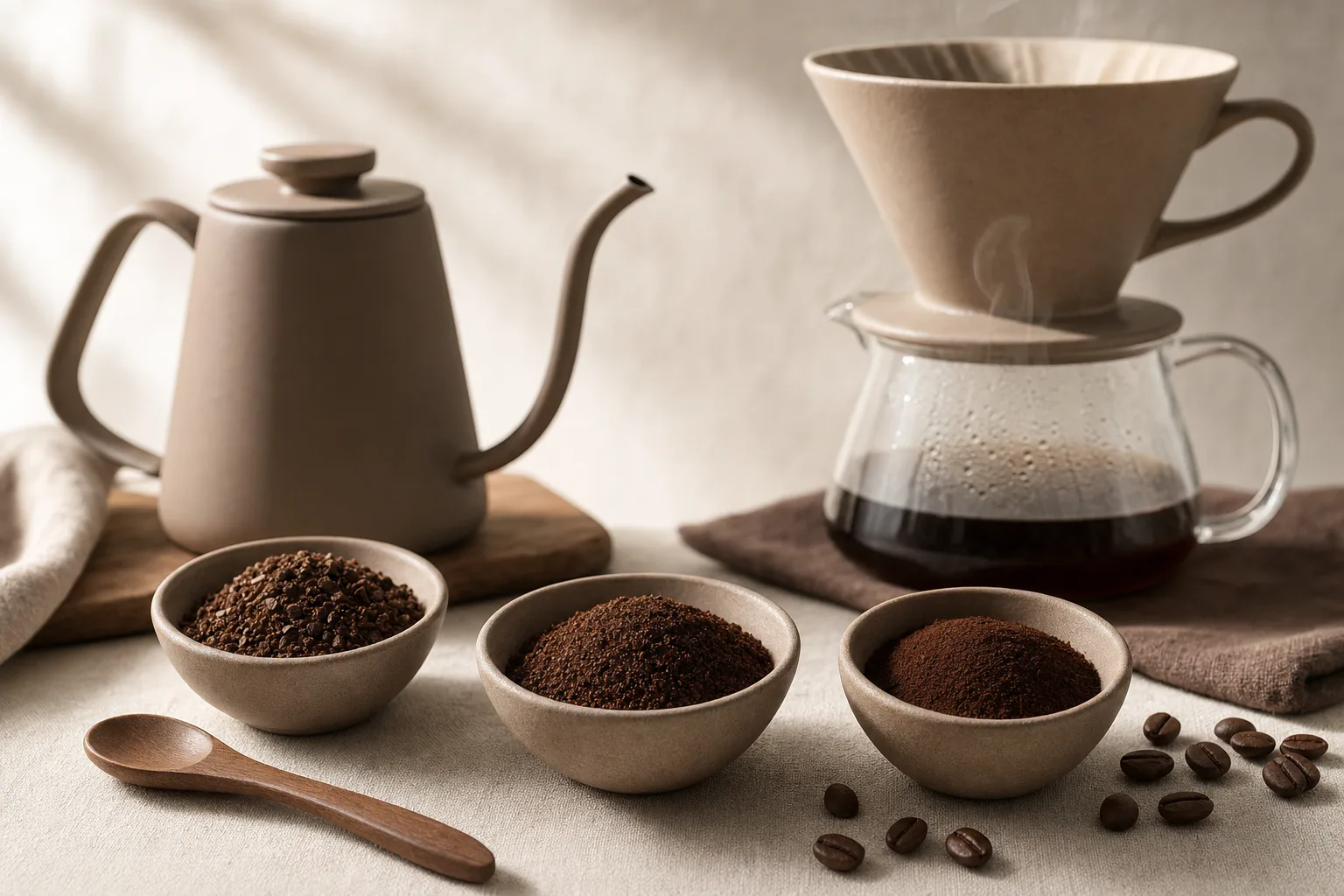
For a Hario V60, start with a medium-fine grind that looks like fine sea salt: roughly 400–700 microns. That gives water enough resistance to pull out sweetness without turning the cup harsh or muddy in the classic conical pour-over brewer.
Dial In Your Hario V60 Grind
Start in the middle, brew one cup, then make one small move at a time
Step 1 Grind
- Start medium-fine
- Aim for fine sea salt
Step 2 Brew
- Bloom 30–45 seconds
- Pour to a 1:16 ratio
Step 3 Taste
- Look for sweetness
- Note sourness or bitterness
Step 4 Adjust
- Sour: go finer
- Bitter: go coarser
Result
A sweeter, clearer V60 without chasing random grinder settings
What grind size should you use for a Hario V60?
Use a medium-fine V60 grind: fine sea salt in your fingers, not powder and not beach sand. The Honest Coffee Guide puts pour-over around 400–700 microns, while JayArr Coffee gives cone pour-over a broader 500–800 micron window.
Those numbers are a starting line, not a magic setting. Beans, filters, and pour speed all affect drawdown: the time water takes to drain through the coffee.
What do you need to dial in a V60?
You need fresh beans, a burr grinder, a V60 and filter, hot water, and a scale. A burr grinder gives you a controllable setting; a blade grinder cannot reliably reproduce one, which makes diagnosis much harder.
- Fresh coffee beans: use one coffee while you find its setting.
- Burr grinder: the five tools below cover electric and hand-grinding options.
- Gooseneck kettle: its narrow spout helps you pour slowly and steadily; see our best gooseneck kettles for pour over.
- Scale: use one to repeat your dose and water; browse our favorite pour-over coffee scales.
Our Top Picks


What V60 grind setting should you use on your grinder?
Start with the setting below, then make a small move after one complete brew. They are landmarks, not promises: the LKCS V60 recipe begins an Encore at 16. The 1Zpresso Q manual confirms its 30-click-per-rotation adjustment, while grind settings still vary with coffee and recipe.
| Grinder | Starting setting |
|---|---|
| Baratza Encore | 15–20; begin at 16 |
| TIMEMORE Chestnut C3S | 12–14 clicks from gently closed |
| 1Zpresso Q | About 45–55 clicks from closed |
| Comandante C40 | 20–24 clicks from zero |
| Hario Mini-Slim Plus | Medium-fine; adjust in small notches |
Step 1: Keep your recipe boringly consistent
Use 15 g coffee and 240 g water for a 1:16 brew ratio. Rinse the filter, bloom with about 45 g water for 30–45 seconds, then pour steadily until you reach 240 g.
A 30–45 second bloom and a 2:30–3:30 total brew are useful V60 guideposts cited by a Home-Barista discussion and Two Chimps. Keep that recipe steady so grind is the one thing you are actually changing.
Step 2: Taste before you touch the dial
Let the coffee cool for a minute, then taste it. Look for a cup that is sweet and clear, with enough body to feel rounded rather than thin or drying.
Step 3: Move finer or coarser, never both ways
If it tastes sour, sharp, or hollow and finishes quickly, grind a little finer. If it tastes bitter, dry, or heavy and drains slowly, grind a little coarser. Change only the grind on the next cup so you can tell whether the adjustment helped.
How do you avoid chasing the wrong V60 setting?
Change one thing per cup. If you alter the grind, dose, water amount, and pour speed together, you will not know which change helped.
- Going by a photo alone: sea salt is a useful picture, but taste gets the final vote.
- Making giant adjustments: move one or two Encore steps, or a couple of hand-grinder clicks, then brew again.
- Chasing time instead of flavor: use drawdown as a clue. Do not force every coffee to finish at exactly the same second.
Why does your V60 taste sour or bitter?
A sour, fast V60 usually needs a finer grind; a bitter, slow V60 usually needs a coarser one. Fix the clearest symptom first, brew the same recipe again, and resist the urge to overhaul everything at once.
Sour, thin, or lemony coffee
Grind finer and check whether the drawdown is racing past two minutes. If the brew time is already normal, first make sure your pour is steady and that you have fully saturated the grounds during the bloom; then make only a small grind adjustment.
Bitter, dry, or muddy coffee
Grind coarser, especially if the bed is still dripping well past 3:30. Do not fix it by adding more water; keep the 1:16 ratio and open the grind slightly so you can judge the result cleanly.
Can you use pre-ground coffee?
You can, but ask a roaster for medium-fine cone-filter coffee and buy only what you will use soon. It is a compromise: once it is ground, you cannot nudge the setting for your beans. For more control, see our roundup of the best grinders for pour over.
Frequently asked questions
What grind size should I use for a Hario V60?
Use a medium-fine grind that looks and feels like fine sea salt, roughly 400–700 microns. It should be noticeably finer than French press coffee but nowhere near powdery espresso. Start there, then change one small click at a time based on how the cup tastes.
What Baratza Encore setting works for V60?
Start around 15–20 on a Baratza Encore; 16 is a common V60 recipe starting point. The numbered ring is only a guide, because calibration and beans vary. If your cup is sour and quick, move finer; if it is bitter and slow, move coarser.
How many clicks should I use on a Timemore C3S for V60?
Start around 12–14 clicks from fully closed on a Timemore C3S for a V60. Count from a gently closed burr set rather than forcing it tight, and treat the number as a neighborhood, not a finish line. If the brew runs slow and dry, open it a little; if it is sharp and fast, close it a little.
How many Comandante clicks are right for V60?
Start at 20–24 clicks from zero on a Comandante C40 for V60. That is a practical filter-brewing starting range, not a fixed recipe. Keep your dose and pouring routine steady before deciding whether to move a click finer or coarser.
How long should a V60 brew take?
For a single-cup V60, aim for about 2:30–3:30 total brew time, including a 30–45 second bloom. Time is a useful warning light, not a scorecard: a tasty cup that finishes a little outside that range beats a bitter cup brewed to an exact timer.
Can I use pre-ground coffee in a V60?
Yes, but ask for medium-fine coffee ground for cone pour over and buy a small amount at a time. Pre-ground coffee loses aroma quickly, and you cannot correct the grind once water hits it. Fresh grinding gives you much more control over sourness and bitterness.