 Coffee Gear Picks
How to Grind Coffee for Pour Over (2026)
Start with a medium-fine grind for pour over, then adjust in tiny steps: go finer when the brew runs fast and tastes sour, or coarser when it runs slow and tastes bitter.
Top pick: a burr grinder with repeatable settings, because it lets you make the small, controlled adjustments pour over requires.
Dial In Your Pour-Over Grind
Start medium-fine, then let the cup and the brew flow tell you where to move next
- Weigh your coffee dose
- Use the same recipe
- Choose medium-fine
- Ignore universal click charts
- Grind just before brewing
- Use burrs, not blades
- Taste the cup
- Notice fast or slow flow
- Move one small step
- Repeat the same recipe
A practical starting point and a simple way to steer the next cup toward sweeter, clearer coffee
Quick answer
Begin medium-fine, grind immediately before brewing, and change only one small grinder step at a time. Move finer for a fast, sour brew; move coarser for a slow, bitter brew. Blue Bottle’s pour-over brew guide uses a medium starting point, while KitchenAid’s guide calls medium to medium-fine, roughly sand-like, not an exact measurement.
What you’ll need
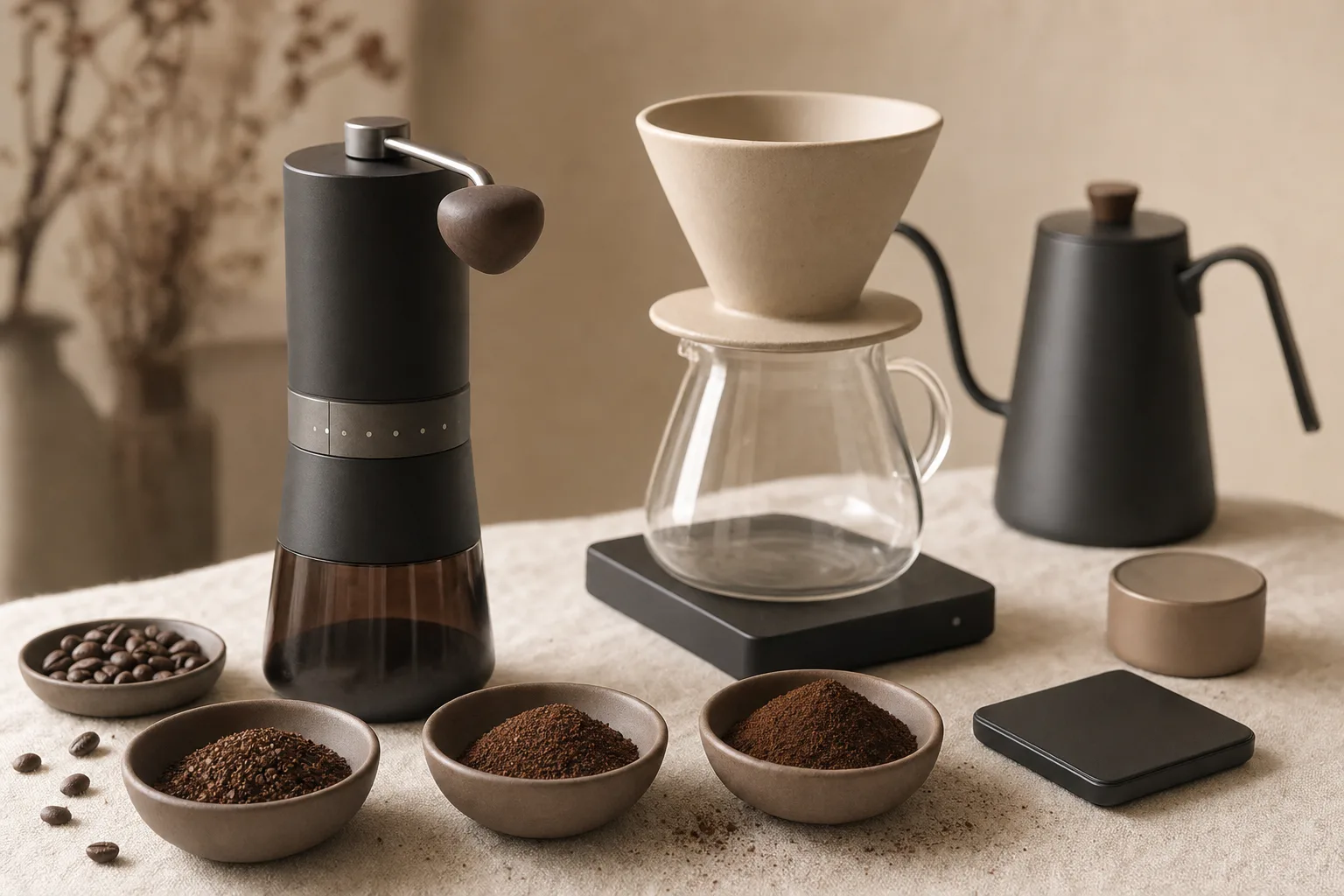
An adjustable burr grinder is the tool that makes dialing in repeatable; it produces more even grounds than a blade grinder and gives you a consistent place to make small changes. See our pour-over grinder picks if yours cannot hold a setting reliably. Counter Culture Coffee’s Guide to Pour-Over Coffee also recommends a quality burr grinder and grinding just before brewing.
- Whole beans — use the same coffee while you figure out the grind.
- Pour-over dripper and filter — rinse the filter and brew the same way each time.
- Scale and timer — these keep your recipe from drifting under your feet.
- Kettle — a steady, gentle pour makes the result easier to read.
How to grind coffee for pour over in five steps
Use a medium-fine starting point, then let taste and flow guide small changes. Grinder numbers are not portable: “20” on one model may look and brew nothing like “20” on another, so skip universal click charts.
Step 1: Measure your beans
Weigh the beans for your usual recipe before you grind. Pick one dose and water amount, then stick with them while you adjust the grinder; otherwise every cup becomes a guessing game.
Step 2: Set medium-fine as your starting point
Set the grinder around medium-fine: think between table salt and fine sand, with distinct grains rather than dusty flour. It is a useful first guess, not a finish line. Lighter coffees, different filters, and different drippers can all want a different spot.
Step 3: Grind immediately before brewing
Grind the dose, then get the grounds into the dripper without letting them sit around. Counter Culture Coffee recommends fresh grinding because coffee loses its fragrant, lively character after it is ground.
Step 4: Brew and notice what happened
Brew your normal recipe and pay attention to two things: the taste and whether water seems to race through or linger stubbornly on top. Extraction—how much flavor water pulls from the grounds—only matters here because it gives you a practical next move.
Step 5: Change one small grinder step
Keep the dose, water, filter, and pouring routine the same; use a coffee scale for repeatable pour-over recipes so you are not changing the recipe by accident. For a fast, sharp sour cup, go a little finer. For a slow, dry bitter cup, go a little coarser. Stumptown Coffee’s How to Perfect Your Pour Over Coffee offers the same sour/fast-to-finer and bitter/slow-to-coarser diagnostic as a starting point.
Common pour-over grinding mistakes
The biggest mistake is treating the grind dial like a recipe card. Your number is useful only because it helps you return to a good cup on your own grinder.
- Chasing somebody else’s click count — write down your own setting instead; burr size and the dial’s zero point differ by grinder.
- Changing three things at once — do not alter grind, dose, and pour speed together. You will not know what fixed the cup.
- Judging only by the grounds’ look — the sand-like cue is approximate. Taste and flow get the final vote.
- Blaming the grind for a wild pour — an aggressive stream can stir the coffee bed and slow the brew even when the grind is fine.
Troubleshoot your pour-over grind by symptom
Use the cup as your compass: fast and sour points finer; slow and bitter points coarser. Change one thing for the next brew, not halfway through the one in front of you.
The coffee is sour and water runs through fast
Move the grinder one small increment finer, then repeat the same recipe. If the flow still races, check for a channel—water finding one easy path through the bed—by making sure the grounds are level before you start pouring.
The coffee is bitter, dry, or drains slowly
Move one small increment coarser. Fines, the powdery little bits in uneven grounds, can clog a filter and stretch the brew; a burr grinder helps, but even a good grinder may need a coarser setting for some coffees.
The result changes when you use another dripper
Start over from medium-fine for the new brewer. Cone drippers, flat-bottom brewers, and larger drippers hold water differently, so do not assume a saved setting will travel. Browse our recommended pour-over coffee makers for those different shapes, and remember that a gooseneck kettle for controlled pouring can change flow rate too. A slow brew is not automatically a grind-only problem.
Frequently asked questions
What grind size is best for pour over?
Start at medium-fine: finer than typical drip coffee but nowhere near powdery espresso. That is only a starting point, because your brewer, coffee, and grinder all change where the sweet spot lands.
Should I grind coffee right before pour over?
Yes. Grind immediately before brewing when you can. Freshly ground coffee is the baseline recommended in Counter Culture Coffee’s pour-over guide, and it gives you the most consistent starting point for dialing in.
Why does my pour over taste sour?
If the brew also ran fast, sourness can indicate that the grind needs to be finer. Keep your dose and pouring routine the same, then make one small move finer for the next brew; if the flow was normal, consider other recipe variables before changing the grind again.
Why does my pour over taste bitter?
If the brew also ran slowly, bitterness or dryness can indicate that the grind needs to be coarser. Make one small move coarser, keep everything else steady, and compare the next cup.
What grinder setting should I use for pour over?
There is no universal setting number. A setting that is medium-fine on one grinder can be much coarser on another, so use the dial only as a repeatable reference for your own grinder.
Can I use a blade grinder for pour over?
You can, but it makes dialing in harder because it creates a mixed bag of powder and bigger chunks. An adjustable burr grinder gives you more even grounds and a repeatable place to make small changes.