 Coffee Gear Picks
Best Coffee Grinder Type: A 2026 Guide
The best coffee grinder type depends on how you brew, how much counter space you have, and how much fuss you can tolerate before caffeine.
What is the best coffee grinder type for most people?
An electric conical-burr grinder is the best coffee grinder type for most home brewers. It is a useful middle ground between daily convenience, repeatable settings, capacity, and price; flat-burr espresso grinders are often more specialized and costlier. For AeroPress specifically, our AeroPress grinder picks narrow it down further.
If you make drip, pour-over, AeroPress, or French press, this type gives you adjustable settings and push-button grinding without committing to an espresso-first setup. It is the sensible place to start rather than a promise that every electric conical grinder suits every brew method.
There are good exceptions. Choose a manual burr grinder when portability, quiet operation, and lower purchase cost matter more than speed. Consider an electric flat-burr grinder when espresso is the center of your routine and you are happy to pay for a more specialized workflow. Use a blade grinder only when the smallest upfront cost and tiniest footprint matter more than controlled grind size.
Serious Eats recommends burr grinders over blade grinders for easier, more consistent grinding in its burr-versus-blade guide. The useful distinction is simple: burr grinders offer an adjustment you can revisit, while blade grinding is managed by time and technique rather than a calibrated setting.
How do blade, burr, manual, and electric coffee grinders compare?
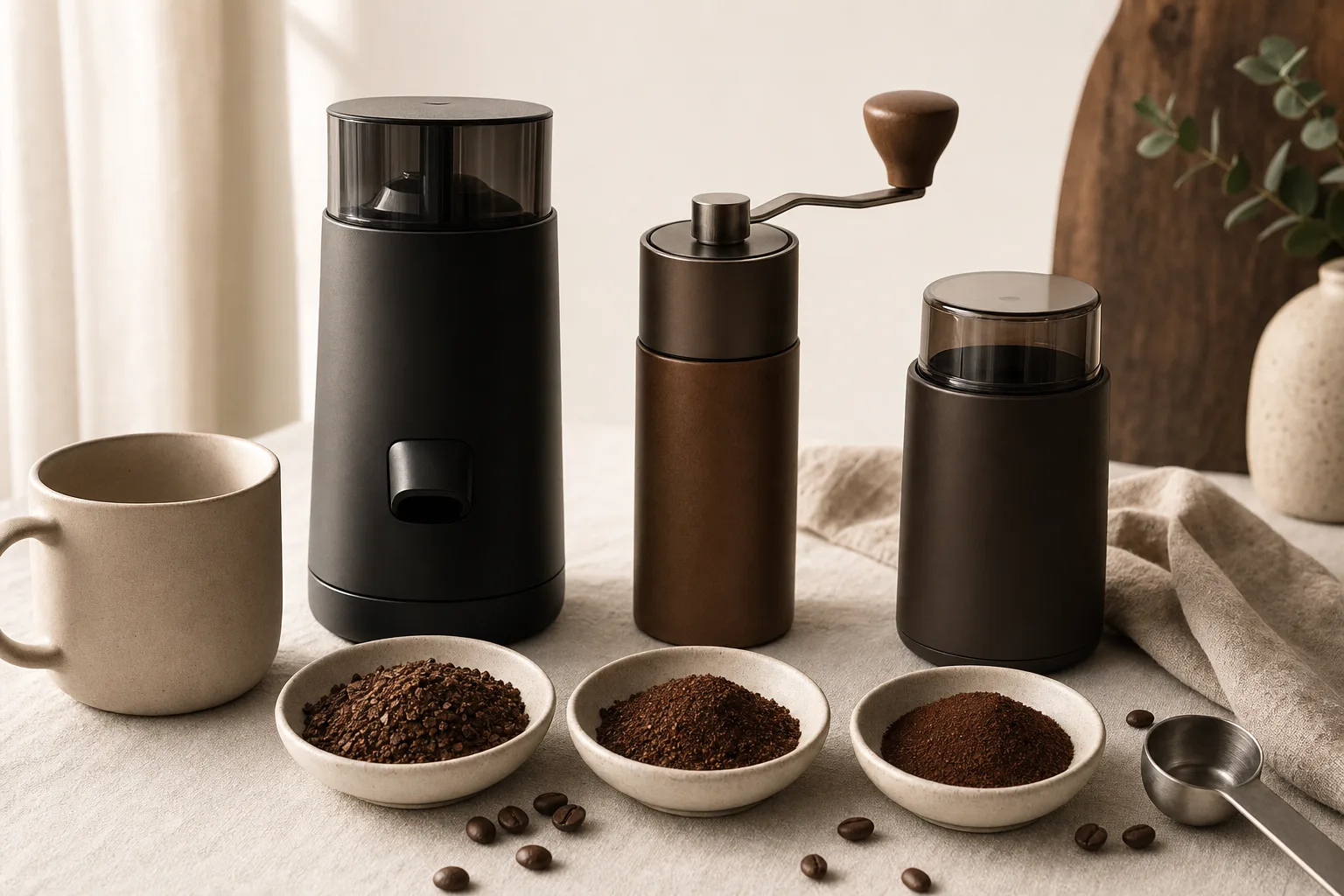
Blade grinders prioritize price and size; manual burr grinders prioritize quiet portability; electric conical-burr grinders suit the widest range of daily home use; and electric flat-burr grinders are the more specialized espresso-oriented option. Choose the workflow first, then the burr geometry and price tier.
| Grinder type | Best for | Typical price band | Key spec | Verdict |
|---|---|---|---|---|
| Blade | Occasional, lowest-cost use | $ | Chopping blade; no calibrated settings | Acceptable only when price outweighs consistency |
| Manual conical burr | Travel, quiet use, value-focused single cups | $–$$ | Hand crank; adjustable conical burrs | Strong value if slower workflow is acceptable |
| Electric conical burr | Most daily drip, pour-over, and multipurpose homes | $$ | Motorized adjustable burr set | Best all-around type |
| Electric flat burr | Espresso-focused or precision-oriented buyers | $$$ | Flat burrs; often broader or finer adjustment | Best specialized upgrade, not a universal need |
Blade grinders
A blade grinder chops coffee with a spinning blade, much like a small food processor. It can prepare grounds for brewing, but it has no true grind setting; time and shaking become the controls. That trade-off is reasonable only when cost and footprint are the priority.
Manual conical-burr grinders
A manual burr grinder is the quiet, packable choice. It suits one cup, travel, shared apartments, and shoppers who prefer to trade effort for a lower purchase cost. The compromise is straightforward: you provide the power, so larger doses take longer.
Electric conical-burr grinders
An electric conical-burr grinder is the everyday default because it combines adjustable grinding with a low-effort workflow. It is a practical upgrade path from pre-ground coffee or a blade grinder for people who brew regularly across more than one method.
Electric flat-burr grinders
An electric flat-burr grinder is usually the more specialized lane. These grinders often appeal to espresso drinkers and people who want close control over small adjustments. They can be an excellent fit, but the burr shape alone does not make them better for every kitchen or brew method.
Which burr type is better: conical or flat?
Neither conical nor flat burrs win for everyone. Conical burrs are the practical default for many buyers, while flat burrs are a more specialized option for people who value particular adjustment and workflow traits, especially around espresso.
Burr shape is only one part of grinder performance. Alignment, burr condition, adjustment design, retained grounds, and the coffee itself also matter. Treat “flat” and “conical” as a starting point for comparison, not as a verdict on a grinder’s suitability.
Mahlkönig's “Flat vs Conical Burrs” guide frames the comparison around particle distribution and workflow, including retention. Particle distribution describes the range of ground sizes; retention is coffee left inside the grinder after a dose. Those traits can matter in use, but neither makes one burr shape a universal champion.
What grinder features matter for your brew method?
Prioritize adjustment control, the grinder’s burr and adjustment design, workflow, effort, and cleaning access. Espresso calls for fine, controllable changes; filter brewing is generally more forgiving. The right choice is the one that supports the coffee you actually make each day.
Adjustment range and control
Adjustment range and control: Espresso calls for close control at the fine end because small grind changes alter how quickly water moves through a coffee bed. If your main goal is dialing in espresso, start with our burr grinder picks for espresso instead of a general-purpose filter grinder.
Drip, pour-over, AeroPress, and French press can work with a broader adjustment range, though repeatable settings still make it easier to return to a recipe. If filter coffee is your main lane, our coffee grinder picks for pour-over are a more relevant next step than an espresso-first shortlist.
Burr quality and consistency
Burr quality and consistency: Burrs are the mechanism that breaks beans into grounds, so their condition and the surrounding adjustment system matter. Do not judge a grinder by “flat” or “conical” alone: alignment, wear, and adjustment design all shape whether it is usable for your preferred brew method.
Workflow
Workflow: Hopper-fed grinders suit households that use one coffee for several days. Single-dose grinding can suit people who weigh each dose, change coffees often, or prefer not to leave beans in a hopper.
Also consider retained grounds, static, dosing, and daily cleanup. These details determine whether changing coffees is convenient and how much attention the grinder asks for between brews.
Manual versus electric effort
Manual versus electric effort: Manual grinders are quiet, portable, and often good value for one serving. Electric grinders are the simpler choice when a household makes several drinks or when speed matters. Decide how often you will grind before paying for a workflow you will not use.
Cleaning and maintenance
Cleaning and maintenance: Look for removable hoppers, accessible burrs, and a chute that can be brushed easily. Regular cleaning helps keep old grounds from accumulating; see our guide to cleaning a burr coffee grinder when it is time for a deeper clean.
How much should you spend on a coffee grinder?
Most first burr-grinder buyers should plan on $50–$150, while $150–$300 usually buys more build quality, workflow refinement, and adjustment control. Under $50 is primarily blade-grinder or basic-manual territory; $300 and above is most sensible when specialized espresso features are the goal.
| Budget | What to expect | Who it suits |
|---|---|---|
| Under $50 | Blade grinders and basic manual burr options; fewer settings and more manual effort | Infrequent brewing, travel, or strict budgets |
| $50–$150 | Better manual grinders and entry electric burr grinders; practical range for filter coffee | Most first burr-grinder buyers |
| $150–$300 | Improved build, workflow, and adjustment control; stronger multipurpose options | Daily brewers and aspiring espresso users |
| $300+ | More specialized burr sets, adjustment systems, and workflow features | Espresso-focused or enthusiast setups |
The middle ranges are the logical place to compare models once you know you want burr grinding. If you want a value-focused shortlist, compare our best burr coffee grinders under $200 rather than paying for specialized features you may not need.
What mistakes should you avoid when choosing a coffee grinder type?
Buy for the routine you have, not the one you imagine. A blade grinder will not provide espresso-style fine adjustment, a large hopper is not ideal for constant bean changes, and burr geometry cannot summarize a grinder’s whole performance.
- Buying a blade grinder while expecting espresso-level control. Blade grinders can be useful in a pinch, but they do not provide the repeatable fine adjustment that espresso recipes require.
- Assuming flat or conical burrs alone determine every result. Burr shape matters alongside alignment, adjustment design, burr condition, and maintenance. Read the whole grinder description, not just the burr label.
- Choosing a filter-focused grinder when espresso is the main drink. Check that the grinder offers sufficiently fine, controllable adjustment before treating it as an espresso option.
- Paying for a large hopper when you change coffee often. A large hopper is convenient for one everyday coffee. If you buy small bags and rotate coffees, a single-dose routine may fit better.
- Ignoring retained grounds, mess, noise, and cleaning access. These are daily-use details, not minor extras. Consider them alongside price and brew range before choosing a grinder type.
Which grinder roundup should you read next?
Use the roundup that matches the type and brew method you have chosen. This guide identifies the lane; the next page helps you compare specific models for a value budget, espresso, or filter brewing.
- our best burr coffee grinders under $200 — for readers who have decided on a burr grinder and want a value-focused shortlist.
- our burr grinder picks for espresso — for espresso drinkers who need controllable fine adjustment rather than a broad filter-coffee setup.
- our coffee grinder picks for pour-over — for filter brewers who want a filter-focused shortlist.
Frequently asked questions
What type of coffee grinder is best?
An electric conical-burr grinder is best for most home brewers because it balances repeatable grounds, fair cost, and easy morning use. Choose manual burr for travel or quiet single cups. Choose flat burr when espresso control matters enough to justify the higher price.
Is a burr grinder really better than a blade grinder?
Yes, burr grinders are the better choice when repeatability matters. Serious Eats explains that burr grinders grind coffee between burr surfaces, while blade grinders chop it. That practical difference makes burr grinders easier to use when you want to return to a familiar setting.
Is a conical or flat burr grinder better?
Neither burr shape is inherently best. Choose by brew method, adjustment needs, workflow, and budget instead of the label alone. Mahlkönig's flat-versus-conical guide frames burr geometry as one part of performance, alongside particle distribution, retention, and grinder design.
Is a manual coffee grinder worth it?
Yes, a manual grinder is worth it for single servings, quiet mornings, travel, and value. It is not the best fit if you make several mugs before work or need fast back-to-back drinks. Hand grinding takes more time and effort than pressing an electric grinder’s switch.
What type of grinder is best for espresso?
A burr grinder with a fine, controllable adjustment range is best for espresso. The type matters less than whether you can make small, repeatable grind changes. If espresso is your main drink, our burr grinder picks for espresso are the practical next comparison.