 Coffee Gear Picks
Best Burr Grinder for Espresso (2026): 7 Top Picks
The best burr grinder for espresso is the one you can dial in quickly, repeat tomorrow, and clean without hating your routine. We researched and compared seven strong options based on grind consistency, adjustment control, retention/static behavior, and daily workflow fit.
Best Burr Grinder for Espresso
7 picks compared by workflow fit — find the right grinder for how you brew
Budget
Best value for new brewers
- Stepped adjustment
- Conical burrs
- Simple workflow
- Under $200
Top Pick Baratza Encore ESP
$$
Fast value dial-in
Check Price on Amazon Precision
Fine-tune every shot
- Stepless adjustment
- 64mm flat burrs
- Low retention
- Prosumer grade
Top Pick DF64 Gen 2
$$$
Fine control for shot tuning
Check Price on Amazon Quiet
Low-noise mornings
- Noise-dampened motor
- Conical burrs
- Consistent grind
- Early-riser friendly
Top Pick Eureka Mignon Specialita
$$$
Lower-noise routines
Check Price on Amazon Manual
Portable precision
- Hand-cranked
- Travel-ready
- Zero counter noise
- Espresso-capable burrs
Top Pick 1Zpresso J-Ultra
$$
Portable precision
Check Price on AmazonQuick answer: DF64 Gen 2 is our best overall pick for most people. Baratza Encore ESP is the safest budget recommendation under $200. If you want stepless control without moving into premium pricing, Turin SK40 gives excellent value.
Quick picks
Our Top Picks


Comparison table
| Product | Best for | Burr set | Adjustment | Retention/static | Espresso level | Price band | |
|---|---|---|---|---|---|---|---|
| DF64 Gen 2 | Most home espresso users | 64 mm flat | Stepless | Low with bellows | Prosumer | $$$ | Check Price |
| Baratza Encore ESP | Best under $200 | Dual range: micro steps 1–20; macro steps 21–40 | $$ | Check Price | |||
| Turin SK40 | Stepless control on a tighter budget | $$ | Check Price | ||||
| Baratza Sette 270 | Fast adjustment changes | $$$ | Check Price | ||||
| Eureka Mignon Specialita | Low-noise mornings | Stepless grind adjustment | $$$ | Check Price | |||
| 1Zpresso J-Ultra | Manual espresso precision | 8 microns per click | $$ | Check Price |
How we evaluate
We score every grinder against five practical criteria: cup quality potential, adjustment precision, workflow speed, retention/static behavior, and maintenance burden. For espresso readers, we weight adjustment precision and repeatability more heavily because tiny setting changes can shift extraction fast. We also compare how a grinder behaves during normal weekday use, since most home users care about consistency under routine pressure.
Our process is research and comparison based. We synthesize manufacturer specifications, burr and adjustment design, and the day-to-day trade-offs of each workflow. This helps us surface where each model tends to work best: fast hopper workflows, single-dose clarity-first setups, quiet shared-home use, or manual low-retention travel setups.
Product reviews
1) DF64 Gen 2 — Best overall burr grinder for espresso
DF64 Gen 2 hits the strongest balance for most home espresso users who want clear shot improvements without stepping into ultra-premium grinder pricing. The 64 mm flat burr format gives better clarity and separation than many entry conical options, while the stepless collar makes tiny shot-time corrections easier when beans age through the week.
Workflow is still simple enough for daily use. You get a single-dose path, low retention behavior with a quick bellows finish, and predictable grind response once you mark your rough espresso zone. If your current grinder feels like guesswork between clicks, DF64 Gen 2 usually feels like a real control upgrade rather than a minor spec bump.
Pros
- ✓ Strong clarity and separation from a 64 mm flat burr setup.
- ✓ Stepless control gives fine-grain dial-in adjustments.
- ✓ Low-retention design supports repeatable single-dose routines.
Cons
- ✗ Single-dose workflow adds one extra step per shot.
- ✗ Learning curve is steeper than basic stepped grinders.
2) Baratza Encore ESP — Best burr grinder for espresso under $200
Encore ESP is the safest budget recommendation when you need true espresso range but want a machine that stays approachable. The stepped interface is easy to learn, replacement parts are widely available, and the grinder is forgiving enough for beginners pulling their first non-pressurized shots.
You trade away micro-level precision versus stepless grinders, especially with lighter beans and narrow extraction targets. But for most people building a capable home setup without overspending, Encore ESP keeps the learning curve manageable and still offers enough control to produce clean, balanced espresso once dose and prep are consistent.
Pros
- ✓ Excellent value for a real espresso-capable grinder.
- ✓ Beginner-friendly adjustment logic with clear repeatability.
- ✓ Large support ecosystem and strong long-term serviceability.
Cons
- ✗ Stepped jumps can feel coarse for very fine dial-in work.
- ✗ Static and retention are moderate in dry conditions.
3) Turin SK40 — Best stepless value pick
SK40 is the strong middle lane for buyers who want stepless espresso control without jumping to a much higher spend tier. It gives single-dose style workflow and low-retention behavior that make recipe iteration faster when you rotate beans frequently.
The fit and finish is more practical than luxurious, but the core espresso job is solid: small adjustments produce clear shot-time changes and the machine is compact enough for tight counters. If you care about precision more than premium branding, SK40 is easy to justify.
Pros
- ✓ Stepless espresso control at a mid-tier price.
- ✓ Low retention workflow for fast recipe changes.
- ✓ Compact footprint for smaller kitchens.
Cons
- ✗ Less refined materials than premium grinders.
- ✗ Noise level is average rather than quiet.
4) Baratza Sette 270 — Best fast dial-in hopper grinder
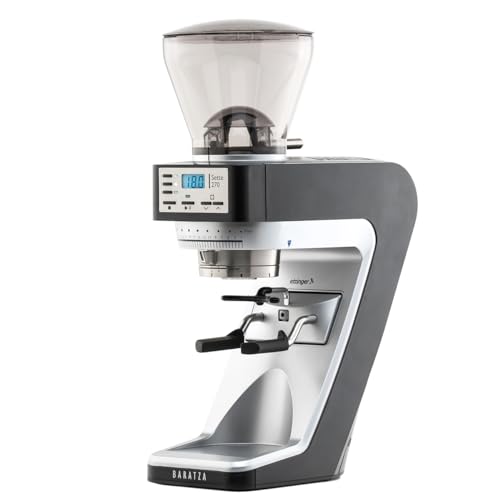
Sette 270 is still one of the fastest grinders to adjust in real home use. The macro-plus-micro system helps you move quickly from broad corrections into fine tuning, which is useful when a new bag lands far from your previous setting. For users who value speed over single-dose ritual, this remains a practical workhorse.
Pros
- ✓ Fast and intuitive macro/micro adjustment changes.
- ✓ Strong espresso-focused grind range.
- ✓ Good fit for busy morning hopper workflows.
Cons
- ✗ Louder sound profile than many newer designs.
- ✗ Not ideal for frequent bean swapping.
5) Eureka Mignon Specialita — Best quiet morning grinder

Specialita is a strong choice for people who need less noise in shared living spaces but still want credible espresso performance. It offers flat-burr flavor potential with a calmer sound profile than many comparably capable options.
Pros
- ✓ Notably quieter operation for early mornings.
- ✓ Consistent espresso potential with flat burrs.
- ✓ Good option for shared-home routines.
Cons
- ✗ Timed hopper workflow is less ideal for bean rotation.
- ✗ Retention is higher than single-dose-focused designs.
6) 1Zpresso J-Ultra — Best manual grinder for espresso precision

J-Ultra is the manual pick for buyers who want high precision without electric grinder noise. You get very low retention, highly repeatable adjustment steps, and excellent travel flexibility. The tradeoff is effort: espresso-fine manual grinding is real work, especially for multiple drinks in a row.
Pros
- ✓ Very precise manual adjustment for espresso recipes.
- ✓ Near-zero retention with clean cup-to-cup repeatability.
- ✓ Portable and easy to store.
Cons
- ✗ Manual effort can be tiring at espresso fineness.
- ✗ Less practical for multi-drink households.
30-day dial-in checklist
Week 1 should focus on consistency, not constant tweaking. Choose one bean, lock a fixed dose, and keep brew ratio unchanged while you adjust grind. Make only one change per shot and log the result. This avoids the common mistake of changing grind, dose, and yield all at once, then losing cause-and-effect clarity. Most home users improve faster with smaller, documented changes than with aggressive experimentation.
Week 2 is where workflow optimization starts. If you are single-dosing, pre-weigh several portions to reduce morning friction. If you are using a hopper, purge lightly after larger grind setting moves. Keep your prep sequence identical every day: grind, distribute, tamp, brew, taste, note. You are building repeatability. A grinder that feels average on day one often feels excellent once routine becomes stable.
Week 3 is when you can start adapting to new beans. Move one click or a tiny collar adjustment at a time and observe shot time plus flavor. If extraction looks correct but taste is still flat, review freshness and water quality before blaming the grinder. Many espresso problems attributed to hardware are actually bean age or prep variance issues. Stable process reveals real grinder limits more accurately.
Week 4 is maintenance and long-term setup. Brush out fines, check your burr chamber cleanliness, and record your baseline settings for espresso and your secondary brew method. This gives you a reset point when performance drifts. By the end of 30 days, your goal is simple: fewer wasted shots, cleaner flavor, and a morning routine that feels automatic.
Frequently asked questions
Conical vs flat burr: which is better for espresso at home?
Conical burrs are generally more forgiving and body-forward, while flat burrs usually push more clarity and separation. In practice, adjustment precision and repeatable workflow matter more than burr geometry alone.
Do I need stepless adjustment for good espresso shots?
No. Stepless adjustment helps with very fine tuning, but strong stepped grinders like Encore ESP can still produce excellent shots if your puck prep and dose are consistent.
Can a budget burr grinder make non-pressurized basket espresso?
Some can. Models designed with an espresso adjustment range can do real non-pressurized shots. General-purpose grinders with wider step jumps are harder to dial in for this use.
How much does retention and static affect daily workflow?
A lot. High retention and static increase mess, force extra purge grams, and slow down back-to-back shots. Lower retention designs usually feel easier to live with every morning.
How often should I clean an espresso grinder?
Brush the chute every few days, deep-clean monthly, and recalibrate after major maintenance or burr swaps. A simple rhythm keeps flavors cleaner and shot times more stable.