 Coffee Gear Picks
Best Espresso Machine and Grinder Combo (2026)
Top pick: Breville Barista Express Impress — the best espresso machine and grinder combo for most people because it keeps the real portafilter ritual but adds assisted dosing and tamping to cut down beginner mistakes.
If you want one box on the counter, the real decision is how much control you want: semi-automatic involvement (you prep the puck and steam milk) or super-automatic convenience (push-button drinks and simpler cleanup).
Best Espresso Machine and Grinder Combo Picks
Ranked by workflow, grinder control, milk setup, cleanup, and counter space
Overall
Semi-auto espresso with fewer beginner mistakes
- Assisted tamping
- 25 grind settings
- Brushed stainless finish
- Real portafilter workflow
Top Pick Breville Barista Express Impress
$$$
Best control-to-help balance
Check Price on Amazon One-touch
Push a button and get milk drinks fast
- Fully automatic
- LatteGo milk system
- 5 coffee varieties
- Ceramic grinder
Top Pick Philips 3200 LatteGo
$$
Best for easy lattes
Check Price on Amazon Premium
Guided drinks for households with different tastes
- Touchscreen
- Auto MilQ
- Alternative milk settings
- 3-second heat-up
Top Pick Breville Barista Touch Impress
$$$
Best guided upgrade
Check Price on Amazon Compact
A narrow super-auto for tight counters
- 7.1-inch listed depth
- One-touch brew
- WiFi customization
- Built-in burr grinder
Top Pick Café Affetto Automatic Espresso Machine
$$
Best space-saver
Check Price on AmazonWhich espresso machine and grinder combo is best for most people?
The Breville Barista Express Impress is the best espresso machine and grinder combo for most people because it solves the two steps that cause the most frustration—dosing and tamping—without turning espresso into a fully automatic black box. If you want one-touch lattes, choose the Philips 3200 LatteGo; for classic value, get the Barista Express.
Quick picks
Our Top Picks


Which espresso machine and grinder combo should you buy?
Buy by workflow first, then by footprint and milk setup. Semi-automatic models (Breville/De’Longhi) reward you with more control over espresso and steaming. Super-automatics (Philips/Café) trade that control for speed, consistency, and easier daily cleanup.
| Product | Best for | Price band | Key spec | Verdict | Link |
|---|---|---|---|---|---|
| Breville Barista Express Impress | Most semi-auto buyers | $$$ | 25 grind settings + assisted tamping | Best balance of control and help | Check Price |
| Breville Barista Express | Classic value | $$ | PID + integrated conical burr grinder | Best if you want to learn manually | Check Price |
| De’Longhi La Specialista Arte Evo | Iced drinks/cold brew | $$ | 8 grind settings + cold extraction | Best De’Longhi compact option | Check Price |
| De'Longhi La Specialista Opera | Assisted tamping upgrade | $$ | 15 grind settings + smart tamping | Best feature set near midrange | Check Price |
| Philips 3200 LatteGo | One-touch milk drinks | $$ | 5 drinks + LatteGo system | Best low-effort super-auto | Check Price |
| Breville Barista Touch Impress | Premium guided drinks | $$$ | Touchscreen + Auto MilQ | Best premium guidance | Check Price |
| Café Affetto Automatic Espresso Machine | Narrow counters | $$ | One-touch brew + 5 grind levels | Best compact super-auto | Check Price |
How did we evaluate espresso machine and grinder combos?
We compared manufacturer specs, Amazon listing data, buyer-facing workflow, and credible editorial coverage. The biggest factors were grinder adjustability, dose control, milk setup, cleanup burden, footprint, and whether the machine supports gradual skill-building or is designed for pure convenience.
Grinder control matters because espresso is unforgiving: a small grind change can swing a shot from sour and fast to bitter and slow. We also leaned on category framing from Good Housekeeping and beginner setup guidance from Wirecutter.
Which espresso machine and grinder combo has the easiest semi-automatic workflow?
The Breville Barista Express Impress has the easiest semi-automatic workflow here because it adds guidance where beginners struggle (dose and tamp) while keeping the parts that teach you espresso (portafilter prep and steaming). It’s the closest thing to “learn it for real” without turning mornings into a calibration session.
In the catalog, it’s listed with 25 grind settings, intelligent dosing, assisted tamping (10kg), and a brushed stainless steel finish. The practical win is consistency: you’re less likely to under-tamp, over-tamp, or end up with a lopsided puck that channels and makes the shot taste thin.
Skip it if your goal is push-button cappuccinos with minimal decision-making. A super-automatic like the Philips 3200 LatteGo is a better match for that lifestyle.
Pros
- ✓ Assisted dosing and tamping reduce guesswork
- ✓ Still uses a real portafilter workflow
- ✓ 25 grind settings give useful dialing room
Cons
- ✗ Not a one-touch latte machine
- ✗ Costs more than the classic Barista Express
Which espresso machine and grinder combo is the best classic value?
The Breville Barista Express is the best classic value if you want to learn espresso the old-fashioned way without buying a separate grinder. You get the core semi-auto experience—dialing in, tamping, and steaming—at a lower price band than the assisted “Impress” machines.
The listing highlights an integrated precision conical burr grinder, low-pressure pre-infusion, PID digital temperature control, and a manual microfoam steam wand. It’s also listed at 13.8"D x 12.5"W x 15.9"H and 22.09 lb, so it’s worth measuring cabinet clearance and counter depth before buying.
Choose this if you like the idea of tweaking grind and dose to chase a sweeter shot. If you’d rather get to “good enough” faster with less mess, the Express Impress earns its higher price.
Pros
- ✓ Strong value for a semi-auto with grinder
- ✓ Manual steam wand gives more milk control
- ✓ Published dimensions make counter planning easier
Cons
- ✗ More learning curve than assisted models
- ✗ Manual tamping can be messy at first
Which espresso machine and grinder combo is best for cold brew and iced drinks?
The De’Longhi La Specialista Arte Evo is the best pick here for iced drinks because its listing includes Cold Extraction Technology alongside a normal semi-automatic espresso workflow. It’s a smart fit if you bounce between hot espresso and iced coffee seasonally, but still want a grinder built in.
The listing includes a built-in conical burr grinder, 8 grind settings, a 15-bar Italian pump, 3 infusion temperatures, a steam wand, and a barista kit. De’Longhi also advertises “cold brew in under 5 minutes” as a key feature—treat that as a brand claim, but it does explain why this model exists.
The trade-off is adjustability. Eight settings can feel tight once you start making smaller espresso tweaks, so the La Specialista Opera is the better De’Longhi pick if you want more grind steps and more tamping assistance.
Pros
- ✓ Cold extraction option for iced drinks
- ✓ Compact semi-auto style workflow
- ✓ Includes steam wand and barista kit
Cons
- ✗ Only 8 listed grind settings
- ✗ Less assisted than the Opera
Which espresso machine and grinder combo has the best assisted tamping upgrade?
The De’Longhi La Specialista Opera is the best assisted tamping upgrade if you like De’Longhi’s layout but want more adjustment and more guidance than the Arte Evo. It competes most directly with the Breville Impress concept: semi-auto involvement, but fewer ways to make a messy puck.

In the catalog, it’s listed with 15 grind settings, Smart Tamping Technology, a 19-bar pump, 3 infusion temperatures, a commercial-style steam wand, and a 67.6 oz capacity. It’s also a bigger machine (14"D x 15"W x 17.5"H) at 28.1 lb, so treat it like a small appliance, not a “tuck it anywhere” gadget.
This is for people who want to stay involved, but want the machine to help keep the counter cleaner and the puck more consistent. If you want the fastest possible morning routine, a super-auto will feel easier.
Pros
- ✓ Smart tamping reduces mess
- ✓ More grind settings than Arte Evo
- ✓ Large listed water capacity
Cons
- ✗ Taller and heavier than many picks
- ✗ Not as simple as a super-automatic
Which espresso machine and grinder combo is best for one-touch milk drinks?
The Philips 3200 LatteGo is the best one-touch milk-drink pick because it’s fully automatic and designed around quick, low-drama cleanup. If you want cappuccinos and lattes without learning puck prep or steaming technique, this is the most straightforward choice in the lineup.
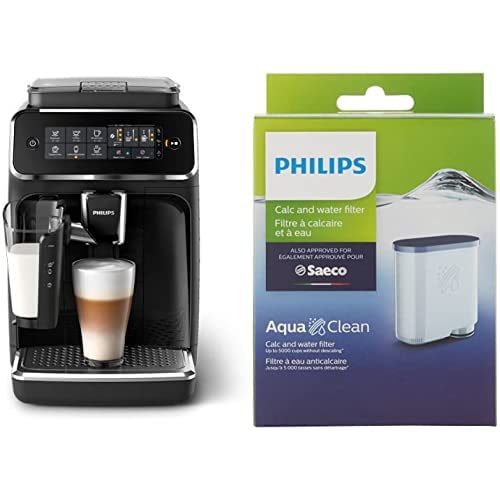
The listing includes 5 coffee varieties, an intuitive touch display, a 100% ceramic grinder, AquaClean filter support, and the LatteGo two-part milk system. It’s listed at 10"D x 17"W x 15"H, so it’s not tiny, but it usually replaces both a grinder and a milk setup.
The downside is creative control: you’re optimizing for repeatability, not for the “I nailed the perfect microfoam” feeling. If you want to learn steaming and latte art, pick a semi-auto with a manual wand.
Pros
- ✓ Easiest milk cleanup in this roundup
- ✓ Fully automatic drink selection
- ✓ Good fit for latte and cappuccino households
Cons
- ✗ Less manual shot control
- ✗ No traditional portafilter experience
Which espresso machine and grinder combo is best if you want touchscreen guidance?
The Breville Barista Touch Impress is the best touchscreen-guided option if you want a semi-automatic machine that feels more like following prompts than memorizing technique. It’s especially useful in households where multiple people make drinks and everyone wants a slightly different milk style.

The listing includes a touchscreen, step-by-step barista guidance, the Impress puck system, Auto MilQ, alternative milk settings, and a 3-second ThermoJet heat-up. It’s also listed with a 67.6 oz capacity and 13.4"D x 14.2"W x 16.3"H dimensions at 24.2 lb.
It’s expensive, and it’s not the “best espresso” choice by default—buy it because you want the guided experience and automatic milk texturing, not because you feel you need a screen to make coffee.
Pros
- ✓ Touchscreen helps multiple users
- ✓ Auto MilQ supports different milk preferences
- ✓ Fast listed ThermoJet heat-up
Cons
- ✗ Premium price band
- ✗ Not necessary for confident manual users
Which espresso machine and grinder combo is best for a narrow counter?
The Café Affetto is the best narrow-counter pick because it offers a super-automatic, bean-to-cup setup in a slimmer listed footprint than most machines in this category. It’s a practical compromise when you want built-in grinding but don’t have room for a full semi-auto “espresso station.”

The catalog specs list one-touch brew in less than 90 seconds, WiFi/SmartHQ app customization, a built-in conical burr grinder with 5 grind levels, a 20-bar pump, and a 1.2L tank. Dimensions are listed as 7.1"D x 16.1"W x 12.48"H, with a 19 lb weight.
Five grind levels leave little room to fine-tune, so I’d treat it as a space-saving choice rather than the safest “buy it for everyone” recommendation. If you have room, the Philips 3200 is the easier super-auto to recommend.
Pros
- ✓ Narrow listed footprint
- ✓ One-touch automatic brewing
- ✓ App customization for drink tweaks
Cons
- ✗ Small 1.2L tank needs regular refills
- ✗ Only 5 listed grind levels
Frequently asked questions
What is the best espresso machine and grinder combo for beginners?
The Breville Barista Express Impress is the best beginner pick if you want real espresso practice. It helps with dosing and tamping, which are two steps that trip up new owners. If you want less work, the Philips 3200 LatteGo is easier.
Are espresso machines with built-in grinders worth it?
Yes, built-in grinder machines are worth it if you want less counter clutter and a simpler morning setup. You give up some upgrade freedom, but you gain a tidy station where beans, grinding, espresso, and milk all live in one machine.
Is a separate espresso grinder better than a built-in grinder?
A separate espresso grinder is usually better if you plan to upgrade, single-dose different beans, or chase tiny shot changes. Wirecutter’s beginner espresso coverage also leans on separate grinder flexibility. Built-ins still make sense for milk drinks and clean counters.
Which is better, Breville Barista Express or Barista Express Impress?
The Barista Express Impress is better for most beginners because it adds assisted dosing and tamping. The classic Barista Express is better if you want the cheaper, more manual route and do not mind learning dose, tamp pressure, and grind changes yourself.
What is the easiest espresso machine with grinder for lattes?
The Philips 3200 LatteGo is the easiest latte pick here. It is fully automatic, makes five coffee varieties, and uses a two-part milk system that is simpler to rinse than a traditional wand. The trade-off is less control over milk texture.
How many grind settings do you need for espresso?
More grind settings make espresso easier to dial in, but the number alone is not everything. Around 15 to 25 settings gives most home users useful room to adjust. Fewer settings can still work if the machine is designed well.
Which related guides can help you choose your setup?
Use these guides if you’re still deciding between an all-in-one espresso station, a cheaper starter machine, or a more general “coffee maker with grinder” setup. If shot quality is the priority, start with grinders; if budget is the constraint, start with the under-$200 machine guide.
- Best burr grinder for espresso — useful if you decide separate gear is the better long-term path.
- Burr grinder settings for espresso — a plain-English guide to dialing in grind size.
- Best espresso machine under $200 — for buyers who want a cheaper machine and separate grinder.
- Best coffee maker with grinder — for households that want built-in grinding but not always espresso.