 Coffee Gear Picks
Best Espresso Machine Built In Grinder (2026): 6 Picks
The best espresso machine built in grinder for most homes is the Breville Barista Express Impress because it gives you fresh grinding, assisted puck prep, and real espresso control without turning every morning into a science project.
Top pick: Breville Barista Express Impress — it gives most home users the best balance of fresh grinding, assisted dosing, assisted tamping, and real portafilter espresso control.
- Price band: $$
- Weight: 23.7 pounds
- Materials: Stainless steel
- Key feature: Integrated conical burr grinder with 25 grind settings and assisted tamping
Best Espresso Machine Built In Grinder
6 picks compared by control, milk workflow, grinder range, cleanup, and counter fit
Overall
Best balance of help and real espresso control
- 25 grind settings
- Assisted dosing
- Assisted tamping
- Portafilter workflow
Top Pick Breville Barista Express Impress
$$
Fresh beans without beginner chaos
Check Price on Amazon Manual learning
Classic grind-dose-tamp-pull routine
- Conical burr grinder
- PID control
- Manual steam wand
- Low-pressure pre-infusion
Top Pick Breville Barista Express
$$
Best for learning the craft
Check Price on Amazon One-touch milk
Cappuccinos and lattes with less fuss
- 13 grind settings
- LatteCrema system
- 7 drink recipes
- Automatic milk carafe
Top Pick De'Longhi Magnifica Evo LatteCrema
$$$
Push-button milk drinks
Check Price on Amazon Easy cleanup
Low-fuss milk system for busy kitchens
- Two-part LatteGo
- Ceramic grinder
- AquaClean filter
- 5 coffee varieties
Top Pick Philips 3200 LatteGo
$
Clean milk parts faster
Check Price on AmazonWhat is the best espresso machine built in grinder for most homes?
The Breville Barista Express Impress is the best pick for most homes because it keeps the flavor control of a portafilter machine but adds intelligent dosing and assisted tamping. It’s the rare built-in grinder machine that helps beginners without hiding the espresso process completely.
Buy the Breville Barista Express if you want the old-school learning curve. Buy the De'Longhi Magnifica Evo or Philips 3200 LatteGo if you want milk drinks with button-push convenience instead of tamping, steaming, and wiping grounds off the counter.
Quick picks
Our Top Picks


Which espresso machines with built-in grinders should you compare first?
Compare these six machines first because they cover the real split in this category: semi-automatic machines for manual espresso and super-automatic machines for push-button drinks. Match the machine to your patience level, milk routine, and counter space.
| Product | Best for | Price band | Key spec | Verdict |
|---|---|---|---|---|
| Breville Barista Express Impress | Most home espresso learners | $$ | 25 grind settings + assisted tamping | Best balance of help and control. |
| Breville Barista Express | Manual learning | $$ | Integrated conical burr grinder + PID | Classic choice if you want to learn the workflow. |
| Breville Barista Touch Impress | Guided premium drinks | $$$ | Touchscreen + Auto MilQ | Best if you want premium guidance and automated milk. |
| De’Longhi La Specialista Arte Evo | Compact espresso and cold brew | $$ | 8 grind settings + cold extraction | Good for smaller counters and iced drinks. |
| De'Longhi Magnifica Evo LatteCrema | One-touch cappuccinos and lattes | $$$ | 13 grind settings + LatteCrema | Best for push-button cappuccinos and lattes. |
| Philips 3200 LatteGo | Easy cleanup | $ | Ceramic grinder + two-part milk system | Best low-fuss super-automatic. |
How did we evaluate espresso machines with built-in grinders?
We compared published specs, manufacturer documentation, Amazon listing data, and named editorial reviews. The biggest factors were grinder adjustability, dosing/tamping help, temperature controls (when listed), milk workflow, cleaning burden, tank access, and footprint.
Grinder range matters because beans change as they age. A shot that tastes sweet on Monday can run fast and sour by Friday if you can’t nudge the grind finer. For grinder-control context, Serious Eats notes that separate grinders often give more range than built-in grinders, so we treat integrated-grinder machines as convenience-first tools.
We also referenced coverage from Good Housekeeping, Wirecutter, and Coffeeness for broader guidance on beginner workflow and automatic milk systems.
Which built-in grinder espresso machine is best overall?
The Breville Barista Express Impress is best overall for buyers who want a real portafilter machine with less beginner guesswork. Its Amazon listing calls out 25 grind settings, assisted tamping, a 2-liter water tank, a 23.7-pound weight, and a stainless steel body—strong fundamentals for learning.
This is the machine I’d steer most pod-coffee upgraders toward first. You still grind into a portafilter and build a real espresso puck, but the machine helps with the parts beginners usually struggle with: inconsistent dosing, uneven tamping, and the “why is there coffee everywhere?” phase.
The tradeoff is that it’s not push-button espresso. You still steam milk manually and clean the portafilter after each drink. If you want a latte while half-asleep, the Magnifica Evo or Philips LatteGo will feel calmer.
Pros
- ✓ Assisted dosing and tamping reduce beginner mess.
- ✓ 25 grind settings give more bean flexibility than many built-ins.
- ✓ Real portafilter workflow leaves room to improve.
Cons
- ✗ Milk steaming is still manual.
- ✗ Larger footprint than many super-automatic machines.
Which built-in grinder espresso machine is best for learning manual espresso?
The Breville Barista Express is best for learning because it gives you the classic grind-dose-tamp-pull-steam workflow without buying a separate grinder. Its listing highlights an integrated precision conical burr grinder, low-pressure pre-infusion, PID temperature control, and a manual microfoam steam wand.
Think of this as the espresso “learn the basics” machine. It teaches you what grind changes do, how puck prep impacts flow, and why milk steaming is its own skill. If you actually want to understand espresso (not just drink it), that’s a feature.
It’s also more trial-and-error than the Impress. Expect more sink shots, more wiping, and an older interface. If that sounds fun, this is a classic. If that sounds annoying, don’t romanticize the mess.
Pros
- ✓ Classic workflow for learning real espresso habits.
- ✓ PID and pre-infusion help support more stable shots.
- ✓ Manual steam wand is useful for latte art practice.
Cons
- ✗ More mess and guesswork than the Impress.
- ✗ Less guidance than newer Breville models.
Which built-in grinder espresso machine is best for guided drinks?
The Breville Barista Touch Impress is best for guided drinks because the touchscreen, assisted tamping, and Auto MilQ settings walk you through espresso and milk texture choices. The Amazon listing notes a touchscreen, a 67.6-ounce capacity, and an Auto MilQ feature.
This is the premium pick for households that make cappuccinos, flat whites, and alternative-milk drinks all week. The screen makes it easier for multiple people to get consistent results without everyone learning the same “barista routine.”
The downside is the price, plus the extra automation gives you more to clean and look after than the simpler Breville options in this lineup. If you like tinkering, it can also feel a little boxed-in. You’re paying for guidance and convenience.
Pros
- ✓ Touchscreen guidance makes drink choices easier.
- ✓ Auto MilQ helps with dairy and alternative milks.
- ✓ Assisted tamping lowers puck-prep frustration.
Cons
- ✗ Most expensive Breville pick here.
- ✗ More automated parts to look after than simpler Breville models.
Which espresso machine with grinder is best for compact cold brew and espresso?
The De'Longhi La Specialista Arte Evo is best if you want a narrower semi-automatic machine with a built-in grinder and cold extraction. Its listing shows 8 grind settings, a 15-bar pump, cold extraction technology, and a relatively compact width.

The width is the real hook. If your counter already has a toaster, kettle, and that one appliance you swear you still use, this De'Longhi is easier to place than many Breville machines.
The tradeoff is grinder range: 8 settings is workable, but not as flexible as the Express Impress. If you swap beans often, you may feel those bigger jumps.
Pros
- ✓ Narrower body works better on crowded counters.
- ✓ Cold extraction feature suits iced-coffee routines.
- ✓ Semi-automatic workflow still gives manual control.
Cons
- ✗ Only 8 grind settings.
- ✗ Less puck-prep help than Breville Impress models.
Which built-in grinder espresso machine is best for one-touch milk drinks?
The De'Longhi Magnifica Evo is best for one-touch milk drinks because it combines a built-in grinder with De'Longhi’s LatteCrema milk system and multiple drink recipes. It’s the right fit when you want cappuccinos and lattes without tamping or steaming.

This is the convenience-first pick. You choose it because you want a milk drink before email, not because you want to practice tamping pressure. The milk carafe is the reason to pick it over a semi-automatic machine.
Don’t buy it expecting café-style latte art practice. Super-automatics are more like very capable breakfast robots: quick, tidy, and consistent enough, but less expressive than a portafilter setup.
Pros
- ✓ One-touch recipes keep mornings simple.
- ✓ LatteCrema system handles milk automatically.
- ✓ Slim width helps it fit more kitchens.
Cons
- ✗ Not ideal for learning portafilter espresso.
- ✗ Less milk texture control for latte art.
Which built-in grinder espresso machine is best for easy cleanup?
The Philips 3200 Series LatteGo is best for easy cleanup because the LatteGo milk system is designed to be simple to rinse (two parts, no tubes, per the listing). It’s also a good fit if you want automatic drinks without turning maintenance into a hobby.
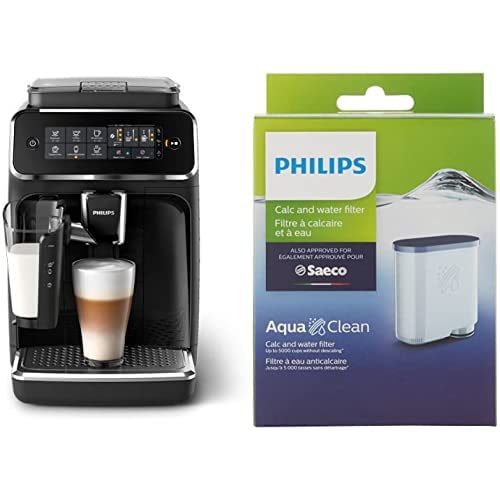
If milk cleanup makes you avoid using a machine, this is the one to look at. LatteGo is built around fewer parts, which matters after the novelty wears off and you just want a clean cup before work.
You give up the manual control of a portafilter machine. Espresso flavor and texture are less adjustable than with Breville’s semi-automatic picks. But for low-fuss households, less scrubbing can be the feature that actually gets used.
Pros
- ✓ Two-part LatteGo milk system is easy to rinse.
- ✓ Good fit for low-fuss automatic drinks.
- ✓ Ceramic grinder is designed for durability.
Cons
- ✗ Less shot control than semi-automatic machines.
- ✗ Not the best route for latte art practice.
Should you buy a semi-automatic or super-automatic espresso machine with a grinder?
Buy semi-automatic if you want control and skill-building; buy super-automatic if you want one-touch drinks and less cleanup. Semi-automatic machines make you handle the portafilter and milk steaming, while super-automatic machines do the grinding, brewing, and often milk frothing for you.
The Breville Barista Express Impress, Barista Express, Barista Touch Impress, and De'Longhi La Specialista Arte Evo sit on the manual-control side. The De'Longhi Magnifica Evo and Philips 3200 LatteGo sit on the convenience side. If you’re comparing these against cheaper machines, the best espresso machine under $200 guide shows why built-in grinder models usually cost more.
If your priority is maximum grinder control (especially for lighter roasts), a separate grinder can be the smarter long-term move. Start with our best burr grinder for espresso guide before locking into an all-in-one machine.
What are the most common mistakes when buying an all-in-one espresso machine?
The biggest mistake is buying for convenience when you actually want control, or buying for control when you actually want one-touch drinks. Be honest about your mornings: a beautiful portafilter machine is a bad buy if you hate wiping grounds and cleaning milk gear.
- Assuming a built-in grinder equals a dedicated grinder. It usually saves space more than it maximizes grind range.
- Ignoring baskets and puck prep. Pressurized baskets are more forgiving; non-pressurized baskets demand better grind and tamp habits.
- Underestimating milk cleaning. Milk residue turns sweet foam into sour fridge smell fast.
- Overbuying touchscreen features. If you mostly drink straight espresso, premium drink menus can sit unused.
- Buying a super-automatic expecting latte art practice. It makes convenient milk drinks, not a barista training station.
Frequently asked questions
What is the best espresso machine with a built-in grinder for beginners?
The Breville Barista Express Impress is the best beginner pick for most homes. It keeps the portafilter workflow but helps with dosing and tamping, so you get fewer messy, uneven pucks while still learning how espresso actually works.
Are espresso machines with built-in grinders worth it?
Yes, they are worth it if you want fresh-ground espresso in one footprint. You give up some grinder upgrade flexibility, but you save counter space, reduce setup clutter, and avoid matching a separate grinder to your first machine.
Is a built-in grinder better than a separate espresso grinder?
A separate espresso grinder is usually better for maximum range and future upgrades. A built-in grinder is better for convenience and smaller kitchens. Serious Eats has noted that separate grinders can offer more control, but most beginners value the simpler setup.
What is the difference between semi-automatic and super-automatic espresso machines with grinders?
Semi-automatic machines make you grind into a portafilter, tamp, pull the shot, and usually steam milk yourself. Super-automatic machines grind, brew, and often froth milk with buttons. Choose semi-auto for skill-building and super-auto for easier mornings.
Which Breville espresso machine with grinder should I buy?
Buy the Barista Express Impress if you want the best middle ground. Pick the Barista Express if you want a more manual, classic learning machine. Choose the Barista Touch Impress if you want touchscreen guidance and automated milk help.
Which espresso machine with grinder is easiest to clean?
The Philips 3200 Series LatteGo is the easiest cleanup pick here. Its two-part LatteGo milk system has no hidden tubes according to the listing, and the AquaClean filter reduces the constant maintenance feeling that turns some automatic machines into chores.
What should you read next?
Read these next if you’re still deciding between an all-in-one espresso machine and a separate setup. They cover the cheaper machine path, dedicated grinder upgrades, grind-setting basics, and the small scale that makes espresso less random.
- Best Espresso Machine Under $200 — useful if built-in grinder machines feel too expensive.
- Best Burr Grinder for Espresso — compare separate grinders before choosing an all-in-one.
- Burr Grinder Settings for Espresso — learn how to dial in shots without guessing.
- Best Coffee Scale for Espresso and Pour Over — get better dose consistency for every shot.