 Coffee Gear Picks
Best Espresso Machine Cleaner (2026): 7 Picks
Which espresso machine cleaner is best for most home setups?
Top pick: Urnex Cafiza Espresso Machine Cleaning Powder — the most flexible choice for semi-automatic espresso owners because it cleans coffee oils from group heads, valves, portafilters, and baskets without locking you into one machine brand. If your problem is chalky mineral scale, do not buy Cafiza alone. You need a descaler instead.
Best Espresso Machine Cleaner Picks for 2026
Ranked by cleaning job, machine fit, format, and everyday fuss level
Coffee Oils
The flexible pick for group heads and soaking parts
- Powder format
- Backflush compatible machines
- Soaks baskets and portafilters
- Not a descaler
Top Pick Urnex Cafiza Cleaning Powder
$
Best overall coffee-oil cleaner
Check Price on Amazon Tablets
Cleaner dosing for routine machine cleaning cycles
- Pre-measured doses
- Less scooping
- Good for routines
- Manual still matters
Top Pick Urnex Cafiza Cleaning Tablets, 100 Count
$$
Best tablet format
Check Price on Amazon Breville
OEM tablets for fewer compatibility doubts
- Breville machine focus
- Tablet format
- Phosphate free
- Small pack
Top Pick Breville BEC250 Cleaning Tablets
$$
Best for Breville owners
Check Price on Amazon Descaling
Mineral-scale removal when water hardness catches up
- Scale removal
- Powder or liquid options
- Water-path cleaning
- Not for coffee oils
Top Pick Urnex Dezcal Descaling Powder, 4 Uses
$
Best budget descaler
Check Price on AmazonQuick answer: Buy Urnex Cafiza Cleaning Powder if you own a compatible semi-automatic machine and want one flexible coffee-oil cleaner. Choose Breville BEC250 Cleaning Tablets for Breville peace of mind, Urnex Dezcal Descaling Powder, 4 Uses for budget descaling, and De'Longhi EcoDecalk Universal Descaler or Durgol Swiss Espresso Descaler if you prefer a liquid descaler.
Quick picks
Our Top Picks


Which espresso machine cleaners are worth comparing?
These seven are worth comparing because they split the job cleanly: four handle coffee oils and routine cleaning, while three handle mineral scale. Buying the wrong type is like scrubbing a greasy pan with plain water; it looks busy, but the grime stays put.
| Product | Best for | Price band | Key spec | Verdict |
|---|---|---|---|---|
| Urnex Cafiza Cleaning Powder | Flexible cleaning of group heads, baskets, and portafilters | $ | Powder; 20 Ounce (Pack of 1) | Most flexible coffee-oil cleaner for compatible semi-automatic machines. |
| Urnex Cafiza Cleaning Tablets, 100 Count | Pre-measured backflush cleaning | $$ | Tablet; 100 Count | Cleaner dosing when your machine accepts tablets. |
| Breville BEC250 Cleaning Tablets | Breville owners who want OEM tablets | $$ | Tablet; 8 cleaning tablets | The least-guesswork pick for Breville owners who want OEM tablets. |
| ACTIVE Espresso Machine Cleaning Tablets | High-frequency cleaning on compatible machines | $$ | Tablet; 120 tablets | Big count for frequent routines on compatible machines. |
| Urnex Dezcal Descaling Powder, 4 Uses | Low-cost limescale removal | $ | Powder; 4.0 Ounce | Low-cost way to handle mineral scale. |
| De'Longhi EcoDecalk Universal Descaler | Simple liquid descaling with broad machine compatibility | $$ | Liquid; 16.9 fl oz (500 ml) | Easy liquid descaling, especially for De'Longhi owners. |
| Durgol Swiss Espresso Descaler | Single-dose liquid descaling convenience | $$ | Liquid; 4.2 Fl Oz (Pack of 4) | Premium single-dose convenience for limescale days. |
How should you choose between a cleaner and a descaler?
Choose a cleaner for coffee oils and brown residue; choose a descaler for limescale and mineral deposits. Espresso owners often need both, but not in the same step: a group-head cleaner is for the coffee-contact parts, while a descaler is for the water path.
Urnex describes Cafiza as a cleaner for espresso machine group heads, valves, and lines, while Urnex describes Dezcal as a scale remover. Whole Latte Love’s espresso cleaning guide also points to Cafiza for soaking portafilters and baskets. Different mess, different bottle.
Which espresso machine cleaner removes coffee oils best?
Urnex Cafiza Cleaning Powder is the best coffee-oil cleaner here for most home espresso owners because the powder format is genuinely versatile. Use it for compatible backflush routines, or mix a soak for metal baskets, shower screens, and portafilters. It is a degreaser for espresso grime, not a fix for hard-water scale.
1) Urnex Cafiza Cleaning Powder
Cafiza powder is what I’d start with on a semi-automatic machine that’s built for backflushing. The big advantage is that it’s not tied to one espresso brand, and it’s useful beyond the machine itself: anything that touches coffee oils (baskets, portafilter spouts, shower screens) can be cleaned as removable parts.
Skip it if your manual says not to backflush, or if your main symptom is slow flow or a machine warning that points to descaling. The downside is the “chemistry set” factor: you have to measure and you have to rinse thoroughly. If you can still smell cleaner after rinsing, keep going.
Pros
- ✓ Flexible powder for several espresso cleaning jobs
- ✓ Strong fit for compatible backflush routines
- ✓ Useful for soaking metal baskets and portafilters
Cons
- ✗ Requires measuring
- ✗ Needs careful rinsing
- ✗ Does not descale mineral buildup
Which espresso machine cleaning tablets are easiest for routine use?
Tablets are easiest when your machine has a cleaning cycle (or your manual calls for a tablet-based routine) because dosing is automatic: one tablet, then rinse. Choose Urnex Cafiza Cleaning Tablets, 100 Count when you want a well-known, consistent tablet; choose ACTIVE Espresso Machine Cleaning Tablets when you want a larger supply for frequent cleaning.
2) Urnex Cafiza Cleaning Tablets, 100 Count
Cafiza tablets are the “no-mess” version of the same coffee-oil cleaning job. If you hate scooping powder (or you share your setup with someone who will absolutely over-scoop), tablets keep the routine consistent.
The trade-off is flexibility. Tablets are great when the routine is “one tablet,” but powder is easier to scale up for soaking multiple parts. And as always: only backflush if your machine is designed for it.
Pros
- ✓ Pre-measured and tidy
- ✓ Good for tablet-based cleaning cycles
- ✓ Designed for coffee-oil and residue removal
Cons
- ✗ Less flexible than powder for soaking
- ✗ Must match your machine routine
3) ACTIVE Espresso Machine Cleaning Tablets

ACTIVE tablets are for the person who cleans often and hates reordering. If you pull multiple shots a day (or you’re maintaining more than one machine), the larger count is the whole point.
The caution is simple: tablet products vary in size and intended routines. Bulk value is only a deal if the tablet and your machine’s instructions line up. If your manufacturer strongly pushes its own tablets, that guidance should carry more weight than the per-tablet price.
Pros
- ✓ Large tablet count
- ✓ Good value for frequent routines
- ✓ Fragrance-free and unscented formula
Cons
- ✗ Not an OEM product
- ✗ Compatibility depends on your machine instructions
Which cleaner is best for Breville espresso machines?
Breville BEC250 Cleaning Tablets is the best cleaner for Breville espresso machines if you want OEM compatibility and fewer doubts. Breville’s own accessory listing says these tablets are designed for Breville espresso coffee machines and formulated for cleaning shower screens and filter baskets.
4) Breville BEC250 Cleaning Tablets
Breville machines are popular because they make home espresso feel less fussy. The cleaning routine should feel the same way. If your machine’s cleaning light comes on and the manual points you toward tablets, BEC250 is the straightforward answer.
The downside is the small pack size versus bulk third-party options, so the per-clean cost can be higher. If you’re shopping alternatives, Cafetto Cino Cleano is another tablet name Breville owners often compare, but if your goal is fewer compatibility questions, the Breville-branded tablet is the safe pick.
Source note: Breville’s BEC250 listing describes the tablets as made for Breville espresso coffee machines and for cleaning shower screens and filter baskets.
Pros
- ✓ OEM Breville accessory
- ✓ Simple choice for Breville cleaning cycles
- ✓ Phosphate-free formula
Cons
- ✗ Small pack count
- ✗ Less appealing for non-Breville machines
Which espresso machine descaler is best for mineral buildup?
Choose Urnex Dezcal Descaling Powder, 4 Uses for low-cost powder descaling, De'Longhi EcoDecalk Universal Descaler for an easy liquid option with De’Longhi support, and Durgol Swiss Espresso Descaler for premium single-dose liquid convenience. These are descalers, not coffee-oil cleaners — they target the pale, chalky limescale that hard water leaves behind.
5) Urnex Dezcal Descaling Powder, 4 Uses
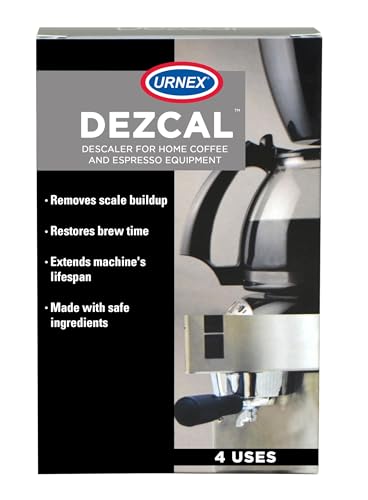
Dezcal is the practical descaler pick when you want to spend less and you don’t mind mixing powder. It’s made for scale removal in home coffee and espresso machines, according to Urnex’s Dezcal product information.
Powder packets aren’t as grab-and-pour easy as liquid, but they store neatly and make sense if you descale on a schedule. Just remember: Dezcal isn’t a Cafiza substitute. It won’t touch the rancid coffee oils hiding in a basket.
Pros
- ✓ Budget-friendly descaling option
- ✓ Odorless powder format
- ✓ Made for coffee and espresso machine scale removal
Cons
- ✗ Requires mixing
- ✗ Not for coffee oils or portafilter grime
6) De'Longhi EcoDecalk Universal Descaler

EcoDecalk is the liquid descaler I’d point De’Longhi owners toward first. It’s easy to dose, easy to pour, and backed by the same brand that makes many home espresso and super-automatic machines.
De’Longhi describes EcoDecalk as a lactic-acid descaler for coffee machines. The downside is cost versus powder: you’re paying for convenience and manufacturer support.
Pros
- ✓ Liquid format is easy to pour
- ✓ De'Longhi manufacturer support
- ✓ Good fit for coffee and espresso machine descaling
Cons
- ✗ Costs more than budget powder
- ✗ Still does not clean coffee oils
7) Durgol Swiss Espresso Descaler

Durgol Swiss Espresso is for people who want descaling to feel as close to single-serve as possible. Open a bottle, follow the machine instructions, rinse well, and you’re done.
The premium angle is convenience, not magic. Durgol describes Swiss Espresso as a descaler and decalcifier for espresso machines.
Pros
- ✓ Single-dose liquid convenience
- ✓ Made for espresso machine descaling
- ✓ Good choice for people who hate measuring
Cons
- ✗ Pricier than powder
- ✗ Only solves scale, not oily coffee residue
How did we evaluate espresso machine cleaners?
We researched and compared these cleaners by cleaning purpose, machine compatibility, dosing format, verified Amazon/manufacturer product details, and whether the product is meant to solve coffee oils, limescale, or both.
We also weighted “fuss level.” Powder is flexible but needs measuring and thorough rinsing. Tablets are tidy but routine-dependent. Liquid descalers are simple but often cost more per use. The best pick is the one you’ll actually use on schedule.
Frequently asked questions
What is the best espresso machine cleaner for home use?
Urnex Cafiza Espresso Machine Cleaning Powder is the best espresso machine cleaner for most semi-automatic home setups. It is flexible enough for compatible backflushing and soaking baskets or portafilters, but it cleans coffee oils only. Buy a descaler too if your issue is mineral buildup.
Is Cafiza a cleaner or a descaler?
Cafiza is a coffee-oil cleaner, not a descaler. It removes brown, sticky coffee residue from group heads, valves, baskets, and portafilters. It is not the product to use when hard-water minerals are clogging the water path.
What is the difference between Cafiza and Dezcal?
Cafiza targets coffee oils and residue. Dezcal targets limescale, which is mineral buildup from water. Think of Cafiza as the degreaser for espresso grime and Dezcal as the scale remover for the water side of the machine.
Can I use vinegar to descale an espresso machine?
Only use vinegar if your machine manual says it is safe. Vinegar can leave a sharp smell and may not be recommended for some machines. A purpose-made descaler like Dezcal, EcoDecalk, or Durgol is usually the cleaner, less risky route.
How often should I clean my espresso machine?
For home espresso, wipe and rinse parts daily, then use cleaning powder or tablets on the schedule in your manual. If shots start tasting bitter, smoky, or stale even with fresh beans, old coffee oils may be part of the problem.
How often should I descale my espresso machine?
Descaling depends on water hardness and how often you brew. Hard water can leave scale faster, like chalky buildup in a kettle. Follow your machine alert or manual, and descale sooner if flow slows or the machine warns you.
Do Breville espresso machines need special cleaning tablets?
Breville owners should strongly consider Breville BEC250 tablets if they want the least guesswork. Third-party tablets may work in some routines, but the machine manual and warranty language should win over bargain hunting.
Can cleaning tablets be used in every espresso machine?
No. Cleaning tablets should only be used where the machine manual allows them. Backflushing is for machines designed for it, usually with a three-way valve. Never drop a group-head cleaner into a water tank unless the product instructions clearly say so.
Which related espresso maintenance guides should readers read next?
If cleaning is part of a broader “my espresso tastes off” problem, these guides help you fix the other variables. A clean machine matters, but grind size and grinder cleanliness still decide a lot of what ends up in the cup.
- Best Espresso Machine Under $200 — useful if your current machine is not worth nursing along forever.
- Burr Grinder Settings for Espresso — dial in shots after your machine is clean.
- Best Burr Grinder for Espresso — upgrade the part that affects flavour every single morning.
- How to Clean a Burr Coffee Grinder — stop stale grinder oils from undoing your machine cleaning work.