 Coffee Gear Picks
Best Espresso Machine Manual Picks (2026)
Which manual espresso machine is best for most people?
The best espresso machine manual pick for most people is the Flair 49 PRO: it delivers true lever control and clear pressure feedback without demanding permanent counter space.
Top pick: Flair 49 PRO. It offers the best balance of real lever control, pressure feedback, compact footprint, and home-barista learning room.
- Price band: $$$
- Footprint/dimensions: 13.5 x 7.5 x 11 inches
- Materials:
- Key feature: integrated pressure gauge with espresso pressure zone
Plan on pairing any manual machine with an espresso-capable grinder and a hot-water workflow (usually a kettle). You’ll also do more preheating and rinsing than you would with a pump machine: worth it for control, annoying if you just want caffeine fast.
Best Manual Espresso Machines for 2026
Ranked by pressure control, heat workflow, portability, learning curve, and daily cleanup
Overall
Best control without taking over the kitchen
- Pressure gauge
- 49 mm system
- Manual lever feel
- Compact counter setup
Top Pick Flair 49 PRO
$$$
Best learning room
Check Price on Amazon Budget
Lower-cost lever practice with fewer regrets
- Manual power
- Folding frame
- Pressure gauge
- Good upgrade path
Top Pick Flair 2GO
$$
Best starter lever
Check Price on Amazon Travel
A serious little espresso kit for bags and cabins
- Portable body
- Manual pumping
- 18g basket
- Protective sleeve bundle
Top Pick WACACO Picopresso
$
Best travel shot
Check Price on Amazon Premium
Old-school lever drama with steam on board
- Built-in boiler
- Steam frother
- Chrome look
- Classic lever workflow
Top Pick La Pavoni EPC-8 Europiccola
$$$
Best classic lever
Check Price on AmazonQuick answer: Choose the Flair 49 PRO for the best home lever learning curve. Save money with the Flair 2GO, go travel-serious with the WACACO Picopresso, or pick the STARESSO PLUS SP300 for the most forgiving portable workflow.
Quick picks
Our Top Picks


How do the best manual espresso machines compare?
Most buyers are choosing between two styles: countertop lever brewers (more control, more setup) and compact travel brewers (more portable, more compromises). Here’s how every verified pick in this roundup stacks up by fit, price band, one key spec, and the plain-English verdict.
| Product | Best for | Price band | Key spec | Verdict |
|---|---|---|---|---|
| Flair 49 PRO | Home baristas who want real lever control | $$$ | 9-bar pressure with 49 mm portafilter | Best balance of control, feedback, and counter-friendly size. |
| Flair 2GO | Budget-minded lever espresso learners | $$ | Pressure gauge on a folding lever frame | The lower-cost Flair lever, and it folds for travel. |
| WACACO Picopresso | Travel espresso with a capable grinder | $ | 80 ml portable brew chamber | Tiny, serious, and picky about grind quality. |
| WACACO Nanopresso with Case, Moss Green | Ground-coffee travel brewing with externally heated water | $ | Hand-pump brewer; ground coffee | Compact pump brewer with a protective case. |
| La Pavoni EPC-8 Europiccola | Classic lever espresso and milk drinks | $$$ | Boiler lever machine with frother | Classic, beautiful, and less forgiving than it looks. |
| STARESSO PLUS SP300 | Beginners who want portable manual espresso | $ | Reusable filter in a compact body | The easiest portable pick for casual beginners. |
How did we evaluate manual and lever espresso machines?
We evaluated these manual and lever espresso machines on the parts that actually make or break daily use: pressure control (and feedback), heat management and preheating, basket style (pressurized vs non-pressurized), cleanup friction, portability, learning curve, and whether the design can produce repeatable espresso without electronics smoothing over mistakes.
Pressure and heat are the two big “gotchas.” Espresso is brewed under pressure, and many home setups target the familiar ~9 bar zone; a gauge makes that target visible instead of guesswork. And because many manual brewers have unheated metal parts, preheating becomes part of the recipe, something reviewers at Coffee Chronicler and Homegrounds both highlight as a real tradeoff.
Which manual espresso machine should you buy for your setup?
Think in terms of workflow: do you want a compact countertop ritual, a toss-in-a-bag travel kit, or a classic boiler lever that can steam milk? The “best” choice is the one you’ll actually use when you’re tired.
1) Flair 49 PRO — Best Overall
The Flair 49 PRO is the best all-around pick because it teaches you faster than most manual brewers. That pressure gauge turns “press harder” into a real signal you can react to, especially helpful when you’re dialing in a new coffee.
The honest downside is pace: you’ll preheat, pull, then rinse and reset. If you want two cappuccinos in five minutes, this is the wrong category. If you want a quiet, repeatable lever workflow that fits in a small kitchen, it’s a great match.
Pros
- ✓ Pressure gauge makes learning and repeatability easier
- ✓ Compact footprint for a true lever setup
- ✓ Rewards careful puck prep with excellent control
Cons
- ✗ Preheating is part of the routine
- ✗ No built-in milk steaming
2) Flair 2GO — Best Budget Manual Lever Setup
The Flair 2GO makes sense when you want to learn lever espresso without paying for every refinement up front. It’s the “I’m curious, but not committed yet” option that still lets you practice the skills that matter: grind, dose, distribution, and a steady press. Its Amazon listing describes a 6061 aluminum frame, a stainless steel brew cylinder, and an integrated pressure gauge, and the frame folds down to travel.
The tradeoff is forgiveness. The Grounds model ships with a bottomless 2-in-1 portafilter, which Flair says needs an espresso-capable burr grinder to dial in, so there is no pressurized basket to smooth over a weak grind. But if you’re on a budget and you want real technique practice (not pod-style convenience), it’s a smart starting point.
Pros
- ✓ Lower-cost entry into Flair lever espresso
- ✓ Integrated gauge shows pressure as you press
- ✓ Folds down for storage or travel
Cons
- ✗ Bottomless portafilter is less forgiving
- ✗ Still demands a real espresso grinder
3) WACACO Picopresso — Best Portable Manual Espresso Maker
The Picopresso is for travel espresso drinkers who refuse to “just drink drip.” When paired with a capable grinder, it can produce surprisingly concentrated shots for something that lives in a bag. Our link goes to a WACACO bundle that pairs the Picopresso with a protective sleeve.
What you give up is forgiveness. Small brew chambers cool quickly, and tiny parts make the sink routine more annoying. If you’re the type who likes dialing in and doesn’t mind rinsing a few pieces, it’s the most serious travel option here.
Pros
- ✓ Excellent portability for true espresso-style shots
- ✓ WACACO kit includes useful prep tools
- ✓ Great fit for experienced espresso drinkers on the move
Cons
- ✗ Very grind-sensitive
- ✗ More fiddly cleanup than it looks
4) WACACO Nanopresso with Case, Moss Green — Best Compact Hand-Pump Travel Pick
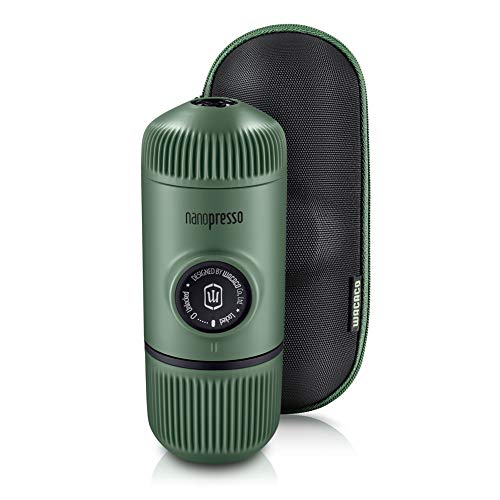
The WACACO Nanopresso with protective case is a compact hand-pump choice for travel. Load ground coffee, add hot water from a separate kettle, and work the piston by hand. It does not heat water or use electricity.
Choose it for a small travel kit when a pump workflow suits you. It is a different design from a lever machine or the non-pressurized Picopresso. Capsule compatibility requires a separate adapter; a larger double-shot basket requires the separate Barista Kit.
Pros
- ✓ Compact manual pump
- ✓ Protective case included
- ✓ No electrical supply needed for brewing
Cons
- ✗ Needs externally heated water
- ✗ Capsule adapter and larger basket sold separately
5) La Pavoni EPC-8 Europiccola — Best Premium Classic Lever Machine

The La Pavoni Europiccola is the classic lever experience in one shiny, compact machine: heated boiler, lever pull, and the ability to steam/froth milk. If you want the full old-school ritual without adding a separate milk frother, it’s the clear “premium” choice in this list.
It’s also less forgiving than it looks. Managing temperature and timing matters, especially when pulling multiple shots back-to-back. Buy it because you want to learn (and enjoy) the craft, not because you want an easy weekday appliance.
Pros
- ✓ Classic lever + boiler workflow
- ✓ Can make milk drinks without extra gear
- ✓ Iconic look for the countertop
Cons
- ✗ Steeper learning curve and more variables
- ✗ Uses electricity and costs more than fully manual brewers
6) STARESSO PLUS SP300 — Best Beginner-Friendly Portable Option

The STARESSO PLUS SP300 is the easiest on-ramp here if you want something portable and don’t want to obsess over grind perfection immediately. It’s a good fit for dorms, offices, and casual “espresso-ish” drinks where convenience matters more than chasing the last 5% of shot clarity.
The limit is control: as your palate and grinder improve, you may outgrow it faster than the more technique-driven options. But as a first portable manual brewer, it keeps the workflow approachable.
Pros
- ✓ Approachable workflow for a portable manual brewer
- ✓ Reusable filter keeps costs down
- ✓ Good for casual espresso-style drinks on the go
Cons
- ✗ Lower ceiling for shot tuning
- ✗ Small capacity limits drink size
Which manual espresso machine is easiest for beginners?
The easiest beginner pick is the STARESSO PLUS SP300 if you want portable and forgiving. The Flair 2GO is the lower-cost Flair lever, and its gauge gives you feedback while you learn. The Picopresso is best once you already have a grinder that can truly do espresso.
The big concept is basket style. A pressurized basket creates extra resistance, so it can produce crema-like foam even with an imperfect grind. A non-pressurized basket depends on your grind, dose, and tamp, better potential flavor, but it tattles on every mistake.
If you’re learning, choose the setup that keeps you pulling shots consistently. You can always “graduate” to a stricter basket once your grinder and technique are locked in.
Frequently asked questions
What is the best manual espresso machine for home use?
The Flair 49 PRO is the best manual espresso machine for most home users. It gives you real lever control, a pressure gauge, and enough room to improve without needing a boiler on the counter. Pair it with a proper espresso grinder and a simple kettle workflow.
Are manual espresso machines better than semi-automatic machines?
Manual espresso machines are better for control and portability, not convenience. A semi-automatic pump machine is easier when you want quick back-to-back drinks and milk-based drinks. Go manual if you enjoy the slower ritual and want to learn what grind and pressure changes do.
Do manual espresso machines need electricity?
Many manual espresso machines do not need electricity, but they still need hot water from somewhere. Flair, WACACO, and STARESSO models are fully manual. La Pavoni Europiccola uses electricity for its boiler, even though you generate shot pressure with the lever.
What grinder do I need for a manual espresso machine?
You need an espresso-capable burr grinder with fine, repeatable adjustments. Manual machines are grind-sensitive because there is no pump to brute-force flow through a coarse puck. Too coarse and the shot gushes; too fine and it stalls. Both taste off.
Is the Flair 49 PRO good for beginners?
The Flair 49 PRO is good for patient beginners, not push-button beginners. The pressure gauge teaches you what your hands are doing, which speeds up learning. The tradeoff is a fussier workflow: preheating, dosing, and grind changes matter from the first shot.
Can a portable manual espresso maker make real espresso?
Yes, if it uses a non-pressurized basket, very hot water, and a grinder that can go truly espresso-fine. The Picopresso is the non-pressurized travel pick here; the Nanopresso uses a hand pump and a more forgiving brewing approach. Expect smaller drinks and more cleanup than a home machine.
What related coffee gear guides should readers open next?
Manual espresso is a chain: grinder → prep → hot water → press. These guides help you shore up the parts that usually cause sour, thin, or inconsistent shots.
- Best Burr Grinder for Espresso: start here if your grinder can’t do fine, repeatable espresso adjustments.
- Best Hand Grinder for Espresso Under $100: especially relevant for Picopresso and travel kits.
- Burr Grinder Settings for Espresso: the fastest way to troubleshoot shots that run too fast, choke, taste sour, or taste bitter.
- Best Coffee Scale for Espresso and Pour Over: makes dose/yield consistent, which makes dialing-in faster.