 Coffee Gear Picks
Manual vs Electric Coffee Grinder (2026): Which Is Better?
In the manual vs electric coffee grinder debate, electric is the better default because it is faster, easier to repeat, and less demanding when coffee is part of every morning. A manual grinder remains the sharper choice for quiet single-cup brewing, travel, and putting more of a modest budget toward the burr set rather than a motor.
Top pick: Baratza Encore ESP — its dual-range adjustment gives a practical electric route for both espresso and filter coffee.
- Price band: $$
- Weight: 5.6 lb
- Materials: plastic housing; 40 mm hardened alloy-steel burrs
- Key feature: dual-range adjustment, with micro-steps 1–20 for espresso and macro-steps 21–40 for filter brewing
Baratza and the Amazon listing supply those Encore ESP specifications; they are useful buying details, not a blanket claim that it is the best grinder for every cup. Check the Baratza Encore ESP listing for current details.
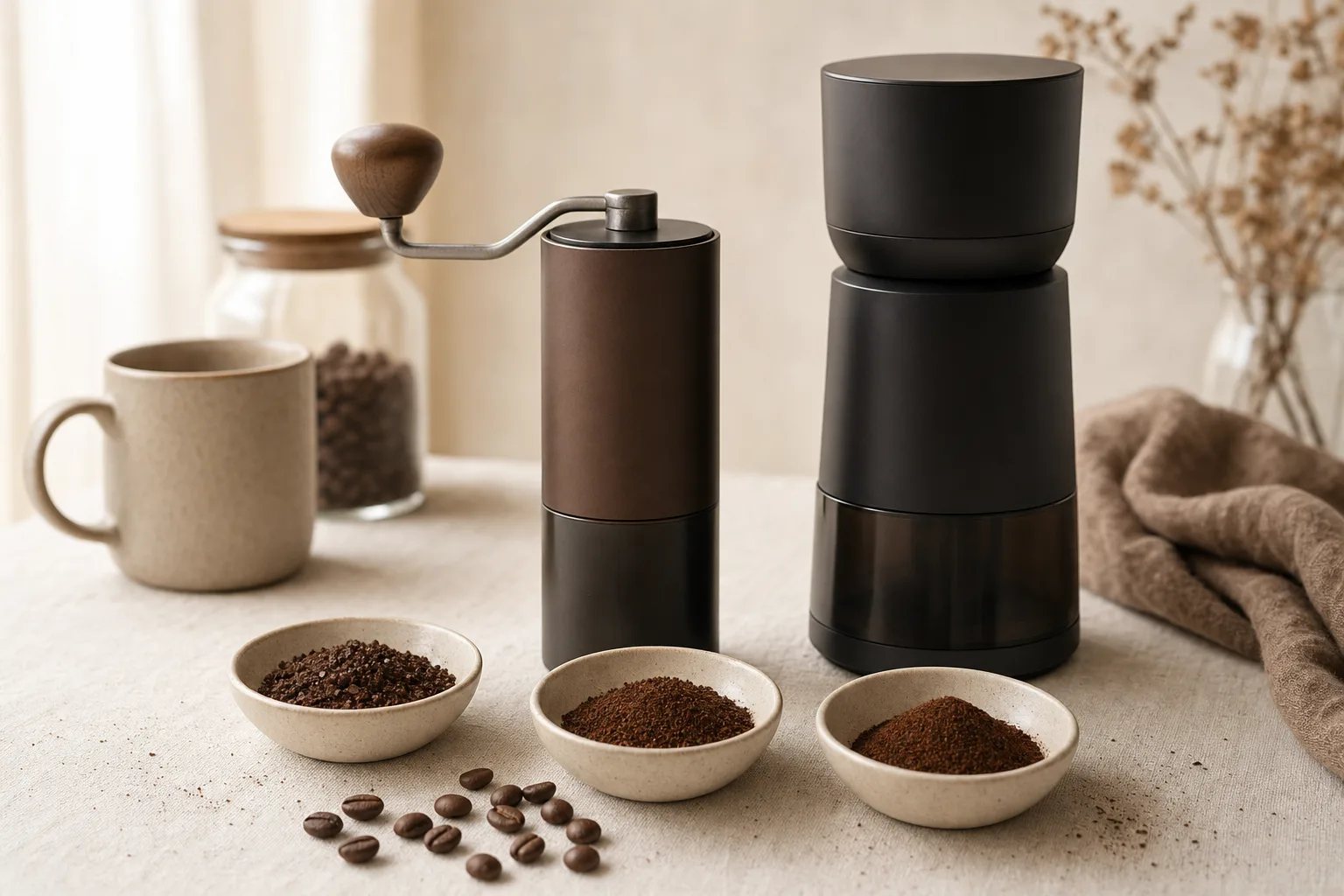
Manual vs Electric Coffee Grinder
Same goal, very different mornings: one is quiet and portable, the other is fast and easy to repeat.
One or two cups, travel, and quiet mornings.
Fast daily coffee, shared households, and frequent espresso.
Choose electric for the most convenient everyday setup; choose manual when portability, silence, and single-cup value matter more than speed.
Which grinder should most people choose?
Most people should choose an electric burr grinder because it removes the daily friction: press a button, grind a dose, brew coffee. Choose a manual burr grinder if you make one or two cups, need silence, travel with coffee gear, or want the best value before the price climbs.
The fork in the road is simple. If grinding by hand sounds charming once and annoying by Friday, buy electric. If a motor buzzing before sunrise sounds worse than a little cranking, buy manual. Do not buy either just because coffee people online made it sound noble.
Category comparisons from Coffeeness and Craft Coffee Spot reach the same practical split: hand grinders favor portability and low noise, while electric grinders favor volume and convenience.
How do manual and electric coffee grinders compare?
Manual burr grinders suit compact, quiet, single-cup routines; electric burr grinders suit repeated doses and shared kitchens. Neither category guarantees a better grind by itself, since burr design and adjustment system vary by model. Use the table for the broad trade-offs, then choose based on how often—and for whom—you brew.
| Product | Best for | Price band | Key spec | Verdict |
|---|---|---|---|---|
| Manual burr grinder | One or two cups, travel, quiet homes, modest budgets | $–$$ | Hand-cranked burrs; no motor or power outlet needed | Best value when speed does not matter |
| Electric burr grinder | Daily coffee, shared households, frequent espresso, bigger batches | $$–$$$ | Motor-driven burrs; hopper and repeatable settings vary by model | Best default for most home routines |
Which grinder gives better value and grind quality for the money?
At a modest budget, a manual grinder often represents better value because less of the build cost goes to a motor, housing, and electronics. That does not make manual grinding inherently better: burr geometry, alignment, adjustment design, and the individual model matter more than the power source.
A well-designed hand grinder can be a more capable purchase than a weak electric model, while a well-designed electric burr grinder can be every bit as compelling. Compare the actual burrs and adjustment range rather than treating “manual” as a quality badge. For specific hand-grinder options, start with our manual grinder picks under $100 if your budget is tight and you mostly brew one cup at a time.
Which grinder is faster and easier every morning?
Electric wins speed and convenience, especially when you brew for two people or make more than one drink. Hand grinding can feel pleasantly deliberate for a single pour-over, but it becomes another task when everyone in the kitchen wants coffee and you are still cranking.
This is why electric is the default winner. If you make drip, French press, or pour-over once a day, manual can fit beautifully. If you brew a pot, pull espresso, or regularly serve guests, an electric grinder removes effort at the point in the routine where it is least welcome.
Which grinder is quieter and better for small kitchens or travel?
Manual grinders are quieter, smaller, and easier to pack because they do not need a motor or outlet. You still hear beans cracking, but not a powered appliance running on the counter. For apartments, nearby sleepers, camping bins, and hotel rooms, manual is the low-drama choice.
Counter space makes the decision more personal. An electric grinder earns its footprint when you use it often; a hand grinder can live in a drawer and come out for one cup. If filter coffee is your main method, our pour-over grinder picks can narrow the options for that routine.
Is a manual or electric grinder better for espresso?
Electric is the better choice for frequent espresso because it makes repeated doses less laborious and often offers convenient adjustment. Manual can still make sense for one daily shot on a budget, but espresso-fine grinding asks more of your hands, particularly with dense light-roasted beans.
Espresso is where blanket grinder advice fails. What matters is whether a specific grinder provides fine enough, repeatable adjustment for dialing in your coffee; manual versus electric is secondary to that capability. For the manual route, see our affordable hand grinders for espresso. For a frequent-use electric setup, see our espresso burr grinder recommendations. Coffee Blog similarly treats espresso as a budget-and-workflow decision rather than a simple category win.
Who should choose a manual grinder, and who should choose electric?
Choose manual when your routine is small, quiet, and portable; choose electric when it is repeated, shared, or espresso-heavy. That is the useful decision rule, not a vague “it depends.” The wrong grinder is the one that adds friction to the way you actually make coffee, regardless of how persuasive its specifications look.
Choose a manual grinder if...
You brew one or two cups, enjoy a little ritual, and want the grinder to disappear into a drawer. Manual also makes sense if you travel, camp, or need coffee before anyone else wakes up. Skip it if arm effort will make you resent brewing.
Choose an electric grinder if...
You brew daily for a household, switch between methods, or make espresso often. Electric is the friendlier long-term choice when coffee is part of the morning traffic jam. Skip it if counter space is tiny, noise is a deal-breaker, or you only brew one slow cup.
Skip both if neither route fits
If you want push-button coffee with no separate grinding step, look at a grind-and-brew machine instead. If you want to make back-to-back espresso and milk drinks, prioritize a dedicated electric espresso grinder with the adjustment range your machine needs. A hand grinder can be excellent, but it cannot remove the work from that workflow.
What supporting gear should you consider?
These are short examples rather than a ranking. Manufacturer and merchant listings supply the specifications below, while your routine should decide the category: the manual options suit quiet single-cup brewing, and the electric options make more sense for faster repeated doses. Check current listings before buying because availability and price move.
Manual route examples
- TIMEMORE Chestnut C2 — listing specs include 25 g capacity, manual operation, and 430 g listing weight. Check price
- 1Zpresso J Grinder, Silver — listing specs include 35 g capacity and 48 mm stainless-steel burrs. Check price
- KINGrinder K6 Manual Coffee Grinder — listing specs include external adjustment, 16 microns per click, and a 25–35 g hopper. Check price
Electric route examples
- Baratza Encore — listing specs include 40 settings, 40 mm conical burrs, and 5 oz capacity. Check price
- Baratza Encore ESP — listing specs include an espresso/filter dual range and 40 mm burrs. Check price
- Breville Smart Grinder Pro — listing specs include 60 settings, programmable dosing in 0.2-second increments, and 1.1 lb capacity. Check price
FAQ
Which is better, a manual or electric coffee grinder?
An electric burr grinder is better for most daily home routines because it is faster and easier to repeat. A manual burr grinder is better if you brew one or two cups, need quiet mornings, travel often, or want stronger value at a modest budget.
Is a manual coffee grinder better for flavor?
Not automatically. Flavor depends more on burr design, alignment, adjustment control, and the specific grinder than on whether your hand or a motor turns the burrs. A good manual grinder can beat a weak electric model, but a good electric grinder can also win.
Should I buy a manual or electric grinder for espresso?
Choose electric if you make espresso often or serve more than one drink at a time. Choose manual if you make one shot, want to spend less, and do not mind arm effort. Espresso rewards tiny grind changes, so adjustment control matters most.
Are manual coffee grinders quieter than electric grinders?
Yes, manual grinders are usually much quieter because there is no motor. You still hear beans cracking, but it is more like a pepper mill than a small appliance. If someone is sleeping nearby, manual is the safer early-morning choice.
Are electric coffee grinders worth the extra money?
Electric grinders are worth it if you brew daily, make multiple cups, or switch between espresso and filter coffee. The extra cost buys speed and less effort. If you only brew one pour-over at a time, a good manual grinder may be the smarter buy.