 Coffee Gear Picks
What Size Pour Over Coffee Server Do You Need? (2026)
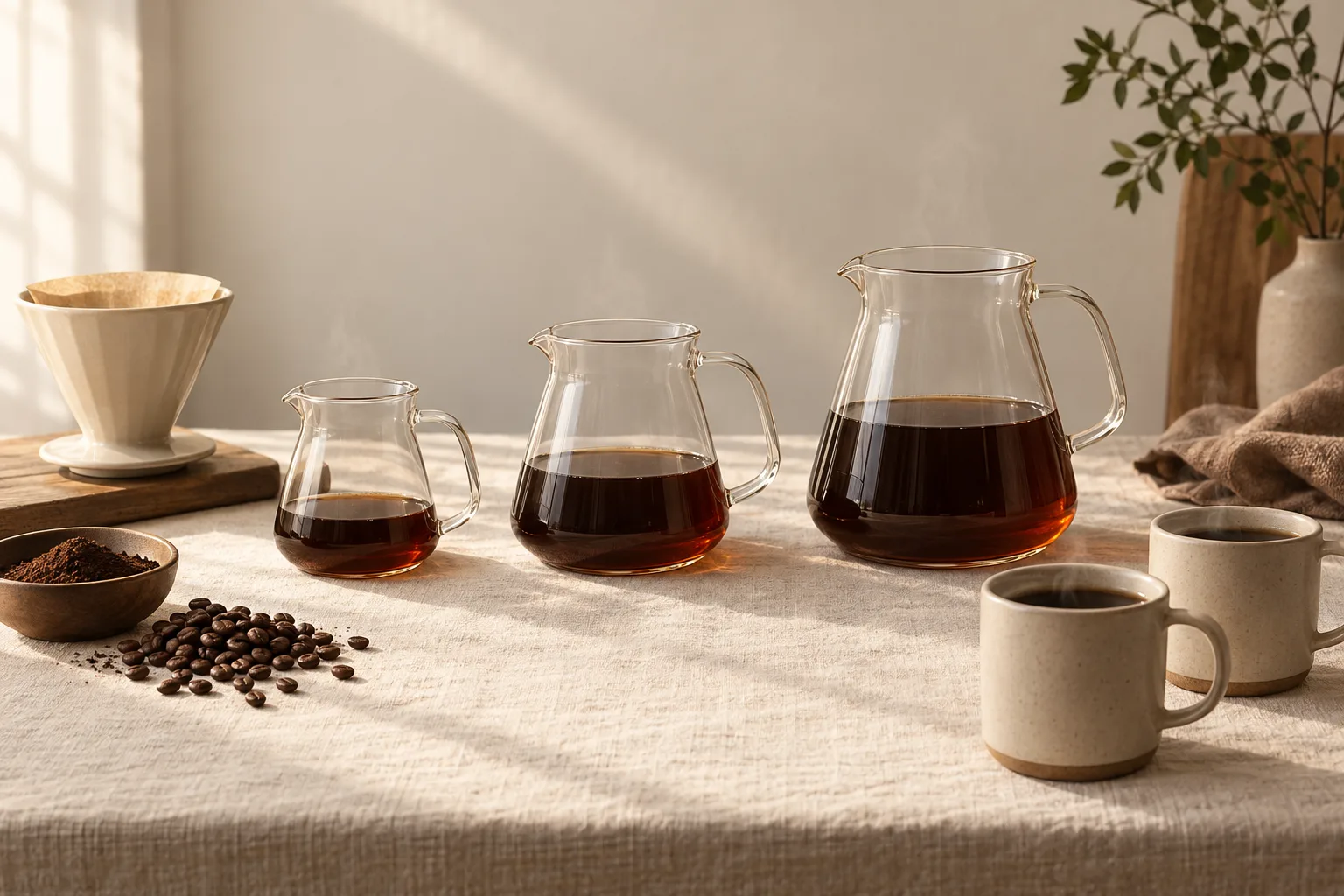
Choose a 600–700 ml pour over coffee server for most one- or two-person homes. Go smaller for solo brews, or up to 800–1,000 ml for bigger batches, always leaving room above the finished coffee.
- Integrated example
- Chemex Classic Series 6-Cup
- Official capacity
- 30 US fl oz; six Chemex cups of 5 oz each
- Material and weight
- Non-porous borosilicate glass; 1.35 pounds
- Filters
- Chemex Bonded Filters; not included
Capacity follows official CHEMEX “Classic Series Info and Support”; material, weight, and filter details appear in the Chemex Amazon listing.
Which server format and size suits your home?
A separate glass server suits a dripper you already own; an integrated brewer replaces both pieces. Choose 300–450 ml for small solo drinks, 600–700 ml for flexible everyday use, or 800–1,000 ml for larger batches. Those are shopping bands, not promises that every vessel holds that much comfortably during brewing.
| Product / format | Best for | Price band | Key spec | Verdict |
|---|---|---|---|---|
| Small separate server | One small brew | Varies | 300–450 ml band | Compact solo choice |
| Medium separate server | One or two drinkers | Varies | 600–700 ml band | Most flexible default |
| Large separate server | Bigger household batches | Varies | 800–1,000 ml band | Check dripper limits too |
| Chemex Classic Series 6-Cup | Integrated brewing and serving | $$ | 30 US fl oz official capacity | Different format, not an add-on receiver |
Separate glass server: keep your dripper
I'd choose this format if you already like your brewer. Hario USA’s V60 Coffee Server comes in 450, 700, and 1,000 ml variants; its V60 Range Server comes in 360, 600, and 800 ml variants. Similar names do not mean identical size ranges.
Integrated brewer: understand Chemex cups
Official CHEMEX “Classic Series Info and Support” defines the 3-cup as 15 oz and the 6-cup as 30 oz. Its cup is 5 oz, not your breakfast mug. The 6-cup works out to about 887 ml by US fluid-ounce conversion, so think of it as roughly three 250 ml servings plus some room, rather than six mugs.
Thermal server: choose for staggered drinking
Podium Coffee Club’s server guidance distinguishes glass for immediate serving from thermal vessels for keeping coffee hot longer. I'd consider thermal if you sip across the morning, but check that it accepts direct brewing. A narrow insulated jug may be useful for storage without being a suitable seat for your dripper.
A receiver is only one part of the setup. For the broader shortlist of kettles, scales, drippers, and other useful gear, see Best Pour Over Accessories (2026): 6 Worth Buying.
How do you choose capacity, headroom, and fit?
Add up your expected finished coffee, then choose a receiver with space left above it. After that, check the manufacturer’s dripper compatibility and your scale’s limits. A bigger capacity number alone cannot tell you whether the dripper sits securely or whether the whole setup fits your brewing spot.
Count drinks in milliliters
Fill your usual mug with cold water to your normal drinking level, then measure it. Two 250 ml drinks need 500 ml of finished coffee; two 350 ml mugs need 700 ml. That's enough difference to change which server you buy, even though both households say they brew “two cups.”
Podium Coffee Club recommends the 600–700 ml neighborhood for default home use. Rethink Cafe frames 300–400 ml as solo, 600–800 ml as versatile, and 1L+ as group territory. These are named editorial guides, not laboratory standards. Use your own serving volume to decide where you land.
Leave room to swirl and pour
Headroom means the empty space above your coffee. As an editorial shopping rule, I would put a 500 ml finished batch in a 600–700 ml receiver, not a 500 ml vessel. That leaves room for a gentle swirl and carrying it to the table without coffee lapping at the spout.
Check whether the listed capacity means a recommended working fill or a maximum. Don't assume there is hidden spare space above the number. For a 750 ml finished batch, I'd lean toward 1,000 ml rather than an 800 ml receiver, unless the maker clearly documents enough usable room.
Separate the water recipe from the yield
Finished yield means the coffee that actually reaches the server. Some brew water stays in the wet grounds, so a recipe using 500 g of water does not deliver a full 500 ml drink. Measure the collected coffee from your usual recipe rather than subtracting a guessed, fixed allowance.
To check yield by weight, weigh the empty server, brew, remove the dripper safely, and weigh the filled server. The difference is the beverage weight; treating grams as roughly milliliters is enough for this shopping decision. The Hario V60 Drip Scale has a 2,000 g maximum, so include the vessel, dripper, grounds, and water when checking its load.
Check the rim, scale, and kettle together
A Hario V60 Ceramic Dripper 02 is a separate dripper, not a promise that every 600 ml jug fits underneath. Check the stated pairing, stable contact at the rim, and clearance above the rising coffee. Avoid buying from capacity alone when the seller gives no useful compatibility information.
Your kettle must cover brew water, with a plan for rinsing the filter too. The Hario Buono’s listed 1.2-liter capacity comes with an approximately 800 ml best-fill recommendation; the Bonavita example holds 1 liter. Once receiver size is settled, Best Gooseneck Kettle for Pour Over (2026): 5 Smart Picks offers researched choices for controlling the pour.
Where should you spend your server budget?
Spend first on the right capacity and a documented fit, then decide whether insulation matters. A fancy receiver won't fix a recipe that produces too little coffee. These tiers describe spending priorities, not fixed market prices; compare current listings only after you know which format you need.
| Tier | Prioritize | Skip unless needed |
|---|---|---|
| Basic / $ | Correct working volume and secure dripper fit | Decorative finishes |
| Flexible / $$ | Useful lid, comfortable handle, easy cleaning | Extra capacity for rare guests |
| Specialist / $$$ | Insulation when coffee waits between servings | Thermal storage for immediate drinking |
Which shopping pitfalls are easy to miss?
Don't buy a bigger receiver to solve a dripper problem. Receiver space, filter capacity, and room for the wet grounds are separate limits. Before buying for guests, decide whether your existing brewer can handle the larger recipe or whether two normal batches would be the simpler choice.
- Buying for an imaginary crowd. If guests visit twice a year, two brews may make more sense than storing a huge server every day.
- Forgetting the cleaning opening. Check the maker’s cleaning instructions and whether your brush can reach inside before choosing a narrow-neck vessel.
- Ignoring the lid during brewing. Check whether it stays on with your dripper or needs to come off. Serving fit and brewing fit are different questions.
Should you keep a separate server or change brewers?
Keep a separate server if you like your current dripper and only need a better receiver. Choose an integrated brewer if you want to replace both pieces. After working out capacity, Best Pour Over Coffee Maker (2026): 6 Top Picks gives you specific brewer options rather than just size bands.
If the integrated format appeals, check the Chemex’s filter requirements as well as its volume. Buying a new brewer means committing to its brewing routine and consumables, not merely gaining a larger jug.
Frequently asked questions
What size pour over coffee server is best for two people?
Choose 600–700 ml for two modest servings, or 800–1,000 ml for two large mugs. Add up the coffee you actually drink, not the volume printed on your mugs. A 600 ml finished batch needs a receiver larger than 600 ml so you have headroom.
Which Hario coffee server size should I choose?
For Hario coffee server size, start with the 600 ml Range Server or 700 ml Coffee Server for everyday flexibility. Hario USA lists Range Server capacities of 360, 600, and 800 ml, and Coffee Server capacities of 450, 700, and 1,000 ml. Check dripper compatibility separately.
Is a 450 ml server enough for one mug?
A 450 ml server is a sensible choice for a finished drink of roughly 250–350 ml. It gives a solo brew some breathing room without a large vessel. If you want a full 450 ml drink, move up a size rather than filling the receiver to its limit.
How much coffee does a 6-cup Chemex hold?
The Chemex Classic Series 6-Cup has an official capacity of 30 US fl oz, about 887 ml. Chemex defines one cup as 5 oz, so six cups does not mean six large mugs. Work out your servings in milliliters before choosing between the 3-cup and 6-cup models.
Should I size my server by brew water or finished coffee?
Size the server by finished coffee plus headroom. Water poured into the dripper is not the same as coffee collected, because wet grounds retain water. If you do not know your finished yield yet, choosing a receiver larger than your recipe’s total brew water is a cautious starting point.