 Coffee Gear Picks
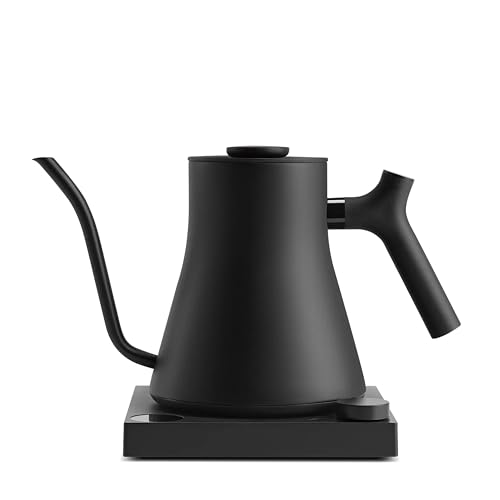
Fellow Stagg EKG Pro Review (2026): Worth the Upgrade?
The Fellow Stagg EKG Pro is worth buying if you brew pour-over daily and want a calmer, more repeatable routine. It is a control-and-convenience upgrade, not a requirement for good coffee.
- Price band
- $$$
- Weight
- 4.25 lb
- Material
- Stainless steel
- Capacity
- 0.9 liter
- Wattage
- Key feature
- Precision gooseneck with to-the-degree temperature control, color LCD, temperature hold, and brew timer
- Sources
- Amazon product listing and Fellow's official Stagg EKG Pro page
Verdict: Fellow Stagg EKG Pro is our top premium pick for daily pour-over: controlled flow and repeatable settings with welcome morning conveniences. Price band: $$$.
Best for: One or two people brewing pour-over or tea who want exact temperature settings and a polished daily routine.
Our rating: 4.4/5
Pros
- ✓ Precision gooseneck gives you control over where and how quickly you pour.
- ✓ To-the-degree temperature selection makes recipes easier to repeat.
- ✓ Color LCD puts settings and brew information in view.
- ✓ Scheduling, Guide Mode, hold mode, and a stopwatch add useful convenience.
Cons
- ✗ Premium price band buys convenience, not automatic coffee brewing.
- ✗ The 0.9 L capacity leaves limited room for large batches and rinsing.
- ✗ Manual pouring still takes attention and practice.
- ✗ Casual brewers may leave many Pro features unused.
Verdict in detail
Buy the Pro when making coffee is a daily ritual you want to refine, rather than a chore you want to remove. The most appealing upgrade is fewer small decisions before breakfast: choose a familiar setting and get on with brewing. For the broader setup, Best Pour Over Accessories (2026): 6 Worth Buying puts the Stagg alongside drippers, scales, and other essentials.
Skip it if your upgrade budget is tight or your current kettle already pours well and reaches your preferred temperature. Our Best Coffee Grinder for Pour Over (2026) guide is a better next stop if your grinder is the weak link. What stands out in this Fellow EKG Pro review is how much of the premium goes toward the routine around brewing, rather than replacing your brewing skills. That is a sensible luxury for an enthusiast, but a poor reason to stretch a starter budget.
Specifications
| Brand | Fellow |
|---|---|
| Capacity | 0.9 liter |
| Wattage | |
| Material | Stainless steel |
| Listed weight | 4.25 lb |
| Listed dimensions | |
| Temperature selection | To-the-degree temperature control |
| Core features | |
| Additional Pro features | Scheduling and Guide Mode |
| Price band | $$$ |
Performance and daily workflow
The Pro's strongest case is deliberate, repeatable brewing: you choose the water temperature, steer the stream, and track the brew. Fellow supplies the controls; you supply the recipe. This analysis focuses on what those features let you do, not a measured heating-time or temperature-accuracy claim.
Pour precision: steer the stream, not a waterfall
The narrow gooseneck is the feature that matters every time you lift the kettle. Bon Appétit's Stagg EKG Pro review emphasizes the precision spout and balanced handle as pour-over tools. Think of the goal as drawing a small circle with water, rather than dumping a jug onto the grounds. That is the kind of control a broad household kettle does not prioritize.
You still decide where the stream lands, how high you hold the kettle, and when to pause. Start with a manageable fill and practice keeping the stream narrow while watching your scale. If your recipe calls for several small pours, that deliberate pace makes sense. If you mainly want to fill a saucepan quickly, the same design is less appealing. A coffee-focused spout is a specialist tool, not the best answer to every hot-water job.
Temperature control: repeat a setting without guessing
Fellow's to-the-degree control lets you return to a chosen setting without timing a cooling period after boiling. The practical benefit is a clear starting point: if a recipe specifies a temperature, you can select it. You do not need to hover over a stovetop kettle with a thermometer. For someone who changes coffee or switches between coffee and tea, that is a useful reduction in fuss.
Do not mistake a selectable degree for proof that every drop reaches the grounds at that exact temperature. Water leaves the kettle and meets a cooler brewer; the displayed setting does not describe the whole journey. Keep your preparation routine the same when comparing recipes. That way, changing the setting is a deliberate choice, not one change hidden among five others. We would buy this feature for repeatable choices, not a promise of a magically sweeter cup.
Heating: useful power, no invented speed contest
The listed heater power tells you this is a powered countertop kettle, but it does not establish a fixed wait. Reviewed's EKG Pro review covers heating and setup as part of everyday use. We are not assigning a boil time here because fill level, starting water temperature, and target setting change what that number means.
For a sensible morning routine, start heating before you weigh and grind the coffee. Those jobs have to happen anyway, so you are not staring at a display through the whole wait. Heat the amount your recipe needs, allowing for the rinse, rather than filling to the maximum out of habit. If speed is your main buying reason, seek a directly comparable heating measurement. The Pro's feature list alone cannot tell you it beats another kettle to breakfast.
Hold mode: a buffer when breakfast interrupts
Fellow's hold feature keeps the selected temperature available while the kettle sits on its base. That is handy when the toast pops just as the water is ready, or when you prepare a second cup after the first. A simpler boil-and-stop routine asks you to judge whether the water has cooled enough to need reheating. Hold mode removes that particular decision.
It is not a thermos. Once the kettle is away from the powered base, it is not actively heating. Put it back between brews if you want the hold function to do its job, and check the setting before serving someone else. Choose a hold duration that fits your routine rather than leaving hot water ready all morning by default. The value here is a forgiving window for brewing, not permission to forget about an appliance indefinitely.
Color LCD: helpful information with some menu overhead
The color LCD is one of the clearest reasons to choose the Pro over a simpler model. Fellow uses it to show information and expose additional settings, while Reviewed discusses the interface alongside the everyday controls. If you enjoy saving a preferred routine, a visible menu is attractive. If you want a single switch, extra choices can feel like homework.
Our advice is to set the essentials first and leave the rest alone until you have a reason to change them. Pick your temperature and hold preference, then learn the timer. Do not spend the first week adjusting every option just because it exists. The display should help you make coffee, not become another screen to manage before work. A nice interface earns its place when it makes your usual task clearer; a rarely opened menu does not add much value.
Scheduling: ready water still needs preparation
Scheduling is for people whose morning begins at a predictable time. Fellow lists it among the Pro features, and Food & Wine's EKG-family review distinguishes the Pro's added workflow features. The appeal is straightforward: arrange the heating routine in advance rather than remembering to start it after walking into the kitchen.
That convenience depends on you preparing the kettle correctly, with water in it and the vessel on its base. Scheduling does not fill the kettle, grind beans, or wet a filter. Check the manufacturer's setup instructions before relying on a scheduled start. If your wake-up time changes every day, this may become an unused feature rather than a meaningful upgrade. For a fixed weekday routine, though, it is easier to justify than a feature you only open to show a friend.
Guide Mode and tea: suggestions, not taste guarantees
Guide Mode gives you temperature guidance, according to Fellow's product page. That is helpful when you want a starting point without looking up a setting on your phone. It also makes sense in a kitchen where one person brews coffee and another makes tea. A preset or suggestion saves a lookup, but it cannot know your preferred strength or the exact leaves in your cupboard.
Use the tea packet or coffee recipe as your first reference, then choose settings that suit your taste. The kettle heats water; it does not measure leaves or decide when to remove them. Likewise, guidance cannot fix an uneven grind or an unsuitable coffee-to-water ratio. We like Guide Mode as a friendly nudge for unfamiliar drinks. It is less compelling if you already have a favorite recipe and never stray from it, which is another reason not to buy on feature count alone.
Brew stopwatch: timing without replacing a scale
The built-in stopwatch puts brew timing within reach, but it does not measure the water you pour. That distinction matters more than the extra convenience. A kettle handles heat and flow; a scale tells you how much coffee and water you are using. Our Best Coffee Scale for Espresso and Pour Over (2026) guide covers that separate job.
Start the stopwatch at the point your recipe uses, often the first contact between water and grounds. Then follow the same timing convention each morning. If your scale already includes a timer, choose whichever display is easier to watch rather than running both just because you can. You want a quick glance at weight and time, not a cockpit full of competing numbers. The Pro's timer is useful, but buying this kettle does not let you remove a scale from a repeatable brewing setup.
Capacity: budget water for the rinse too
The small capacity is fine for a focused one- or two-person routine, but count all the water you need before choosing it. A hypothetical recipe using 500 g of brewing water plus 150 g for rinsing fits within the listed capacity. A recipe using 800 g plus that same rinse does not. Those are planning examples, not recommended recipes or measured yield figures.
This matters with a larger brewer such as the Chemex Classic Series, 6-Cup. Its cup label does not mean the kettle can cover every batch and preparation step in one fill. Check your actual recipe rather than matching cup counts on boxes. Do not overfill to make a large batch fit, and remember that a refill interrupts the routine. For guests, several mugs of tea, or a household that shares hot water all morning, capacity may be a stronger buying factor than scheduling or a prettier display.
Alternatives worth considering
The Bonavita 1L Variable Temperature Kettle is the more practical electric alternative if temperature selection and a controlled pour are your priorities. Its listed hold feature covers an important part of the Pro's everyday appeal without the premium interface focus. Choose it when you want to follow a recipe, not spend extra for a richer menu. Check Bonavita Price
The Hario V60 Buono Stovetop Kettle wins if you like a simple stovetop routine and mainly need a narrow spout. It does not give you electric scheduling or automatic temperature selection, so you keep more of the heat-management job. That is a fair trade if it suits how you already brew. For value electric and stovetop options side by side, see Best Gooseneck Kettle for Pour Over (2026): 5 Smart Picks. Check Hario Price
The Hario V60 Drip Scale is a different kind of alternative: an upgrade to buy first if you still pour by eye. Its weight display and timer address recipe repeatability rather than water heating. It is not a substitute kettle. Before acting on a Stagg EKG Pro kettle review, ask which problem actually spoils your routine: guessing the water amount, wrestling with the stream, or waiting on temperature. Spend on the tool that solves that problem.
Frequently asked questions
Is the Fellow Stagg EKG Pro worth it?
Yes, for daily pour-over brewers who will use its temperature control, hold mode, and scheduling. Our editorial score is 4.4/5. If you brew occasionally or mainly want an affordable controlled pour, a simpler electric or stovetop gooseneck is a better buy.
What is the difference between the Fellow Stagg EKG and EKG Pro?
Both focus on controlled gooseneck pouring and adjustable temperature. Fellow lists a color LCD, scheduling, Guide Mode, and more customizable settings among the Pro upgrades. Choose the Pro for those workflow extras, not because the standard EKG cannot make excellent pour-over coffee.
How much water does the Fellow Stagg EKG Pro hold?
The Fellow Stagg EKG Pro holds 0.9 L of water. That suits many one- or two-person pour-over recipes, but remember to include water for rinsing the filter and warming the brewer. Larger shared batches can require a refill; do not fill beyond the marked maximum.
Does the Fellow Stagg EKG Pro keep water hot?
Yes. Fellow includes a temperature-hold function that maintains your selected setting while the kettle is on its base and hold mode is active. It is useful between pours or cups. Water still cools when you lift the kettle, so hold mode is not the same as insulation.
Is the Fellow Stagg EKG Pro good for pour-over coffee?
Yes. Its precision gooseneck and adjustable temperature suit a slow, deliberate pour-over routine. Bon Appétit frames it as a control tool rather than an automatic brewer. You still need to weigh the coffee and water, choose a suitable grind, and follow your pouring recipe.