 Coffee Gear Picks
Best Espresso Machine Semi Automatic Picks 2026
The best espresso machine semi automatic pick for most homes is the Breville Bambino Plus—it’s compact, heats up fast, and makes milk drinks far less finicky thanks to its automatic steam wand.
Top pick: Breville Bambino Plus — it gives most home users the best mix of compact size, fast heat-up, automatic milk texturing, and forgiving espresso workflow.
- Price band: $$
- Weight: 11 lb
- Materials: Stainless steel exterior finish
- Key feature: ThermoJet heat-up with automatic milk steam wand
Best Semi-Automatic Espresso Machines for Home
Seven picks ranked by learning curve, grinder needs, milk workflow, and counter space
Overall
Fast, compact, and forgiving for weekday shots
- ThermoJet heat-up
- Automatic milk wand
- Compact body
- Beginner-friendly workflow
Top Pick Breville Bambino Plus
$$
Best fit for most homes
Check Price on Amazon Budget
Small counter, lower spend, real espresso habits
- Very narrow footprint
- Fast heat-up
- Manual milk learning
- Good starter machine
Top Pick Breville Bambino
$
Compact value pick
Check Price on Amazon With grinder
One big box instead of a machine-plus-grinder puzzle
- Built-in burr grinder
- Assisted tamping
- Smart dosing
- Less counter clutter
Top Pick Breville Barista Express Impress
$$
Best all-in-one setup
Check Price on Amazon Dual boiler
For people making cappuccinos back to back
- Dual boilers
- PID controls
- Shot timer
- Steam while brewing
Top Pick Rancilio Silvia Pro X
$$$
Serious home upgrade
Check Price on AmazonQuick answer: Choose the Breville Bambino Plus for the best balance of speed, size, and milk-drink convenience. Go with the Breville Bambino to spend less, the Breville Barista Express Impress if you want a semi automatic espresso machine with grinder, the Gaggia Classic E24 if you want a 58mm tinkerer platform, or the Rancilio Silvia Pro X for frequent back-to-back cappuccinos.
Quick picks
Our Top Picks

Which semi-automatic espresso machine should you compare first?
Start with the Bambino Plus as your baseline. It’s the clearest example of the modern “easy real espresso” category: fast heat-up, a small footprint, and a milk workflow that doesn’t punish beginners. From there, only move cheaper, more manual, or more expensive if your routine clearly benefits.
| Product | Best for | Price band | Key spec | Verdict |
|---|---|---|---|---|
| Breville Bambino Plus | Most home espresso buyers | $$ | ThermoJet reaches extraction temperature in 3 seconds | The easiest machine to recommend for most kitchens. |
| Breville Bambino | Compact counters and lower budgets | $ | Compact footprint with PID and fast heat-up | Almost the same speedy core, with less milk automation. |
| Breville Barista Express Impress | Buyers who want an all-in-one setup | $$ | Integrated conical burr grinder with 25 settings | Best if you want fewer separate buying decisions. |
| Gaggia E24 (RI9380/46) | Hands-on espresso learners and modders | $$ | 58mm commercial stainless steel | Great for learners who want a 58mm path and upgrades. |
| Rancilio Silvia | Durable single-boiler home setups | $$$ | 12-ounce brass boiler | A sturdy single-boiler step up for patient users. |
| Rancilio Silvia Pro X | Serious home baristas and milk drinks | $$$ | Semi-automatic workflow | The serious pick for back-to-back milk drinks. |
| De'Longhi Dedica Maestro | Narrow counters and casual espresso drinks | $$ | Three infusion temperatures with Active Temperature Control | Slim, stylish, and better for casual espresso routines. |
What matters most when choosing a semi-automatic espresso machine?
Prioritize what changes your day-to-day results: heat-up time, temperature approach (thermoblock vs boiler), how sensitive the workflow is to grinder quality, milk-steaming convenience, counter footprint, and whether the portafilter size gives you an easy accessory path.
“15-bar/20-bar” pump numbers are not a useful way to rank home machines. Espresso is typically brewed around ~9 bars at the puck, and guides like Clive Coffee’s espresso walkthrough focus on grind, dose, yield, and time, because those are what drive taste. In other words: a stable routine beats a loud pressure sticker.
Which semi-automatic espresso machine is best for your kitchen?
Think of these machines as different “levels of responsibility.” Breville models reduce friction (especially for milk drinks). Gaggia and Rancilio reward hands-on learning and 58mm accessories. De’Longhi is the space-saver for casual routines. The right pick is the one you’ll happily use on a Tuesday.
1) Breville Bambino Plus — Best Overall
Buy the Bambino Plus if you want real espresso habits without turning it into a second job. The quick-heating design makes it realistic to pull a shot on a busy morning, and the automatic steam wand removes the most common beginner pain point: inconsistent milk texture.
The main tradeoff is ecosystem. Breville’s 54mm format is convenient and compact, but it’s not as universal as the 58mm world used by Gaggia and Rancilio. If you want a simple, repeatable cappuccino routine, though, this is the easiest recommendation in the lineup.
Pros
- ✓ Very fast heat-up for weekday use
- ✓ Automatic milk wand lowers beginner frustration
- ✓ Compact body fits small counters
Cons
- ✗ 54mm accessories are less universal than 58mm gear
- ✗ Not ideal for heavy back-to-back entertaining
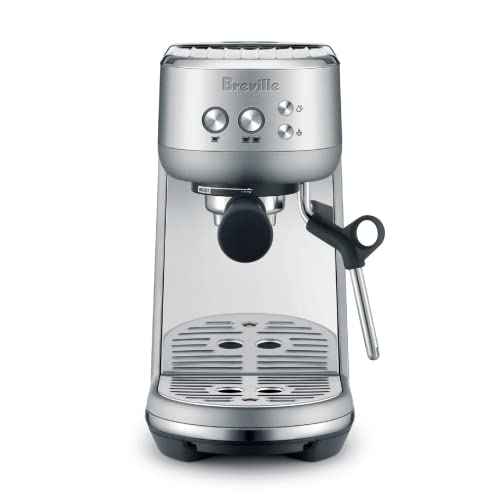
2) Breville Bambino — Best Budget
Buy the regular Bambino if you want Breville’s fast warm-up and compact footprint, but you’re fine steaming milk manually (or you mostly drink straight espresso and Americanos). It’s also a smart choice if you’d rather put the savings into a better grinder.
The catch is that milk drinks will ask more of you: pitcher position, timing, and stopping before you overheat. If you’re building your first setup, start with our best burr grinder for espresso guide, because grinder consistency matters more than small machine feature differences.
Pros
- ✓ Narrow footprint is easy to leave on the counter
- ✓ Fast heat-up keeps mornings moving
- ✓ Leaves more budget for a grinder
Cons
- ✗ Manual milk takes practice
- ✗ Small drip tray can feel cramped during cleanup
3) Breville Barista Express Impress — Best With Grinder
Buy the Barista Express Impress if you want the shortest path from “no gear” to “making espresso daily.” The integrated grinder plus assisted dosing/tamping reduces puck-prep mistakes that commonly lead to channeling and harsh, uneven shots.
The compromise is modularity. If you later want a higher-end grinder, you’ll be paying for a grinder you no longer need. But if an all-in-one station is what keeps your routine consistent (and your counter uncluttered), this is the most sensible single-box option here.
Pros
- ✓ Built-in grinder cuts clutter and decision fatigue
- ✓ Assisted tamping helps beginners prep more evenly
- ✓ Good fit for households starting from zero gear
Cons
- ✗ Separate grinders offer more upgrade flexibility
- ✗ Bigger footprint than Bambino-style machines
4) Gaggia E24 (RI9380/46) — Best for Tinkerers
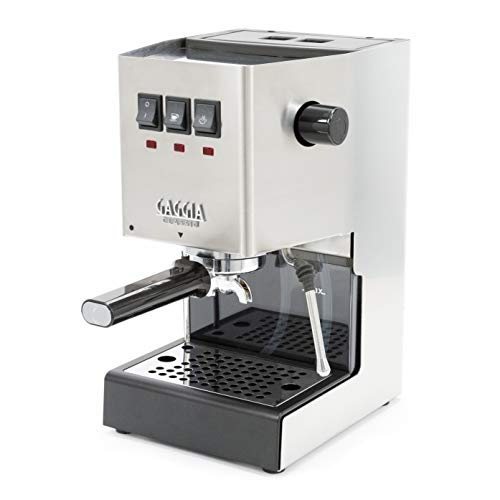
Buy the Gaggia Classic E24 if you want to learn espresso in a more traditional 58mm ecosystem. It’s a great fit for hands-on users who enjoy dialing in, swapping baskets, and building a setup over time rather than leaning on automation.
Expect a steeper learning curve than the Breville machines, especially for milk drinks, since single-boiler routines require waiting and timing. The Gaggia Classic platform is also well-known for its mod/upgrade community; Whole Latte Love’s Gaggia Classic coverage gives a good overview of why so many people stick with it.
Pros
- ✓ 58mm portafilter works with many accessories
- ✓ Great for manual espresso learners
- ✓ Strong enthusiast upgrade path
Cons
- ✗ More technique-sensitive than Breville picks
- ✗ Single-boiler workflow slows milk drinks
5) Rancilio Silvia — Best Classic Upgrade

Buy the Rancilio Silvia if you want a durable, classic single-boiler machine and you’re comfortable with a slower, more manual cadence. It’s best for people who already have (or plan to buy) a capable espresso grinder and mostly drink straight shots.
The limitation is milk-drink throughput. You brew first, then switch modes and wait to steam—fine for one cappuccino, annoying for three. If your household is latte-heavy, it’s usually smarter to jump to a dual-boiler machine rather than fight the waiting game.
Pros
- ✓ Durable, simple single-boiler design
- ✓ Good match for espresso-focused users
- ✓ Classic 58mm workflow and accessories
Cons
- ✗ Slow for multiple milk drinks
- ✗ Less beginner-friendly than Breville machines
6) Rancilio Silvia Pro X — Best Dual Boiler

Buy the Silvia Pro X if you regularly make milk drinks and you’re tired of single-boiler compromises. Dual boilers let you brew and steam at the same time, and PID control helps you hold steadier temperatures while you dial in better beans.
It’s not a “first espresso machine” for most people. You’ll still need a serious grinder, a scale, and the willingness to keep up with cleaning. But if your kitchen is effectively making café-style drinks every day, this is the clearest performance upgrade on the list.
Pros
- ✓ Dual boilers suit back-to-back milk drinks
- ✓ PID controls support more repeatable brewing
- ✓ Shot timer and preinfusion help serious dial-in work
Cons
- ✗ Expensive once you add grinder and tools
- ✗ Too much machine for casual weekend use
7) De'Longhi Dedica Maestro — Best Slim Pick

Buy the Dedica Maestro if your counter is narrow and your espresso goals are casual. The slim body makes it easy to keep out full-time, which matters more than people admit—espresso machines that live in cabinets don’t make many coffees.
Just keep expectations realistic: the compact build means a tighter workspace and less of a long-term “upgrade path” than a 58mm machine. For Americanos, occasional lattes, and learning the basics without sacrificing width, it’s a practical space-first pick.
Pros
- ✓ Slim body fits kitchens that cannot spare much width
- ✓ Quick-heating thermoblock supports fast drinks
- ✓ Good casual alternative to larger machines
Cons
- ✗ Cramped workflow around cup and tray area
- ✗ Lower upgrade ceiling than Gaggia or Rancilio
Frequently asked questions
What is the best semi-automatic espresso machine for beginners?
The Breville Bambino Plus is the best beginner pick for most people. It heats quickly, has a compact body, and its automatic steam wand removes one of the trickiest early skills: getting consistently silky milk without over-aerating it.
Is Breville Bambino Plus better than Gaggia Classic?
The Bambino Plus is better for convenience; the Gaggia Classic E24 is better for skill-building and accessories. Choose Breville if you want fast heat-up and automatic milk. Choose Gaggia if you want a 58mm portafilter ecosystem and more room to tinker.
Do semi-automatic espresso machines need a grinder?
Yes, unless you plan to use pressurized baskets or pre-ground coffee and accept a lower ceiling. Fresh, espresso-fine grounds are what let these machines pull syrupy shots instead of thin, fast, sour ones.
Is a semi-automatic espresso machine with a built-in grinder worth it?
It is worth it if you want less clutter and fewer setup decisions. A separate grinder usually upgrades better later, but an all-in-one machine like the Breville Barista Express Impress makes sense if simplicity keeps you brewing every morning.
What is the difference between semi-automatic and automatic espresso machines?
A semi-automatic machine lets you start and stop the shot, so you control dose, grind, tamp, and yield. An automatic machine controls more of the timing or volume for you. Semi-automatic gives more control, but it asks for more attention.
How much should I spend on a semi-automatic espresso machine?
Most home buyers should plan for $400 to $800 for the machine, then budget for a grinder, scale, cleaning supplies, and fresh beans. Dual-boiler setups cost much more, and they mainly pay off if you make lots of milk drinks.
Which related espresso guides should you read next?
If your shots taste inconsistent, the fix is usually prep, not a new machine. These guides help you upgrade the parts of the workflow that actually change taste.
- Best Burr Grinder for Espresso — the grinder matters as much as the machine.
- Burr Grinder Settings for Espresso — dial in without wasting half a bag.
- Best Coffee Scale for Espresso and Pour Over — make dose and yield repeatable.
- Best Espresso Machine Under $200 — what you give up (and what you don’t) at lower budgets.