 Coffee Gear Picks
Best Espresso Machine Under $600 (2026): 7 Smart Picks
The best espresso machine under 600 for most people is the Breville Bambino Plus because it combines fast heat-up, PID temperature control, low-pressure pre-infusion, automatic milk texturing, and a compact footprint without forcing you into a built-in grinder.
Best Espresso Machines Under $600
7 picks compared by grinder setup, milk workflow, counter space, and learning curve
Overall
Fast, compact, and friendly before coffee kicks in
- 3-second heat-up
- PID control
- Auto milk texture
- Compact body
Top Pick Breville Bambino Plus
$$
Best balance for most buyers
Check Price on Amazon With Grinder
One box for beans-to-shot mornings
- Built-in burr grinder
- PID control
- Manual steam wand
- All-in-one setup
Top Pick Breville Barista Express
$$
Best if you own no grinder
Check Price on Amazon Technique
For people who want to learn the craft
- 58mm portafilter
- 9-bar extraction
- Steel housing
- Manual steam wand
Top Pick Gaggia Classic Evo Pro
$$
Best traditional learning platform
Check Price on Amazon Milk Drinks
Slim latte help for tight counters
- Auto steam wand
- 3 foam settings
- 54 oz tank
- Narrow footprint
Top Pick De'Longhi Dedica Maestro Plus
$$
Best compact latte machine
Check Price on AmazonWhat is the best espresso machine under $600?
The Breville Bambino Plus is the best espresso machine under $600 for most buyers. Buy the Barista Express if you need a built-in grinder, the Gaggia Classic Evo Pro, Thunder Black if you want to learn real technique, or the De'Longhi Dedica Maestro Plus if compact milk drinks matter most.
Serious Eats has also highlighted the Bambino Plus in broader espresso-machine coverage, while NBC Select covers several affordable Breville and De'Longhi-style options. This guide stays tighter: keep it under $600 and choose based on your grinder situation first.
Quick picks
Our Top Picks


Which espresso machines under $600 are worth comparing?
The seven machines below are the under-$600 models worth putting side by side. The big split is simple: Bambino-style machines leave grinder choice open, Barista Express and La Specialista add a grinder, and Gaggia or KitchenAid give you a more traditional 58mm-style workflow.
| Product | Best for | Price band | Key spec | Verdict |
|---|---|---|---|---|
| Breville Bambino Plus | Most buyers | $$ | 3-second ThermoJet, PID, auto milk | Best balance of ease and espresso potential |
| Breville Barista Express | Built-in grinder | $$ | Integrated conical burr grinder | Convenient all-in-one starter setup |
| Gaggia Classic Evo Pro | Learning technique | $$ | 58mm commercial portafilter, 9-bar extraction | Best traditional machine for tinkerers |
| De’Longhi La Specialista Arte Evo | Grinder combo with cold brew | $$ | Built-in burr grinder, 8 settings | Best if you want guided prep and more drinks |
| De'Longhi Dedica Maestro Plus | Compact milk drinks | $$ | Auto steam wand, 54 oz tank | Best slim machine for latte drinkers |
| Breville Bambino | Compact value | $ | 47 oz tank, PID, ThermoJet | Best lower-cost Breville option |
| KitchenAid KES6403 | Narrow countertops | $$ | 58mm portafilter, 15-bar pump | Best narrow countertop alternative |
How did we choose espresso machines under $600?
Selection here comes from manufacturer specifications, current Amazon listings, specialist editorial coverage, and buyer-fit factors. The most important pieces were temperature control, pre-infusion, portafilter style, milk workflow, grinder setup, counter footprint, water tank size, upgrade path, and how much patience each machine asks from a new owner.
PID means the machine works to hold water temperature steady, so shots taste less random. Low-pressure pre-infusion gently wets the coffee before full pressure, like letting a dry sponge soften before squeezing it. For grinder reality checks, Home-Barista's grinder forum is a useful reminder that the grinder often decides whether espresso tastes syrupy or thin.
Which espresso machine under $600 is best for most people?
The Breville Bambino Plus is the safest first recommendation for most homes. It gives you fast heat-up, PID temperature control, low-pressure pre-infusion, and automatic milk texturing in a small body, so weekday espresso feels less like a science project before breakfast.
The big win is what it does not include: a built-in grinder. That means you can pair it with the grinder you actually want, upgrade later, and keep the machine itself compact. Breville’s included-accessories list typically covers essentials like a milk jug, tamper, and filter baskets, so you can start pulling shots without buying a drawer full of extras.
The downside is feel. If your dream is a heavier, old-school machine with a commercial-style portafilter and lots of manual control, the Bambino Plus can feel a bit appliance-like. For most people, though, that’s the point: it gets hot fast, makes milk easy, and takes up less space than many toaster ovens.
Pros
- ✓ Fast ThermoJet heat-up for quick mornings
- ✓ Automatic milk texturing helps latte drinkers
- ✓ Leaves budget and space for a dedicated grinder
Cons
- ✗ Less traditional feel than the Gaggia
- ✗ Small body can feel light when locking in the portafilter
Which espresso machine under $600 is best if you need a built-in grinder?
The Breville Barista Express is the best choice if you want one purchase, one plug, and one workflow. The built-in conical burr grinder plus PID control and pre-infusion make it a legitimate starter platform, not just a convenience gadget.
It’s also a commitment in both size and routine. At roughly 22 lb and about 16 inches tall (per typical listing specs), it wants a permanent spot on the counter. In return, you get a tidy “bean hopper → grind → dose → brew → steam” flow that’s easier to stick with than a scattered setup.
The tradeoff is upgrade flexibility. If the grinder starts feeling limiting, you can’t swap it out the way you can with a separate grinder setup. Dial-in can also feel fiddly because espresso adjustments are tiny. Still, if you want the best espresso machine under 600 with grinder, this is the cleanest mainstream answer.
Pros
- ✓ Built-in burr grinder solves the no-grinder problem
- ✓ PID and pre-infusion give a strong starter platform
- ✓ Manual steam wand leaves room to learn milk texture
Cons
- ✗ Separate grinders are easier to upgrade
- ✗ Dialing in can be fiddly for new users
Which espresso machine under $600 is best for learning real espresso technique?
The Gaggia Classic Evo Pro, Thunder Black is the best pick if you want espresso to feel manual, traditional, and a little stubborn (in a good way). A 58mm portafilter and a commercial-style steam wand make it a real “learn the craft” machine, not a shortcut.
This is for people who want to understand why grind, dose, tamp, and timing matter. The larger reservoir helps if you’re making a couple drinks back to back, and the 58mm ecosystem is the one most espresso tutorials and accessory makers assume. Coffeeness has long treated Gaggia-style machines as strong value picks for skill growth.
Skip it if you want your machine to do the thinking. Compared with the Bambino Plus, the Gaggia asks more from you and gives less automation back. Bad prep tastes bad; good prep tastes rich, thick, and earned.
Pros
- ✓ 58mm commercial-style workflow for skill building
- ✓ Three-way solenoid valve helps with cleaner puck knockouts
- ✓ Strong upgrade path for hobbyists
Cons
- ✗ Less forgiving than Breville automatic workflows
- ✗ Milk steaming takes more practice
Which espresso machine under $600 is best for grinder-assisted drink variety?
The De\'Longhi La Specialista Arte Evo is best if your household wants espresso plus grinder help and a few extra drink options without building a separate gear shelf. It’s the “guided combo” alternative to the Barista Express, with cold-extraction features called out in its product marketing.

The included accessories (like a dosing funnel and tamping mat on many bundles) make the workflow feel more coached than bare-bones machines. That matters if two people in the house want different drinks and neither wants espresso tools scattered everywhere.
The catch is size and flexibility. It’s larger than a Bambino-style setup, and the built-in grinder is still tied to the machine. If you mainly drink straight espresso and love upgrading parts, go separate. If you want a guided combo machine with more drink variety, this is the more playful pick.
Pros
- ✓ Built-in grinder keeps the setup in one footprint
- ✓ Extra drink options beyond straight espresso
- ✓ Helpful included prep accessories (bundle-dependent)
Cons
- ✗ Larger footprint than compact machines
- ✗ Less flexible than a separate grinder setup
Which espresso machine under $600 is best for compact lattes?
The De\'Longhi Dedica Maestro Plus is the best compact latte machine in this price range if you want milk drinks with minimal fuss. The automatic steam wand and foam settings are the entire point: it’s designed to make “decent espresso + consistent milk” repeatable in a small kitchen.

This is a smart buy if your morning goal is a cappuccino with soft foam, not a deep dive into pressure charts. Auto steaming helps you get milk that’s closer to glossy “wet paint” than bubble bath, without babysitting the pitcher every second.
It’s less espresso-nerdy than the Gaggia and less espresso-first than the Bambino Plus. That’s fine. For tight counters and milk-heavy routines, convenience matters. Just budget for a capable grinder if you want shots that can stand up under all that milk.
Pros
- ✓ Automatic steam wand with foam control
- ✓ Slim body fits small kitchens
- ✓ Large removable tank for the size
Cons
- ✗ Less traditional espresso workflow
- ✗ Not as enthusiast-focused as Bambino Plus or Gaggia
Which espresso machine under $600 is best for compact value?
The Breville Bambino is the best compact value pick if you like the Bambino Plus idea but want to spend less. You still get the fast ThermoJet-style heat-up and PID temperature control, but you give up some convenience polish, especially around milk.
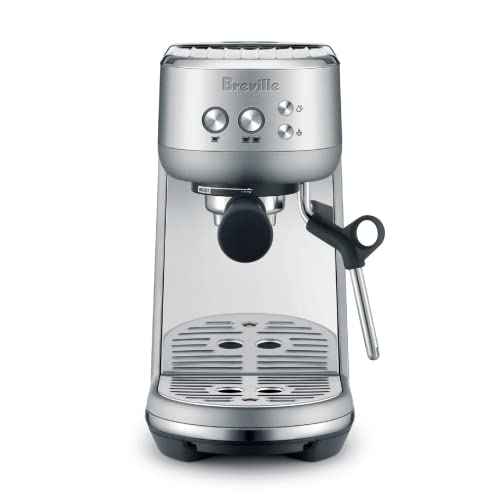
Think of it as the leaner sibling. If you mostly drink straight espresso, or you already have a milk-frothing routine you like, the savings can be better spent on beans and a stronger grinder.
It’s also light enough to tuck into a small kitchen without feeling like a permanent countertop monument. Pair it with a proper grinder and it can beat a bigger machine paired with a weak grinder. If lattes are your daily drink, though, the Plus earns its name.
Pros
- ✓ Lower-cost path into Breville's compact espresso lineup
- ✓ Very compact footprint
- ✓ PID and pre-infusion still included
Cons
- ✗ Fewer convenience touches than Bambino Plus
- ✗ Milk workflow is less automatic
Which espresso machine under $600 is best for narrow counters?
The KitchenAid KES6403 is the best narrow-counter alternative if width is your enemy. It’s one of the slimmer semi-automatic machines that still aims for a 58mm-style workflow, which is a rare combo at this price.

The interesting bit is how “standard” it feels despite the skinny footprint. If you want a more traditional portafilter size but can’t give up half the counter, KitchenAid makes a surprisingly neat case for itself.
The honest downside is community gravity. Breville and Gaggia have more specialist chatter, more how-to content, and more troubleshooting breadcrumbs. That doesn’t make the KitchenAid bad—it just means you may find fewer rabbit-hole guides when you hit a weird shot problem.
Pros
- ✓ Very slim width for cramped counters
- ✓ 58mm commercial-grade portafilter style
- ✓ Temperature-sensor approach aims for consistency
Cons
- ✗ Fewer specialist-community recommendations than Breville or Gaggia
- ✗ Less shared troubleshooting knowledge online
Frequently asked questions
What is the best espresso machine under $600?
The Breville Bambino Plus is the best espresso machine under $600 for most buyers. It heats quickly, has PID temperature control, offers automatic milk texturing, and stays small enough for normal counters while leaving room in the budget for a better separate grinder.
What is the best semi automatic espresso machine under $600?
The best semi automatic espresso machine under $600 is the Breville Bambino Plus if you want ease, or the Gaggia Classic Evo Pro, Thunder Black if you want a more traditional learning machine. Choose Breville for smoother mornings and Gaggia for more manual espresso practice.
Is the Breville Bambino Plus better than the Barista Express?
The Bambino Plus is better if you already own, or plan to buy, a separate grinder. The Barista Express is better if you want one machine with a built-in grinder. Separate grinders are easier to upgrade later, but the Barista Express is simpler at checkout.
Should I buy an espresso machine with a built-in grinder under $600?
Buy an espresso machine with a built-in grinder under $600 if convenience matters more than long-term upgrade flexibility. The Breville Barista Express and De'Longhi La Specialista Arte Evo make sense for clean counters and simple shopping, but separate grinders give you more room to improve.
Is the Gaggia Classic Evo Pro, Thunder Black beginner-friendly?
The Gaggia Classic Evo Pro, Thunder Black is beginner-friendly only if you want to learn. It rewards good grinding, dosing, and tamping, but it will not hold your hand like the Bambino Plus. Expect a few sink shots before the coffee tastes thick and sweet.
Do I need a separate grinder for an espresso machine under $600?
Yes, unless you buy a model with a built-in grinder. For the Bambino Plus, Bambino, Gaggia Classic Evo Pro, Thunder Black, Dedica Maestro Plus, and KitchenAid KES6403, a real espresso-capable burr grinder matters more than fancy accessories.
Are espresso machines under $600 good for lattes?
Yes, espresso machines under $600 can be very good for lattes if the steam wand fits your patience level. The Bambino Plus and Dedica Maestro Plus are easiest for milk drinks, while the Gaggia Classic Evo Pro, Thunder Black gives more manual control once you learn the wand.
What related espresso gear should you budget for?
Budget for a grinder, scale, and a little dial-in time before buying prettier accessories. Espresso is a chain, and the weakest link shows up fast. A good machine with a poor grinder tastes thin, sour, or bitter no matter how shiny the stainless steel looks.
- Best Burr Grinder for Espresso — the first pairing guide to read if you choose a Bambino, Gaggia, Dedica, or KitchenAid.
- Burr Grinder Settings for Espresso — use this when shots gush, choke, or taste like lemon peel.
- Best Coffee Scale for Espresso and Pour Over — dose and yield consistency make espresso far less random.
- Best Hand Grinder for Espresso Under $100 — a budget path if an electric grinder stretches the setup too far.
- Best Espresso Machine Under $200 — worth reading if $600 feels too high and you want simpler alternatives.